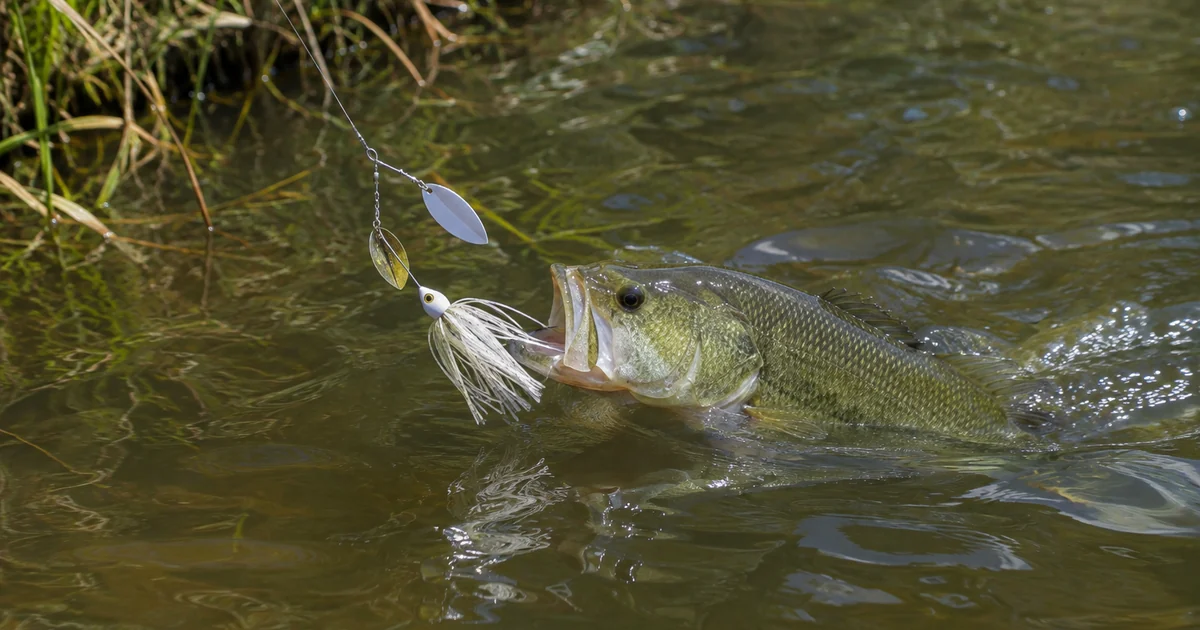
Spinnerbait bass fishing works because the blades talk to a sense most anglers never think about. A bass’s lateral line detects vibration and pressure changes, and it lets the fish feel prey even in total darkness or zero-visibility water. Spinnerbait blades are built to trigger it, so the fish can find your bait before it can see it.
That’s also why a spinnerbait is so adjustable. Change the blade, the wire angle or the trailer and you change how it sounds, flashes and runs. Here’s how to tune a spinnerbait for the conditions in front of you, using the blade science and rigging workshop from Bass Fishing Mastery.
Bass Fishing Mastery: the complete 86-page bass guide behind this article. See the guide →
Blade Science: Pick the Blade by Water Color and Speed
| Blade | Shape and spin | What it gives you | Use it in |
|---|---|---|---|
| Colorado | Round, rotates slowly | Maximum water displacement and thump | Murky to stained water, cold-water slow-rolling, night fishing |
| Willow leaf | Long and narrow, spins fast | Maximum flash, minimal vibration | Clear water, fast retrieves, imitating fast-moving shad |
| Indiana | Teardrop, a compromise | Moderate vibration and flash | Stained to clear water, all-purpose, when you’re unsure |
| Tandem | Two blades, usually Colorado or Indiana up front and willow behind (or two willows) | Combined flash and vibration | Most conditions, the default tournament setup |
The pattern is simple. The less the fish can see, the more thump you want. The clearer the water and the faster the bait, the more flash you want.
Blade swapping
Factory blades are a starting point. The ebook’s workshop suggests swapping them for aftermarket Hildebrandt or Booyah blades in specific sizes or colors:
- Stained water: painted blades in chartreuse, white or orange.
- Clear water: hammered nickel for more flash.
The Rod and Line
| Component | Spec from the ebook |
|---|---|
| Rod length | 7’0″ to 7’3″ |
| Power | Medium-heavy |
| Action | Moderate-fast (bends through the top 40%) |
| Line | Fluorocarbon, 15 to 17 lb |
The ebook’s reason for fluorocarbon here is sensitivity plus invisibility near the lure. It’s near-invisible underwater, has only 12 to 15% stretch, and is abrasion resistant.
The moderate-fast action sets the spinnerbait apart from the jig and Texas rig rods, which are fast. In the matrix, the buzzbait shares the exact same rod spec.
The Workshop: Three Spinnerbait Mods
The ebook treats factory spinnerbaits as a starting point. These three modifications change how the bait hooks, falls and runs.
Mod 1: Add a trailer hook
The trailer hook is the first spinnerbait modification in the ebook’s workshop. It’s a short-shank treble hook added to the main hook with a small loop of line.
What it fixes: short strikes, where a bass nips the back of the skirt without ever touching the hook. The ebook calls it essential in warm water, when bass are aggressive.
Sizing: match the trailer hook to the main hook. A trailer that’s too large looks unnatural; one that’s too small misses fish.
When you get short strikes, the ebook gives you three options: shorten the lure, add a trailer hook, or switch to a smaller presentation.
One caution from the mistakes chapter: trebles in matted grass and laydowns are donations. In the thick stuff, leave the trailer hook off and keep the bait single-hook.
Mod 2: Add a soft plastic trailer
Thread a paddle-tail swimbait or a curly-tail grub onto the main hook. The ebook lists three effects:
- It adds bulk.
- It slows the fall.
- It gives the fish something to hold onto.
Mod 3: Bend the wire
The wire arm decides where the blades ride relative to the hook, and you can adjust it.
| Wire angle | Blade position | Best for |
|---|---|---|
| Wider | Blades ride higher, more lift | Keeping the bait up in the water column |
| Narrower | Blades ride lower | Slow-rolling near the bottom |
Pair this with blade choice. The ebook points both settings at the same job: the Colorado blade for cold-water slow-rolling, and the narrower wire angle for slow-rolling near the bottom.
Three Retrieves and When to Use Each
The steady retrieve
The ebook’s beginner plan starts with a white or chartreuse spinnerbait on a steady, medium-speed retrieve along visible structure. Learn how it feels at different speeds, and find the speed that produces. It’s the baseline everything else builds from.
Fish it parallel to structure whenever you can. The pro tips say spinnerbaits produce more bites parallel to a dock or grass edge than on perpendicular casts. Along a laydown, position yourself so one cast covers the entire length of the log.
The slow roll
Slow-rolling keeps a spinnerbait low and slow, with a Colorado blade thumping. It’s the ebook’s choice in two situations:
- Cold-water pre-spawn, 50°F to 58°F. A slow-rolled spinnerbait with a Colorado blade is on the ebook’s lure list, alongside the jerkbait and the flat-sided crankbait. The March chart puts slow-rolled spinnerbaits at staging areas in 10 to 18 feet.
- Muddy water. When the lake turns chocolate after heavy rain, bass switch to lateral-line hunting and move tight to cover and shallow. The playbook’s answer is a Colorado-blade spinnerbait slow-rolled, tight to cover, slow and methodical.
The search retrieve
When fish are active, the spinnerbait becomes a fast search bait:
- Wind-driven points. When wind blows directly onto a point with cover, bass stack there ready to react. Fish fast with a spinnerbait.
- Light rain. The surface disturbance reduces spooking, and bass are very active.
- Fall creek backs. In mid-fall, shad migrate into the backs of the creeks and fast presentations work. Spinnerbaits are on the ebook’s list with swimbaits and lipless crankbaits.
Wind and Water Color
Let the wind pick your water
Wind is the spinnerbait angler’s friend, and the ebook says so in several places.
- Light to moderate wind: very good fishing. The current it creates activates bass. Fish windward banks and current-influenced structure with spinnerbaits and other search baits.
- The wind-blown bank: the wind has been pushing food onto it all day. The ebook’s playbook says to fish the wind-blown side with a spinnerbait, swimbait or crankbait if you can present there, because the chop covers your sins and turns fish on.
- Too windy to fish it: move to the first protected water down-current of the blown bank, such as points and pockets collecting what the wind delivers.
- Strong wind, 20 mph and up: casting gets hard. The ebook calls for heavier lures, 3/4 oz and up, for control, fished carefully near protected structure.
Reading muddy and stained water
Rivers and lakes after rain give you a color gradient. The ebook’s rule: clear water makes bass nervous, muddy water makes them half-blind, and the stained band in between is where hunting is easy. When you have all three, fish the stain first.
A mud line is an edge like a weed line. Bass hold on the darker side and ambush along the boundary. Cast to the clear side and work the spinnerbait across the line.
Color follows the water:
| Water | Lure colors from the ebook’s chart |
|---|---|
| Clear | Natural shad |
| Lightly stained | Chartreuse/white |
| Stained or murky | Chartreuse/white, black/blue |
| Muddy | Black/blue, solid black, bright chartreuse |
| Fall shad | Chrome/blue, white/silver, pearl |
Spinnerbaits also shine in current. The ebook’s river chapter notes that moving baits like spinnerbaits love current because the river adds action and the fish decide fast.
The Spinnerbait Season Map
| When | Spinnerbait play |
|---|---|
| March, 50°F to 60°F | Slow-rolled with a Colorado blade at staging areas |
| Summer, dawn to 9 AM | Along emerging shallow cover |
| Summer, 9 AM to noon | Mid-depth structure, 4 to 12 feet, as bass move deeper |
| Summer, 5 PM to dark | Back to the shallow morning areas and grass edges |
| October | Creek backs and shallow flats, with shad-colored crankbaits and swim jigs |
It’s also the search bait of the ebook’s one-bag bank system. A spinnerbait plus a backup covers water fast and comes through grass and wood.
Learn what the spinnerbait is telling you
The ebook’s first-10-trips plan pairs a spinnerbait with a Texas rig for a reason. You open with about 20 minutes of steady spinnerbait fishing, then switch to the Texas rig. The focus question is where each one got bit. Different cover types? Different depths?
That comparison is the real lesson. The spinnerbait finds active fish fast, and the slower bait picks apart what it finds. Note the depth, cover, retrieve and time of day of every spinnerbait bite, and you’ll learn which water on your lake suits it.
Once the water drops below 58°F in fall, the ebook swaps speed lures for jigs, Texas rigs and medium-diving crankbaits. For that phase, see jig fishing for bass. For colder water, the jerkbait guide takes over. And for the fall shad bite, see the best fall bass lures and fall bass in creek arms.
Quick Answers
What color spinnerbait is best for bass?
Match the water. Natural shad in clear water, chartreuse/white in stained water, and black/blue or bright chartreuse in muddy water. In fall, shad colors like white/silver and chrome/blue lead.
When should you use a Colorado blade spinnerbait?
In murky or stained water, for slow-rolling in cold water, and at night. Its slow rotation creates maximum thump that bass feel through their lateral line.
What line is best for spinnerbaits?
The ebook’s line matrix calls for 15 to 17 lb fluorocarbon on a 7’0″ to 7’3″ medium-heavy, moderate-fast rod.
Why do bass miss my spinnerbait?
Usually they’re short-striking the back of the skirt. Add a trailer hook matched to the main hook size, or shorten or downsize the bait.
Tight lines,
— David