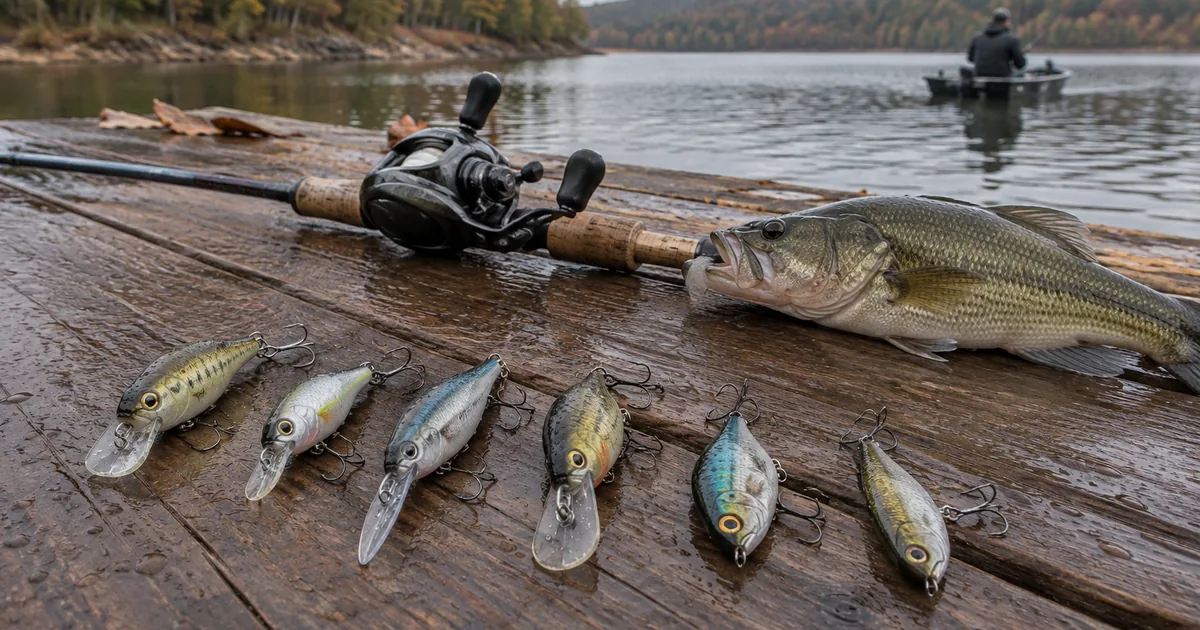
Crankbait fishing for bass is a depth decision first and a retrieve second. Every crankbait is built to run at one specific depth, produce one specific action, and trigger one specific kind of strike. Choose the model that matches the depth the fish are using, then keep it bumping into something all the way back to you.
That second half is what most anglers skip. A crankbait swimming through open water is a passable baitfish imitation. A crankbait knocking off a stump, ticking gravel, or ripping free of grass is a reaction trigger, because a sudden change of direction fires an involuntary grab that a bass makes before it decides anything.
This is the full crankbait system from Bass Fishing Mastery: the six families and the depths they own, the rod and line each one needs, the tuning most anglers never do, and the seasons where each style earns its place.
Bass Fishing Mastery: the complete 86-page bass guide behind this article. See the guide →
The Six Crankbait Families and the Depth Each One Owns
| Style | Running depth | What it does | Where to throw it |
|---|---|---|---|
| Square bill | 0–4 ft | Blunt, wide bill that bounces off hard cover instead of burying in it; nothing in the family fights snags this well | Shallow wood, rock, stump fields, the edge of a dock |
| Shallow diver | 2–6 ft | Rounded bill, a moderate wobble at a moderate speed | Weed edges, clean sand banks, the shallow end of a point |
| Medium diver | 6–12 ft | Longer oval bill; the reservoir workhorse | Humps at mid depth, the lip of a channel, points, the depths fall fish move through |
| Deep diver | 12–25 ft | Long extended bill that needs a long cast to reach its number | Deep structure and summer ledges, roughly June into August |
| Flat-sided | Any depth | A tight shimmy in place of a wide roll | Water between 50°F and 60°F, and fish that have seen too many lures |
| Lipless | Any depth, sinks | No bill at all, a hard vibration, fishable at any speed | Grass in spring, open water in fall, ripped free of vegetation |
Read that table as a depth ladder, not a shopping list. The square bill and the deep diver are not competing lures; they are two different jobs. If bass are holding on a channel edge in 18 feet, a square bill cannot reach them no matter how well you fish it. If bass are tight to a laydown in 3 feet, a deep diver digs into the mud and never gets near the wood.
The flat-sided bait is the exception worth understanding. It trades the wide roll for a tight shimmy, which is the more believable action when the water is cold or the fish have seen everything. In the 50°F to 60°F band it does a job no wide-wobbling bait does, and it pairs naturally with the same conditions that favor jerkbait fishing.
Rod, Reel and Line: Why Crankbait Gear Breaks the Rules
Nearly every other bass technique rewards a fast rod. Crankbaits do not. A bass strikes a moving treble-hook lure and pulls against it immediately, so you need a blank that bends and keeps steady pressure instead of a tip that snaps and tears the hooks loose. That is why fiberglass, heavier and more flexible than graphite, is the classic crankbait material.
| Application | Rod length | Power | Action | Line |
|---|---|---|---|---|
| Shallow crankbait | 7’0″–7’3″ | Medium | Moderate | 12–15 lb fluorocarbon |
| Deep crankbait | 7’4″–7’8″ | Medium-Heavy | Moderate-Fast | 10–12 lb monofilament |
The line choices are deliberate. Fluorocarbon sinks slightly, so it adds a little depth to a shallow bait while keeping hooksets crisp. Monofilament stretches, and on a deep diver that stretch is insurance: it absorbs the shock that pulls small trebles out of a bass fighting at the end of a long cast. Thin mono also lets a deep bait reach its full depth.
Two mechanical details matter as much as the gear. Keep the rod low and off to the side through the retrieve, not up high. A low rod angle keeps the lure deeper and gives you a better hookset angle. And tie hard baits on a non-slip loop knot, which leaves the lure free to swing and dramatically improves its action.
One pre-trip sentence covers the rest: before you launch, confirm that every treble still bites into a thumbnail and that the drag gives line under a measured pull, because both of those are set to a number rather than to feel in the six essential bass fishing knots.
Make It Hit Something
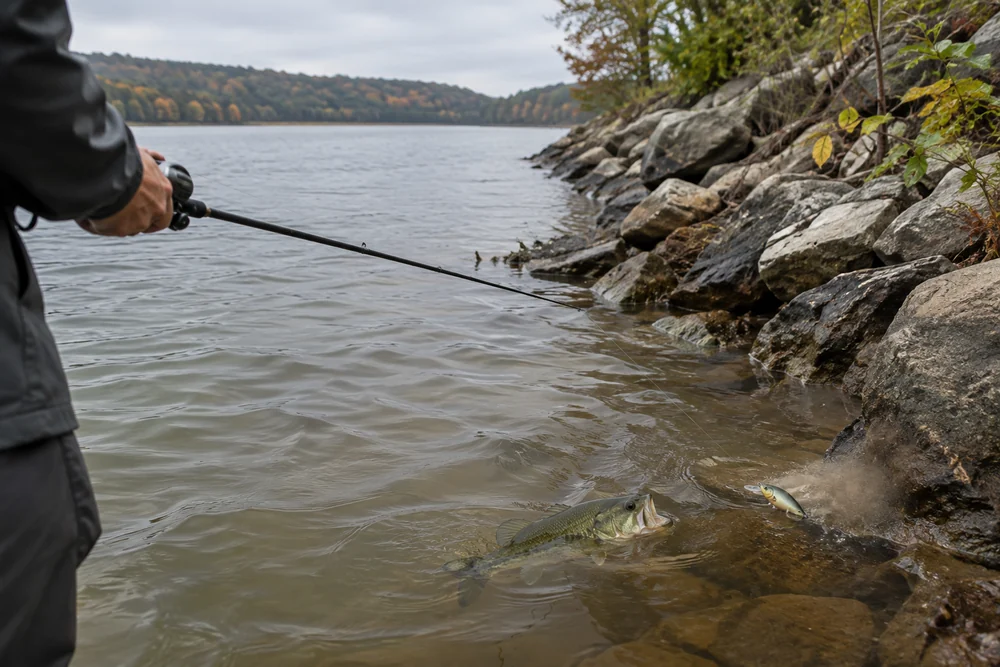
The single rule that separates a productive crankbait retrieve from a decorative one: make contact with the bottom or with cover on every cast. If you never snag, you are not fishing deep enough.
- Deflection is the trigger. A crankbait that veers off a rock, a stump or a dock post changes direction suddenly, and that is exactly what produces a reflex strike rather than a considered one.
- Fish parallel. Crankbaits get more bites running along a dock, a grass edge or a laydown than crossing it. One cast down the length of a fallen tree covers more fish-holding water than a dozen casts across it.
- Work points from deep to shallow. Hold the boat out past the end of a point, start your casts up in water thinner than where you think the school is sitting, then crank the bait back down the slope toward you. One retrieve then covers every depth the fish could be using. Fishing points for bass has the rest of that approach.
- Match the hook system to the cover. Trebles in matted grass and heavy wood are donations. When grass grows above your bait, go to a single hook or go elsewhere; when there is a canopy and open water beneath it, that is lipless territory, and you rip it free.
- Let the bait earn its speed. Test a new lure before you fish it by shaking the rod tip and watching the action, then adjust speed until it looks right.
If you are getting swipes and short strikes instead of solid hookups in early fall, do not change spots. Change size. This year’s shad are 2 to 3 inches, and a magnum bait gets slapped at rather than eaten.
The Tuning Nobody Does
Crankbaits rarely come out of the package running true, and a bait that tracks off to one side loses most of its effectiveness. The fix takes twenty seconds. Retrieve the lure where you can watch it and note which way it leans. If it runs left, bend the line tie loop slightly to the right with needle-nose pliers; if it runs right, bend the loop left. Make small corrections, because overcorrecting is easy. A properly tuned crankbait runs straight and true at speed.
While you are at it, two more items. Replace the factory trebles on budget hard baits, because the stock hooks are usually the weakest part of the lure, and check your split rings for corrosion; a ring failure during a fight with a good fish is entirely avoidable. Store hard baits in individual compartments so hooks do not tangle and finishes do not get chewed, and keep soft plastics in a separate box, since some plastics contain solvents that dissolve hard bait paint.
When Each Crankbait Earns Its Place
Crankbaits are a year-round category, but the family changes with the water.
- 50°F to 58°F, pre-spawn: a flat-sided crankbait with subtle action, worked on staging fish along channel edges and secondary points.
- 58°F to 65°F: a lipless crankbait ripped through the first green grass, and a medium diver on points.
- Summer, dawn to 9 AM: a shallow crankbait along emerging cover in 1 to 6 feet.
- Summer, 9 AM to noon: a medium diver as bass slide out to 4 to 12 feet.
- Summer, noon to 5 PM: a deep diver on ledges, humps and creek channel edges in 15 to 25 feet.
- Early fall: medium crankbaits in shad colors at creek arm mouths and the points where shad are transitioning.
- After the fall cold snap, below 58°F: medium-diving crankbaits replace the speed baits, along with jigs and Texas rigs. The lures that take over at that point are covered in this fall lure breakdown.
Color follows water clarity, not fashion. Natural greens and watermelon in clear water. Chartreuse and white in stained water. Black and blue or solid dark patterns in mud. Chrome, blue, white, silver and pearl whenever bass are keyed on shad.
Real-world scenario: the summer ledge. Across the big reservoirs of the South and the Midwest, summer largemouth gather in numbers on the ledges where creek channels cut in, most of them holding between 18 and 22 feet down. One good ledge is worth 50 fish or more in a single day. The sequence the guide gives for finding one is plain: idle the 18 to 25 foot band with your eyes on the sonar until fish and baitfish show up together, drop a waypoint the second they do, then fish the school between noon and 5 PM with a deep diver, a football jig or a big swimbait. The crankbait is the search tool in that group, because one long cast runs the whole school at depth. This is the exact job the deep diver was designed for, and the spot keeps producing for the rest of the season.
Three Mistakes That Cost Crankbait Fish
- Casting at the fish instead of past it. A bait that lands on the target erases the strike zone instead of covering it. Put it down well beyond the cover, on a line that swims it naturally through the zone.
- Fishing a dull or bent hook. Trebles take a beating from rock and concrete, and a point that has rolled over or gone soft will skid off a jaw instead of digging in. Inspect every treble after any session on hard bottom, and retire whatever fails the test.
- Setting too hard, too early. With a moderate rod and treble hooks, let the bait and the blank do the work. Sweep, keep steady pressure, and if a fish jumps right after the hookset, lower the rod and pull from the side until it comes back under.
A crankbait is not a lure you throw when nothing else works. It is the fastest way to find out what depth the bass are using and which stretch of bank is worth slowing down on, and once you are willing to bump cover on every cast, spinnerbait fishing and crankbaits together will cover most of the water you can reach.
Quick Answers
What depth does a crankbait run?
It depends entirely on the bill. Square bills run 0 to 4 feet, shallow divers 2 to 6, medium divers 6 to 12, and deep divers 12 to 25 feet with a long cast. Lipless baits sink, so they fish any depth.
What line should I use for crankbaits?
Use 12 to 15 lb fluorocarbon for shallow crankbaits, since it sinks slightly and adds depth. Use 10 to 12 lb monofilament for deep divers, because the stretch keeps you from pulling trebles free.
How fast should I reel a crankbait?
Fast enough that the bait is working and still contacting bottom or cover. Cold water asks for two separate reductions: take 30 percent off your speed, then take 30 percent off again. A cold bass needs the lure in its face far longer before it commits.
What makes a crankbait get bitten?
Deflection. Crankbait fishing for bass produces best when the lure strikes something and changes direction suddenly, which triggers a reflex grab rather than an inspection.
Tight lines,
— David