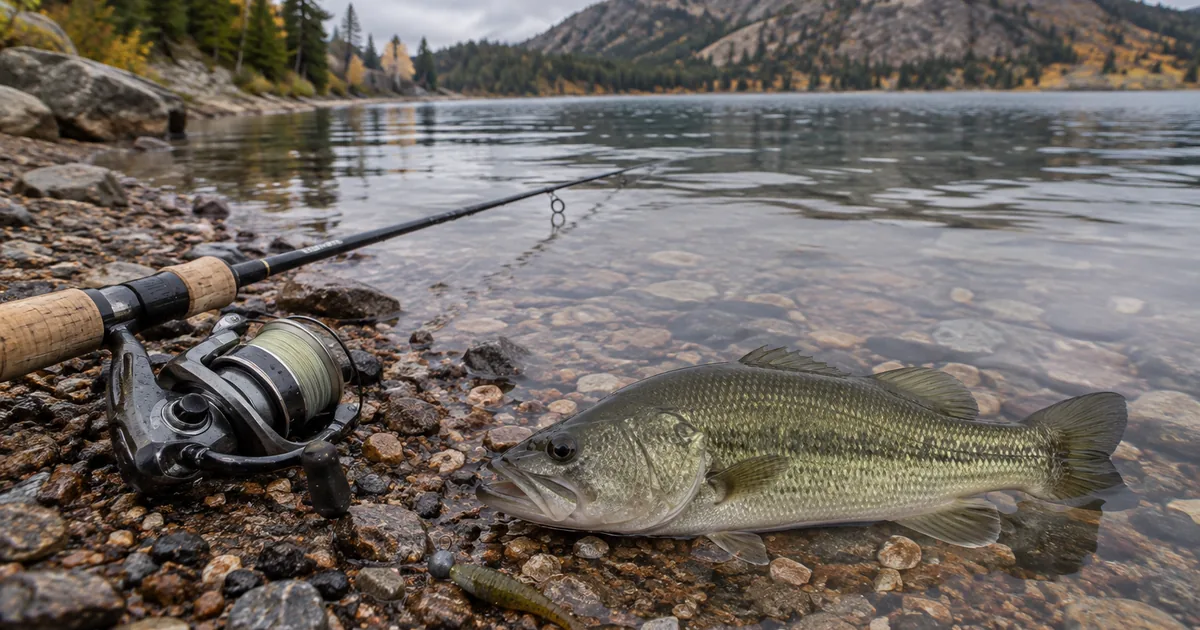
Ned rig fishing is a small buoyant soft plastic on a mushroom-head jig of 1/15 to 3/16 oz, shaken slowly on the bottom, and it catches bass in every season, every water clarity and under every weather condition. That includes the days after a cold front, when almost nothing else produces.
The reason is mechanical, not magical. The ElaZtech material the bait is molded from floats, so the plastic stands straight up off the head between moves with its tail waving while the jig sits flat on the bottom. The bait is in a feeding posture even when you are doing absolutely nothing.
That is the whole appeal: it keeps the lure in the strike zone for as long as possible with as little movement as possible. Here is the complete setup, the exact cadence, and where to put it, built from the finesse system in Bass Fishing Mastery.
Bass Fishing Mastery: the complete 86-page bass guide behind this article. See the guide →
What Makes the Ned Rig Different
Finesse fishing has become perhaps the fastest-growing category in bass fishing over the past decade, and the logic is simple: smaller lures, lighter line and more subtle presentations are often the difference between catching fish and going home frustrated on pressured, clear-water lakes.
The Ned rig sits at the center of that movement because of the stand-up design. A standard jig head lays a worm flat on the bottom. The mushroom head plus buoyant plastic does the opposite: the head stays planted, the bait points up, and every twitch of the rod makes the tail quiver in place instead of dragging the whole lure forward and out of the zone.
It shares that principle with the shaky head and the wacky rig. All three are built for the situations where bass refuse to commit to anything active: post-cold-front, pressured fish, cold water, and clear water with high visibility.
The Complete Setup
| Component | Spec | Why it matters |
|---|---|---|
| Jig head | Mushroom head, 1/15 to 3/16 oz | Stands the bait upright on the bottom. Go with the lightest head that still holds bottom contact |
| Hook | Ned rig mushroom head in size 1 or 2, short shank | ElaZtech bait only, which stays on the hook without any rigging step |
| Bait | Small ElaZtech stick or finesse body | The buoyant material is what makes the bait float upright off the head |
| Line | Fluorocarbon, 6 to 10 lb | Smallest diameter and the most natural fall of any line choice |
| Rod | 6’8″ to 7’0″, light or medium-light power, fast action | Spinning gear. Light enough to shake the bait without moving it |
| Reel | 2000 to 2500 size spinning | The finesse size class, built for 6 to 12 lb line |
| Knot | Palomar | Near 100% strength and the preferred knot for every finesse presentation |
The Z-Man TRD and Finesse TRD are the benchmark baits, and the Z-Man Finesse ShroomZ is the benchmark head. The bait slides onto that short shank and the material grips it, so there is no Texas-rigging, no O-ring and no tool involved. If you want the Palomar steps along with the rest of the connections worth knowing, they are in bass fishing knots.
On weight, resist the urge to go heavier for comfort. Pick the lightest head that still lets you feel bottom: the slower, softer fall it produces is worth bites. Step up a size only because depth, wind or current has left you no other option.
The Cadence That Catches
This is where most anglers get the Ned rig wrong. They fish it like a worm. It is not a worm, and the retrieve is almost embarrassingly short.
- Cast near structure.
- Let the bait fall all the way down. Do not reel while it drops.
- Shake it 2 or 3 times.
- Pause 5 to 8 seconds.
- Drag it forward 6 inches.
- Repeat.
Six inches. Not three feet. The entire point is that the bait barely travels, so a single cast can take two or three minutes to work properly. Fish it slower than feels natural, and then slow down again. In cold water, slow your retrieve by 30%, then slow it another 30%, because a cold bass may need 10 to 15 seconds just to move over and commit.
The pause is the part that produces. During those 5 to 8 seconds the bait is standing on its tail, waving, doing the work for you. Anglers who cannot stand the stillness shake it constantly and wonder why the rig has a reputation they cannot reproduce.
Dead-sticking counts as a presentation. Leaving the Ned rig completely motionless for an extended stretch is often what finicky fish need.
Where to Fish It
The honest answer is almost everywhere, but a few places are a cut above.
Structure with a clean bottom. Cast near structure, let the rig settle, and work it through with the shake-pause-drag cadence. Points with multiple cover types at different depths are year-round producers, and the Ned rig lets you pick them apart at any of those depths.
Clear, pressured water. This is the rig’s home field. On heavily pressured lakes, fish the same areas as everyone else but with smaller, quieter presentations, because pressured fish have already seen the aggressive stuff. Natural colors belong here: watermelon and green pumpkin in clear water, with chartreuse and white or black and blue reserved for stained water. For the wider lure thinking on glass-clear lakes, see the best bass lures for clear water.
Rivers, dragged across gravel. River bass are more predictable than lake bass, not less, and the Ned rig worked across gravel bars is one of the best river presentations there is. Current seams, the line where fast water meets slow, are the number one target. Approach from downstream, because river bass face upstream essentially always, and cast above the target so the current carries the bait into the strike zone the way real food arrives. River setups lean slightly heavier than lake finesse gear: a 6’10″ to 7’ medium spinning rod, a 2500 reel and 10 to 12 lb fluorocarbon.
Spawning flats, when you can see the fish. The Ned rig is one of only three baits the guide accepts for bed fishing, alongside a small swimbait and a 1/4 oz finesse jig, and it earns that place by holding still in front of a fish that is guarding rather than feeding. Keep your distance, keep the presentation unhurried, and plan on being refused many times before you are not. The approach distances and the full bed-fishing routine live in the May post-spawn lure guide, so there is no need to repeat them here.
Deep schools in winter. Bass are tightly schooled in the deepest stable water in January and February, with a feeding window during the warmest part of the day. Finding the school is 90% of the battle, and once you have it, slow finesse work keeps producing from the same tiny area.
Spotted bass deserve a specific mention. Their schooling tendency is much stronger than a largemouth’s, and they are drop shot and finesse specialists by nature. If your lake holds them, finesse is not a backup plan, it is the main plan.
Ned Rig vs Drop Shot vs Shaky Head
| Rig | What it does best | When to pick it |
|---|---|---|
| Ned rig | Stands upright on the bottom and holds position with almost no input | Bottom-oriented fish on any structure, in any season and any clarity |
| Drop shot | Holds a bait at a precise fixed depth indefinitely, off the bottom | Clear water, pressured fish, and bass you can see suspended on sonar |
| Shaky head | Stands a 4 to 5 inch finesse worm vertically with the tail waving | When fish want a longer profile but the same stay-in-place action |
All three answer the same question in different ways, so carry at least two. More on the precision option in drop shot fishing for bass.
Real-World Scenario: The Morning After a Cold Front
Real-world scenario from the situational playbook in the guide. A front blew through overnight. The sky is bluebird, the barometer spiked, and the lake feels dead.
The read: the bass did not leave. Rising pressure after a cold front pushes them tight to cover and shrinks their strike zone, so they are there, they are just tight and grumpy.
The play: slow down by half, size down by one, and fish tight. The bait has to land in the living room, not the neighborhood. Shaky head, finesse jig, drop shot and the Ned rig, worked on the shady or dense side of the best cover available. Expect fewer bites than normal and convert the ones you get.
That last line is the whole mindset. Post-front days are not days to cover water, they are days to put a standing bait beside a specific piece of cover and leave it there. The wider post-front approach is laid out in post-cold-front bass fishing.
Quick Answers
What size jig head should I use for a Ned rig?
Between 1/15 and 3/16 oz, on a mushroom head in hook size 1 or 2. Start with the lightest head that still keeps the bait in contact with the bottom and only go heavier for depth, wind or current.
What rod and line do I need for a Ned rig?
A 6’8″ to 7’0″ spinning rod in light or medium-light power with a fast action, a 2000 to 2500 size reel, and 6 to 10 lb fluorocarbon. That line gives you the smallest diameter and the most natural fall.
How do you work a Ned rig?
Cast, let it fall completely, shake it 2 or 3 times, pause 5 to 8 seconds, then drag it forward 6 inches and repeat. The pause does the catching, so fish it slower than feels natural.
When is the Ned rig the best choice?
Whenever bass refuse to chase: after a cold front, on pressured clear-water lakes, in cold water, and over gravel in rivers. Ned rig fishing produces in every season and every water clarity, which is why it belongs on a rod year-round.
Tight lines,
— David