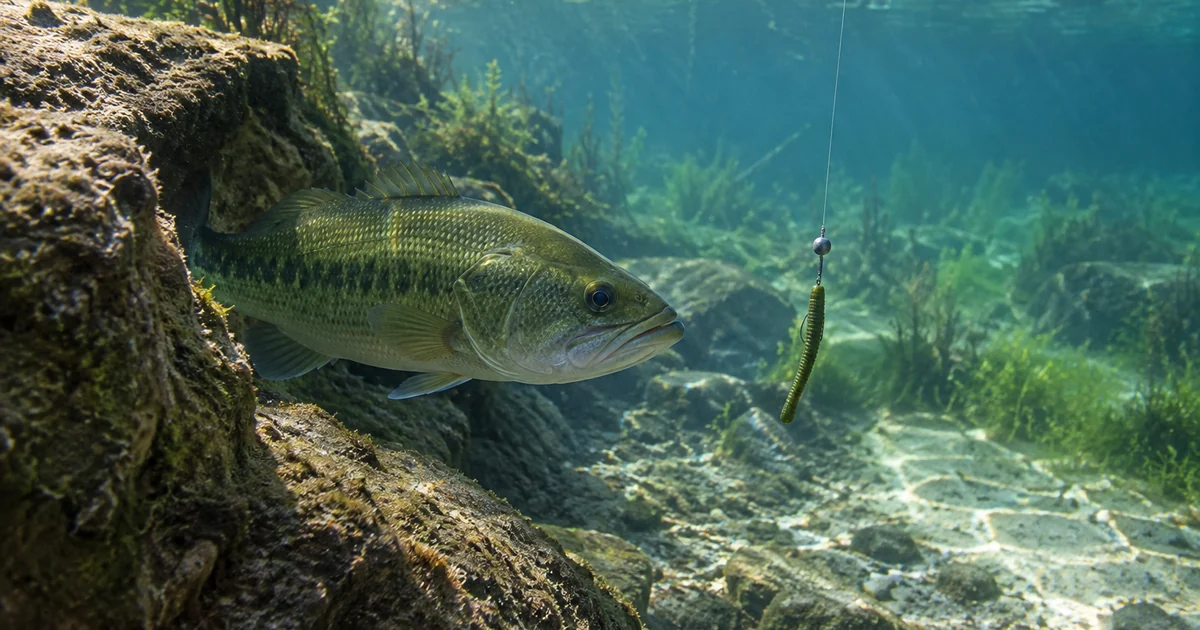
The best bass lures for clear water are small, natural and quiet: a drop shot, a Ned rig, a finesse worm on a shaky head, a light finesse jig and a weightless wacky rig, backed up by a willow-blade spinnerbait and a glide bait when the fish are willing to chase. Fish them on fluorocarbon, in green pumpkin, watermelon or shad colors, from as far away as you can cast.
That short list is not a matter of taste. Clear water changes what a bass can see, including you, and every choice below follows from that. This guide lays out the lures, the rod and line for each, the colors, and the approach that makes them work, all taken from the Bass Fishing Mastery guide.
Bass Fishing Mastery: the complete 86-page bass guide behind this article. See the guide →
Why Clear Water Changes the Lure You Tie On
In stained water, a bass sees your bait late and has to decide fast. In clear water it gets a long, close look, and the bass is built to use it.
Bass judge distance and target prey in a small cone of binocular vision in front of and slightly above the head. They see color with reasonable accuracy and are especially sensitive to contrast and silhouette. In clear water, that means a fake looks fake for longer.
They can also see out of the water. Through a window directly overhead, a physics effect called Snell’s Window, a bass in shallow clear water can see an angler on the bank or in a boat. That is why the guide insists on stealth, long casts and dark clothing on clear, pressured water.
There is a behavior shift too. The guide’s rule for reading water color is simple: clear water makes bass nervous, muddy water makes them half-blind, and stained water is where hunting is easy. A nervous fish that can inspect everything is the exact fish finesse fishing was built for.
| Clarity | Visibility | What it means for lure choice |
|---|---|---|
| Crystal clear | The clearest water on the chart | Smallest baits, lightest line, most natural colors |
| Clear | 2 to 5 ft | Finesse first, natural or shad colors, moving baits with flash |
| Stained | 1 to 2 ft | Bolder colors and more vibration start to pay |
| Muddy | Under 1 ft | Thump and silhouette: Colorado blades, black and blue |
The 7 Best Bass Lures for Clear Water
The order follows the guide’s own logic: start with the presentations that keep a bait in front of a wary fish the longest, then add the moving baits for when bass are feeding.
1. Drop Shot
No rig in the guide ranks higher for this water. Bass Fishing Mastery names the drop shot its top technique when the water is clear, when the lake is pressured, and when your sonar shows fish that ignore anything moving. The reason is simple: the bait hangs at one depth, right in front of the fish, and stays there.
The setup: a small drop shot hook (size 1 or 2) on a Palomar, 18 to 24 inches of tag hanging below, and the tag threaded back down through the eye from the front so the point sits at a right angle to the line. Weight is a minimum, not a habit. In shallow water 3/16 oz is enough; go to 1/4 or 3/8 oz as it gets deeper. Hook a finesse worm, a little minnow or a Ned body through the tip of the nose so it rides level, and work it with tiny shakes while the sinker stays put on the bottom.
2. Ned Rig
A small ElaZtech bait on a 1/15 to 3/16 oz mushroom head. The buoyant plastic stands straight up off the bottom between moves. The guide says it catches bass in every season, every water clarity and every weather condition, including after cold fronts. The cadence is short: let it hit bottom near the cover, a couple of shakes, a long rest (5 to 8 seconds), a half-foot drag, and again. If it feels too slow, you are probably close to right.
3. Finesse Worm on a Shaky Head
The 4 to 5 inch finesse worm is the guide’s smaller profile for clear water and pressured fish. Put it on a 1/8 to 1/4 oz stand-up jig head so the worm stands off the bottom with the tail waving. Shake with your wrist, not your arm, and keep the head in place: the goal is to hold the bait in the strike zone as long as possible.
4. Finesse Jig
The finesse jig runs 1/8 to 1/4 oz and is fished on 8 to 12 lb fluorocarbon with spinning gear. The guide lists it for clear water, cold water and post-cold-front conditions. A small craw of about 3 inches is the trailer to start with. Keep the two sized together; an oversized trailer on a light head looks wrong to a fish that has time to study it. For the full head-and-trailer system, see jig fishing for bass.
5. Weightless Wacky Rig
Center-hook a Senko-style stick bait and it sinks flat, both ends quivering, a fall no other bait copies. With no weight it belongs in the 1 to 8 foot zone. Drop it beside visible cover on a slack line, because most bites come before it reaches bottom: a sideways tick of the line is your signal. No bite? Rest it a few seconds, one soft twitch, and let it sink again. For color, stay natural here: green pumpkin or watermelon.
6. Spinnerbait With Willow Blades
Not everything in clear water has to be slow. The willow leaf blade spins fast with a tight rotation: maximum flash, minimal vibration. The guide matches it to clear water, fast retrieves and imitating fast-moving shad. If you swap blades, hammered nickel gives more flash in clear water. Fish it on 15 to 17 lb fluorocarbon.
7. Glide Bait
A hard-bodied lure that glides side to side on a sweep-and-pause retrieve. The guide rates it extremely effective in clear water and in winter.
On rocky, clear water with smallmouth, add a 4 to 5 inch tube. The guide calls it the premier smallmouth lure: it spirals down like a crawfish on an internal jig head.
Rod, Line and Weight for Each Lure
Clear water is where line choice matters most. Fluorocarbon has a refractive index close to water, which makes it near-invisible underwater, and the guide names it the best line for clear water. Braid is highly visible, so pair it with a fluorocarbon leader. But don’t overcorrect: the guide’s own warning is to reserve invisibility worries for clear water and slow presentations, and to match the line type to the technique everywhere else.
| Lure | Rod | Line |
|---|---|---|
| Drop shot | 6’10″ to 7’2″ medium-light, fast, spinning | 8 to 12 lb fluorocarbon (deep: 30 lb braid + 10 lb fluoro leader) |
| Ned rig | 6’8″ to 7’0″ light or medium-light, fast, spinning | 6 to 10 lb fluorocarbon |
| Finesse worm, shaky head | Spinning, as for the Ned rig | 6 to 10 lb fluorocarbon |
| Finesse jig | Spinning | 8 to 12 lb fluorocarbon |
| Spinnerbait (willow) | 7’0″ to 7’3″ medium-heavy, moderate-fast | 15 to 17 lb fluorocarbon |
| Large swimbait | 7’6″ to 8’0″ heavy or extra-heavy, moderate-fast | 17 to 25 lb fluorocarbon |
Set the drag at 25 to 30 percent of the line’s breaking strength. Light line on a locked drag is how good clear-water fish get lost.
Colors That Work in Clear Water
The guide’s color chart is short on this point. In crystal clear water, start with natural colors, watermelon and green pumpkin, then shad and chrome. In clear water, green pumpkin and watermelon red first, natural shad second. Save the very bright colors, like hot chartreuse, for stained and muddy water, where the chart puts them.
Two refinements. In fall, when bass feed on shad, chrome and blue, white and silver, and pearl take over, and the size of the bait matters as much as the color: see the best fall bass lures. And on bright, sunny days the chart favors natural greens and watermelon with a subtle shad.
How to Fish Clear Water So the Lures Get a Chance
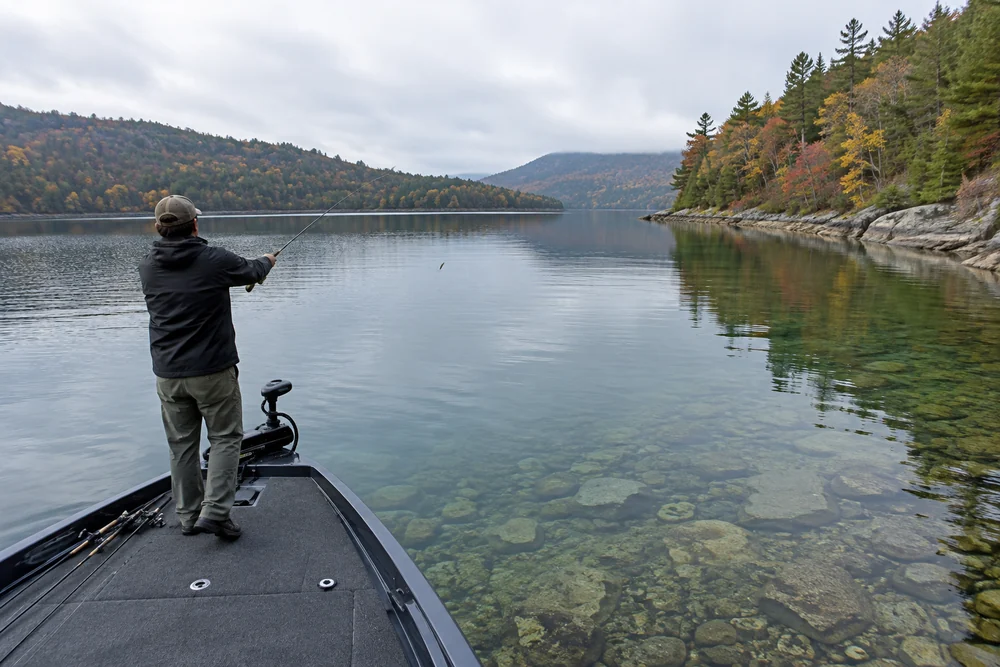
The best clear-water lure fails if the bass saw you first. These are the guide’s rules for the approach.
- Make long casts and land past the target. A bait that splashes down on top of a bass spooks it instead of tempting it. Aim six to ten feet beyond the fish and let the retrieve bring the bait by.
- Keep the boat back and quiet. Even an electric trolling motor on high in shallow, clear water can spook bass 30 feet or more away. Don’t run over the water you plan to fish.
- Use the light. Bass vision peaks in low light, so dawn, dusk and overcast days are their most confident feeding windows. In summer, night fishing works best on warm, clear water.
- Go smaller and quieter on pressured lakes. Pressured fish have seen the aggressive baits. The guide’s edge is finesse in the same areas everyone else fishes.
Clear-water fisheries in the guide make the same point. Table Rock Lake is described as clear water that demands finesse, Douglas Lake’s ultra-clear water demands sophisticated finesse, and on Shasta Lake drop shot and finesse presentations dominate.
Real-world scenario: a bluebird afternoon on clear water
Here is how those rules stack up on a typical tough day, built from the guide’s situational playbook rather than a fish story. The sun is high, there is no wind, and you can see a bass hovering near a dock post. That fish has almost certainly spotted you already, so the first move is to leave it and mark the spot. Meanwhile, work the shade: the dark side of the docks and the deeper edge nearby, with a drop shot or a Ned rig on light fluorocarbon. Twenty minutes later, come back low and far, sun in your face, and make a single long cast past the dock post so a small natural bait slides by at an angle. If a fish follows and turns away, the next cast gets more speed and a sudden twitch; if it still refuses, go one size smaller. One plan, three short decisions, and every one of them comes from the clear-water rules above.
When Clear-Water Bass Follow but Won’t Bite
Followers are the classic clear-water problem: the fish is interested but has had too long a look. The guide’s fix comes in two steps. Step one is counterintuitive: go faster, and break the rhythm with a rip, a turn or a stop-and-go, since a bass has to commit quickly to food that looks like it is getting away. If the followers keep coming, downsize and go more natural. Another quick test from the guide’s pro tips: on the next cast to the same spot, change the color or the size. A following fish is a catchable fish.
When you can see a bass and it won’t eat, it has usually seen you too. Leave it, mark it and come back in about twenty minutes. On the return, keep your distance, stay low and face the sun so your shadow falls behind you. Then you get one shot: land a small natural bait far past the fish and bring it by at an angle. Ignored? Walk away again.
For more problem-and-fix answers like these, see bass fishing tips, and for a broader lineup by lure type, the best bass lures guide.
Quick Answers
What color lure is best for clear water bass?
Natural colors: green pumpkin, watermelon and watermelon red, plus shad and chrome patterns. Keep bright chartreuse for stained or muddy water.
What line is best for clear water bass fishing?
Fluorocarbon. Its refractive index is close to water, so it is nearly invisible. Use 8 to 12 lb for a drop shot and 6 to 10 lb for a Ned rig, or a fluorocarbon leader if you fish braid.
How do you catch bass in clear water?
Stay back, make long casts past the target, and use small, natural finesse baits such as a drop shot, Ned rig or shaky head. Fish hardest at dawn, dusk and on overcast days, when bass feed with the most confidence.
Is a drop shot good in clear water?
Yes. It is the single most effective technique for clear-water bass, because it holds the bait at one depth in front of a wary fish for as long as you want, and that is why it tops this list of the best bass lures for clear water.
Tight lines,
— David