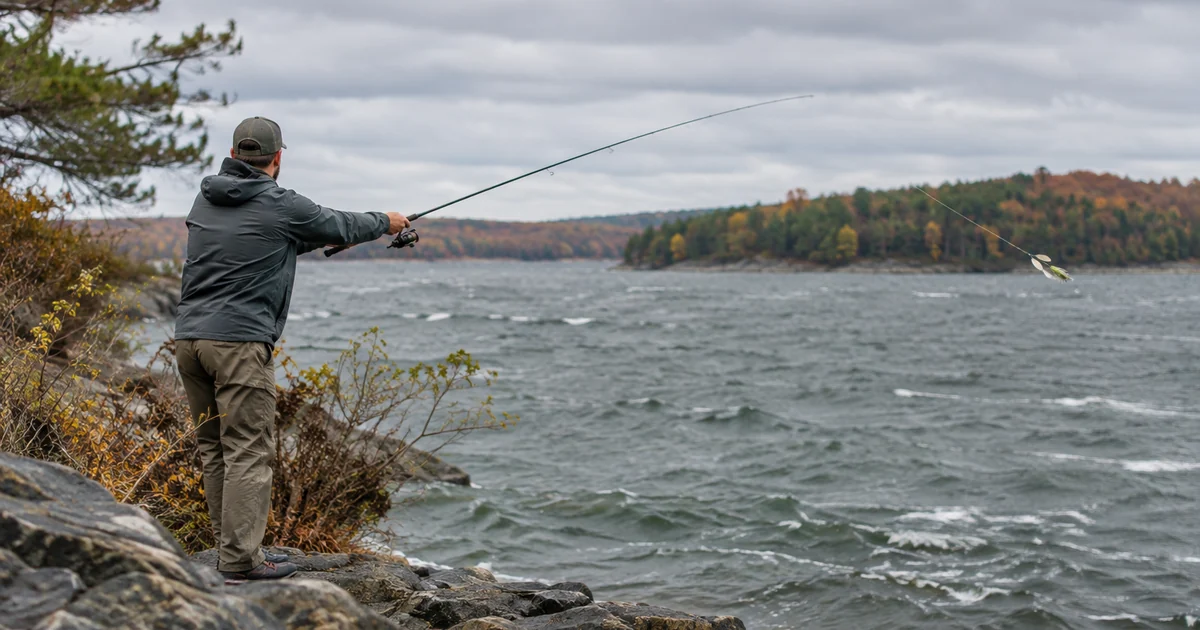
Most bass fishing tips are written for a perfect day. Real trips aren’t perfect. A front blows through, the lake turns to mud, the wind wrecks your plan, or a bass follows your lure to the boat and swims off. What you need in that moment isn’t a new lure. It’s a read of what changed and a clear next move.
That’s how this list works. Below are 15 situations that actually happen on the water, grouped by what’s causing the problem. For each one you get the read (what’s going on under the surface) and the fix (what to do in the next hour). It’s the situational playbook from Bass Fishing Mastery, rewritten for quick use on the water.
Bass Fishing Mastery: the complete 86-page bass guide behind this article. See the guide →
The 15 Situations at a Glance
| # | Situation | First move |
|---|---|---|
| 1 | Bluebird sky after a cold front | Half the speed, one size smaller, tight to cover |
| 2 | Lake turned muddy after rain | Thump and dark silhouette, slow, tight to cover |
| 3 | Bass busting bait, ignoring you | Downsize hard, match the bait |
| 4 | Fish follow and turn away | Speed up, add an erratic trigger |
| 5 | Weekend boat traffic | Dawn, prop-proof corners, the evening exit |
| 6 | You can see the bass, it won’t eat | Leave, come back in 20 minutes, one cast |
| 7 | Flat calm, bright midday | Fish the shade like structure |
| 8 | Night trips keep failing | Check the water clarity first |
| 9 | One hour on a new lake | Map, then point, creek mouth, windward bank |
| 10 | Wind blew out your spots | Fish the blown side or just down-current of it |
| 11 | Southern water still in the 80s | Keep fishing summer |
| 12 | Tournament, no practice | Season picks the area, structure picks the spot |
| 13 | Grass everywhere | Fish the edges and irregularities |
| 14 | Half the lake died in late summer | Stay in the oxygenated band |
| 15 | First real cold snap of fall | Follow the bait |
Weather Problems (Situations 1, 2, 7, 10)
1. A cold front passed overnight and the lake feels dead
The read: the barometer jumped. Bass pulled tight to cover and their strike zone shrank. They’re still there, just in a bad mood.
The fix: cut your speed in half, drop one lure size, and put the bait right on the best cover, on its shady or thickest side. A shaky head, finesse jig or drop shot does this job. Expect fewer bites and make each one count. The full rig-by-rig setup is in our guide to bass fishing after a cold front.
2. Heavy rain turned the water to chocolate milk
The read: bass can’t see much, so they hunt with their lateral line. They move shallow and tight to cover.
The fix: give them thump and a dark silhouette. Slow-roll a Colorado-blade spinnerbait, or fish a black/blue jig or dark plastics, slowly and right against cover. Then look for any clearer water coming in. A mud line is an edge, and bass use it like one.
7. Bright sun, no wind, nothing moving at midday
The read: the light pushed bass into shade and depth. The open water really is empty.
The fix: fish shadows the way you’d fish a rock pile. The shaded strip along a dock, the dark face of a fallen tree, the shadow under a bluff and the deep edge of the grass all count. From there it’s one of two plays: crawl a slow bait through that shade, or drop a jig down the nearest break. Watch the sky too. A passing cloud or a little wind often ends this pattern by itself.
10. The wind came up hard and ruined your spots
The read: the wind reorganized the lake. It’s pushing food and bait somewhere, and the bass go with it.
The fix: if you can present on the wind-blown side, fish it with a spinnerbait, swimbait or crankbait. The chop hides your mistakes and turns fish on. If it’s unfishable, move to the first protected water just down-current of that bank: the points and pockets that catch what the wind delivers.
Bass That Won’t Commit (Situations 3, 4, 6)
3. Bass are crashing bait and won’t look at your lure
The read: schooling bass are locked on one size of bait, and it’s almost always smaller than what you’re throwing.
The fix: downsize radically and match the profile: a small topwater, a fluke or a tail-weighted minnow. Cast past the school and work through it, then fish its rim, where the biggest fish pick off stragglers. Move fast, because these blitzes end quickly. We go deeper on this one in how to catch schooling bass.
4. Bass follow your lure in and turn away
The read: they’re interested but not convinced. This usually happens in clear water, when the lure is moving slowly and the fish gets too long a look.
The fix: change two things, speed before anything else. Prey that’s getting away forces the fish to decide now. If that’s not enough, make the lure act erratic with a rip, a sudden turn or a pause followed by a burst. Still getting followers? Go smaller and pick a natural color.
6. You can see the bass and it won’t touch anything
The read: a bass you can see in calm water has almost always seen you too. That round is already lost.
The fix: mark it, walk away and return twenty minutes later with a plan. This time keep your distance, stay low, face into the sun, and land a single cast far past the bass. Bring a small, natural-looking bait by it on an angle rather than straight at it. No interest? Go away again. Fish you can see settle down once nobody is pressuring them.
Water and Season Puzzles (Situations 8, 11, 13, 14, 15)
8. Night fishing on your lake never produces
The read: night fishing works on warm, clear water. If your lake or river is stained or muddy, darkness plus murk leaves the bass with almost nothing to hunt by.
The fix: on stained water, spend your time at dawn, dusk and in the midday light windows instead. If you still want to fish at night, go black for silhouette, maximum thump, tight to cover and very slow, and keep your expectations realistic.
11. It’s 84 degrees on your Southern lake while everyone online is fishing fall
The read: fall works its way south lake by lake, only as quickly as cool nights show up. Your water hasn’t left summer yet.
The fix: keep running the summer program with no guilt: dawn and dusk, shade, and depth through midday. Fall tactics are coming attractions for now. Your own fall begins the week the water slips below 80, so once several cool nights stack up in a row, go read the thermometer. Our guide to when fall bass fishing starts covers that transition.
13. There’s grass everywhere and it all looks the same
The read: bass don’t use the middle of a grass bed. They use its edges and anything irregular in it.
The fix: hunt the differences. Fish the deep outside edge parallel to it, the points and inside turns of the grass line, the holes and pockets in the mat, and any spot where the grass meets another plant or a different bottom. Tick the tops of submerged grass. Against thick mats, use single hooks only.
14. Half the lake quit producing overnight in late summer
The read: below the thermocline, the oxygen is gone. Bass can only live in the top layer of water and in the few places that stay oxygen-rich.
The fix: stop fishing the dead water. Keep your baits at 25 feet or less (the 15-to-25-foot zone and up), around weed beds (they produce oxygen), wind-exposed banks and moving-water inflows. Fall turnover will reopen the whole lake. Until then, fish only the water that can hold fish.
15. The first real cold snap of fall just hit
The read: baitfish react before the bass do. Shad bunch up into schools and drift into creeks and pockets. A hard snap can start the shad die-off, and bass load up on easy meals.
The fix: chase the bait instead of the shoreline. Wherever you can see baitfish, there’s a reason to cast. Look for birds diving and throw shad-shaped lures in white, silver or chrome. Spot dying shad twitching at the surface? Don’t leave that area all day, because the frenzy won’t last.
Crowds and the Clock (Situations 5, 9, 12)
5. Weekend traffic: wakes, jet skis and tubers everywhere
The read: boat traffic sorts the bass, it doesn’t remove them.
The fix: fish the early window before the crowd launches. At midday, work the stumpy, weedy, too-shallow corners that props avoid. Then stay late. The last ninety minutes after the crowd leaves can be the best bite of the day.
9. You have one hour on a lake you’ve never seen
The read: there’s no time to search, only time for high-percentage spots that work everywhere.
The fix: spend ten minutes on a satellite map first: points that drop into deep water, creek mouths, the dam. On the water, look before you cast (water color, bait, birds, wind). Then fish the best point, the best creek mouth and the windward bank with a moving bait, fifteen minutes each.
12. Tournament blast-off is in an hour and you had no practice
The read: you can’t find fish in an hour, but you can choose good water and fish it cleanly.
The fix: let the season pick the area (what does today’s water temperature say?) and let structure pick the spots: points, creek mouths, the best cover available. Use a search bait to find fish that will bite. Your first fish becomes the pattern: note its spot type, depth and retrieve, then run every similar spot on the lake. Fish the conditions, not the nerves.
The Rules Behind All 15 Fixes
Read the fixes again and the same few principles keep coming back. They’re worth carrying onto any water:
- Your first cast to new water is your best cast of the day. Nothing has spooked the fish yet. Position well and use your best presentation first.
- Fish the thermometer, not the calendar. A season begins when the water says it does, and that can mean weeks of difference between the North and the South. The water temperature chart is the real calendar.
- Let the wind choose your bank. Wind blowing straight onto a point with cover stacks active bass there. Fish it fast with a spinnerbait or crankbait.
- Multiply every fish. A caught bass tells you about every similar spot on the lake. Fish the pattern, not the place.
- Don’t leave before the last thirty minutes of light. It’s a feeding window, and most anglers spend it loading the truck. Our guide to the best time to fish for bass builds on this.
- Fix the free things. Wrong lures cost you fewer good bass than a drag cranked too tight, a dull point or a knot you didn’t wet. Set the drag, touch up hook points and wet every knot before you cinch it.
One habit ties it all together: before your first cast, stop and look. Water color, bait, birds and wind will tell you which of these 15 situations you’re in.
Quick Answers
What is the most important bass fishing tip?
Fish the water temperature, not the date. Seasons arrive when the thermometer says so, and every location and lure choice follows from that number.
Why do bass follow my lure but not bite?
They’re interested but not convinced, usually because they got too long a look in clear water. Speed up, add an erratic move like a rip or a pause and restart, and downsize if they keep following.
How do you catch bass when they are not biting?
First figure out why: a cold front, muddy water, bright calm sun or heavy boat traffic each call for a different fix. After a front, slow down, size down and fish tight to the best cover.
What should I do on a new lake with little time?
Spend ten minutes on a satellite map, then fish the best point, the best creek mouth and the windward bank with a moving bait for about fifteen minutes each.
Tight lines,
— David