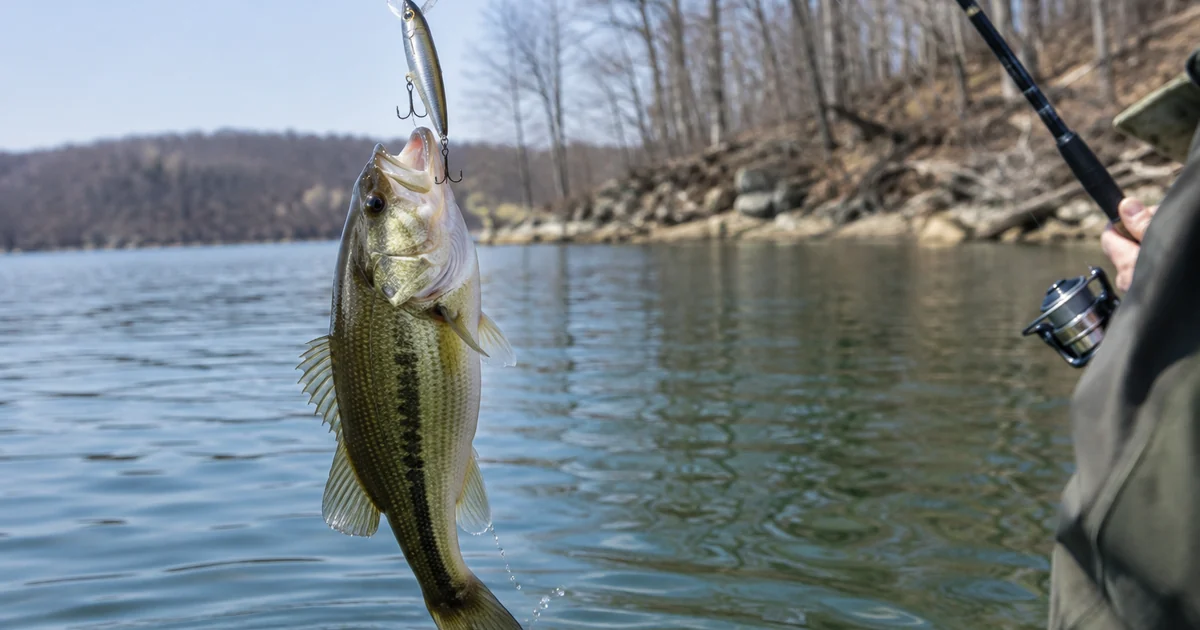
Jerkbait fishing for bass comes down to one moment: the pause. A jerkbait is a long, slender hard bait built to hang motionless in the water column. You jerk it twice, it darts, then it sits there like an injured baitfish. That stillness is when the bass eats.
Everything else in this article exists to make that pause deadly: a rod that moves the bait without overpowering it, a line that helps it hang, a knot that lets it swing, a bait that truly suspends, and a pause length set by the thermometer. All of it comes from the jerkbait system in Bass Fishing Mastery.
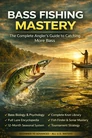
Bass Fishing Mastery: the complete 86-page bass guide behind this article. See the guide →
Why a Jerkbait Gets Bit
The ebook breaks bass strikes into three types: hunger, reaction and aggression. A jerkbait is mostly a reaction tool. Reaction strikes are involuntary. They’re triggered by a lure that suddenly changes speed or direction, and a jerkbait does exactly that on every snap of the rod.
Then it stops. A bait that was fleeing a second ago is now hanging still and vulnerable, right in front of a fish that just turned to look. That’s why the ebook is blunt about it: the bass strikes on the pause. If you’re not getting bites, one of the 50 pro tips says to lengthen your pause before you change lures.
The Setup: Rod, Line and Knot
| Component | Spec from the ebook | Why it matters |
|---|---|---|
| Rod length | 6’8″ to 7’0″ | Between the precision of shorter rods and the reach of 7’+ rods |
| Rod power | Medium | Same power class the matrix gives walking topwaters and shallow cranks |
| Rod action | Moderate-Fast | Flexes in the upper 40% of the rod |
| Line | Fluorocarbon, 10 to 14 lb | Invisible, keeps the action subtle, slight sink helps suspending |
| Knot | Non-slip loop knot | Lets the lure swing freely on the pause |
| Hooks | Quality trebles, matched to factory size | Factory trebles on budget lures are often inferior |
The rod
Medium power with a moderate-fast action is a different tool than the heavy, fast sticks the ebook assigns to casting jigs and flipping. A fast blank bends only in the top 25% for maximum sensitivity. A moderate-fast blank bends through the top 40%, the same action the matrix gives deep crankbaits, spinnerbaits and walking topwaters.
The line
The ebook’s line matrix puts jerkbaits on 10 to 14 lb fluorocarbon. It does three jobs here: it’s nearly invisible underwater, it keeps the bait’s action subtle, and it sinks slightly, which helps the bait hold its depth on the pause. Line type matters more than line visibility. Fluorocarbon is the wrong call on a floating topwater, but on a suspending jerkbait its sink works for you.
The knot
Tie a non-slip loop knot. It creates a permanent loop at the split ring, so the bait swings freely instead of being locked to the line. The ebook calls it a must-know for any hard bait fishing because it dramatically improves action on jerkbaits, topwaters and swimbaits.
- Tie an overhand knot in the main line, 8 to 10 inches from the end. Don’t tighten it.
- Pass the tag end through the lure’s eye and back through the overhand knot.
- Wrap the tag end around the main line 4 to 5 times.
- Pass the tag end back through the overhand knot, the same direction as step 2.
- Wet it and tighten by pulling the main line while holding the loop.
Tuning a Jerkbait to Truly Suspend
Here’s the workshop detail most anglers skip. According to the ebook’s rigging chapter, factory jerkbaits are often slightly positive or slightly negative in buoyancy, meaning they rise or sink on the pause instead of hanging dead still.
- If your jerkbait floats up on the pause, add small Storm SuspenStrips (adhesive tungsten tape) to the belly until it hangs level.
- If it sinks on the pause, remove adhesive weight from the belly by sanding.
Is the fuss worth it? Yes, because a bait that hangs perfectly still is far deadlier in cold water, and cold water is exactly where a jerkbait makes its name. A chilled bass can take 10 to 15 seconds to drift up and decide. If your lure is creeping toward the surface the whole time, you’re dragging it away from the fish just as it makes up its mind.
One of the ebook’s pro tips: test a new lure’s action by shaking your rod tip over a bucket of water before you fish it. It’s also a quick way to check how your jerkbait sits after you add or remove weight.
Hooks and split rings
The same workshop chapter covers hard bait maintenance:
- Replace factory hooks on budget lures immediately. VMC Cone Cut trebles, Owner ST-36 and Gamakatsu round-bend trebles are the upgrades the ebook names. Match the hook size to the factory specification, usually printed on the packaging.
- Inspect split rings regularly. Corrosion and repeated stress make them fail, and a split ring failure on a big fish is heartbreaking. Replace them annually or whenever they look corroded.
- Test every point. Drag it over your thumbnail, held at a 45-degree angle. A sharp hook bites in; one that skates across needs a tungsten carbide file or a replacement.
- Store hard baits separated. Tangled hooks damage finishes. Keep lures out of direct sunlight, which fades paint and can warp plastic bodies.
The Pause Clock: Let Water Temperature Set the Count
The retrieve is jerk, jerk, pause. Water temperature dictates how long that pause lasts:
| Water temperature | Pause length | What’s going on |
|---|---|---|
| Below 50°F | 8 to 12 seconds | Slow metabolism, the bass needs time to commit |
| 50°F to 60°F | 3 to 5 seconds | Fish waking up and moving toward staging areas |
| Above 65°F | 1 to 2 seconds | Fast, aggressive fish, keep the bait moving |
Two refinements from the seasonal chapters:
- Pre-spawn staging fish. In the 50°F to 58°F pre-spawn window, the ebook’s lure list calls for a jerkbait with 5 to 8 second pauses.
- Cold water rule. One pro tip says to slow your retrieve by 30% in cold water, then slow it another 30%. Cold bass want the bait in their face for an extended period.
Count the seconds on every pause so the cadence stays honest. If you’re getting followers but no bites, the ebook’s advice from forward-facing sonar applies: slow down, add longer pauses or downsize.
When to Throw a Jerkbait: The Season Map
The jerkbait is a cold-water specialist, and its best months show up again and again in the ebook’s charts.
| Month | Water temp | Where the bass are | Jerkbait’s role |
|---|---|---|---|
| March | 50°F to 60°F | Staging areas, 10 to 18 ft | Primary lure, alongside slow-rolled spinnerbaits and swimbaits |
| April | 58°F to 68°F | Pre-spawn to spawning, 4 to 15 ft | Still in the lineup with lipless cranks, jigs and swimbaits |
| Any month | 45°F to 55°F (quick-reference chart) | Waking up | Slow jerkbaits and deep jigs |
Where to fish it in pre-spawn
According to the ebook, fish start moving in earnest toward the spawn once the water hits 53°F to 55°F, and the pace picks up as it nears 60°F. The big females are gorging to store energy before spawning, so this stretch ranks among the best chances all year at a heavy fish on a fast-moving bait. A jerkbait worked through 8 to 15 feet, close to where the fish will eventually spawn, fits that window perfectly.
Where to point the boat:
- Points on secondary creek arms, 8 to 15 feet deep.
- Channel edges at 12 to 20 feet that sit beside spawning coves.
- The first real drop-off below flats where fish could spawn.
Start where the water is warmest. Sheltered, shallow coves heat up first, and a sunny afternoon can push the temperature up 3 to 5 degrees. Slide a little deeper as the day heats up. If you’re after a trophy, the ebook sends you to the deep end of the pre-spawn zone, the 15 to 20 foot channel edges beside the main spawning coves, and matches that water with big swimbaits and football jigs. Those are covered in the jig fishing guide.
Models and Colors
The ebook names four top jerkbaits: the Megabass Vision 110, the Strike King KVD Jerkbait, the Rapala Shadow Rap and the Lucky Craft Pointer 100. Whichever you pick, check that it suspends before you trust it.
For color, use the ebook’s master chart. In clear and crystal-clear water, natural shad and chrome patterns lead. When the bait you’re imitating is shad, chrome/blue, white/silver and pearl are the standard choices.
Fixing a Jerkbait Day That Isn’t Working
- Followers that turn away: the ebook’s playbook says speed up first and add an erratic trigger, like a rip, a direction change or a kill-and-restart. If followers persist, downsize and go natural.
- No bites at all: lengthen the pause before you change lures.
- Hooked fish jumping off: a bass that jumps right after the hookset is often poorly hooked. Apply side pressure immediately to keep it down.
- Lost fish at the boat: check your drag. The ebook sets it at 25 to 30% of the line’s breaking strength.
Once the water climbs past the jerkbait window, the search job moves to blades. See spinnerbait fishing for bass for how to tune those, the best bass lures for the full lineup, and the bass water temperature chart for what to throw at every reading.
Quick Answers
What is the best rod for jerkbait fishing?
The ebook’s rod matrix calls for a 6’8″ to 7’0″ medium-power rod with a moderate-fast action, paired with 10 to 14 lb fluorocarbon line.
How long should you pause a jerkbait?
Let water temperature decide: 8 to 12 seconds below 50°F, 3 to 5 seconds from 50°F to 60°F, and 1 to 2 seconds above 65°F.
What water temperature is best for jerkbaits?
Jerkbaits are cold-water specialists. The ebook’s charts list them from the mid-40s, worked slowly, up through the pre-spawn, especially in the pre-spawn window when water reaches 50°F to 58°F and bass stage on points and channel edges.
How do you make a jerkbait suspend?
Add small adhesive tungsten strips to the belly of a jerkbait that floats up on the pause. If it sinks, remove belly weight by sanding until it hangs level.
Tight lines,
— David