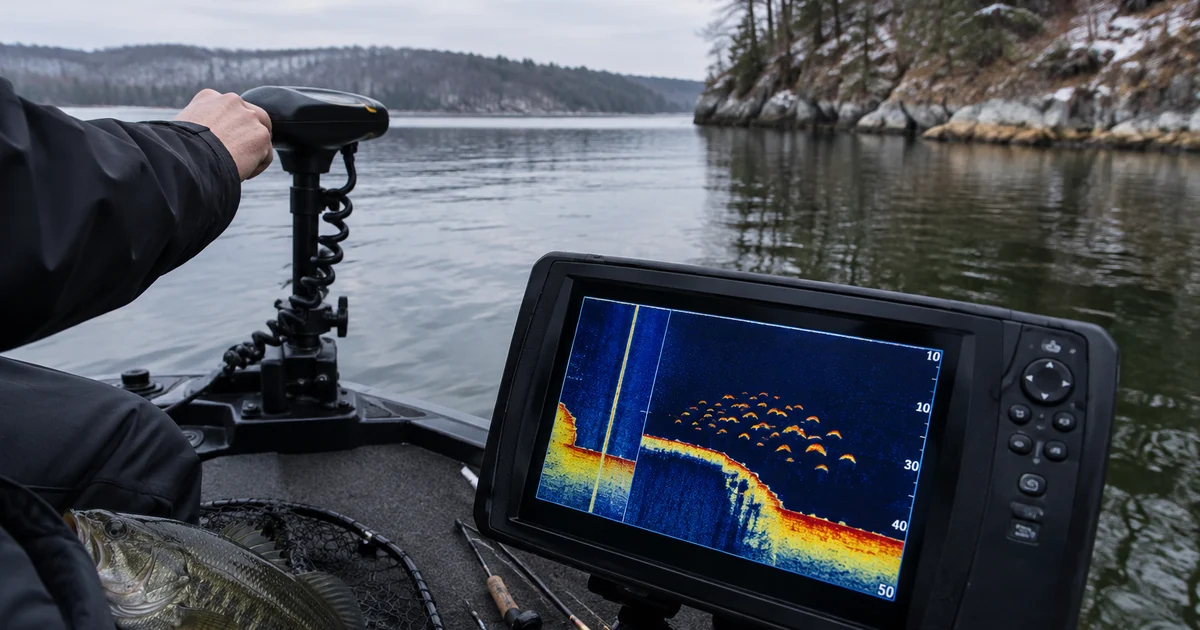
In winter, your fish finder stops being a nice extra and becomes the main tool in the boat. Bass gather in tight schools on deep structure, and the rest of the lake goes quiet. Casting blind across that empty water is how winter trips end with zero bites.
Using a fish finder for bass in cold water is a two-part job. First you locate the school. Then you park on top of it and fish straight down, with baits that hang in a sluggish fish’s face until it finally decides to eat.
Here’s that workflow, step by step, using the electronics and seasonal chapters of Bass Fishing Mastery.
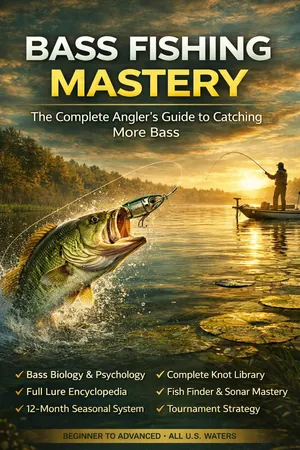
Bass Fishing Mastery: the complete 86-page bass guide behind this article. See the guide →
Why Winter Is Sonar Season
In January and February, bass crowd together in the deepest water whose temperature holds steady. On a Southern reservoir that’s often 20 to 40 feet down; Northern lakes put them shallower. Finding that school is 90% of the battle. Once you’re on it, multiple fish can come from the same tiny area.
That’s a perfect match for electronics. A deep school on a hump or channel bend is invisible from the surface, but it shows clearly on the screen. And the drop shot, which the book singles out for fish that show up on your screen but refuse to chase a moving lure, is built to be fished straight down.
Build the Search List Before You Launch
Don’t idle the whole lake. Start with a short list of places where winter fish should be.
- Creek channel bends, especially outside bends where the original channel cut deepest.
- Main lake humps. They’re only findable with a fish finder or a detailed contour map, which is exactly why they get so little pressure.
- Steep bluff walls.
- Ledges, where the bottom can drop 15 feet in 10 horizontal feet.
- Deep points and channel bends, the February locations in the book’s 12-month chart.
To build the list at home:
- Navionics: download the contour map for your lake and mark waypoints on your phone before you launch.
- Google Earth historical imagery: set it to the lowest-water year to see original creek beds, roads and timber lines that are now underwater structure.
- State agency maps: many fish and wildlife agencies publish free contour PDFs that are more detailed than some commercial apps.
- LakeMaster: very detailed contour data on many Midwestern and Southern reservoirs.
The winter bass fishing guide covers why these places hold fish and how the season unfolds month by month. This article is about the screen.
What a Winter School Looks Like on 2D Sonar
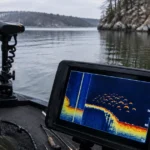
Run your list slowly. On traditional 2D, you’re reading five things.
| On the screen | What it means | Winter read |
|---|---|---|
| Bottom line | Thick, dark, double line = hard bottom (rock, gravel, clay); thin, fuzzy line = soft mud or silt | Hard bottom on deep structure is where you want to slow down |
| Second echo | A doubled bottom line from sonar bouncing twice off very hard bottom | A strong sign of rocky structure, even before you see it |
| Fish arches | Wider, more complete arch = larger fish; half-arch = fish at the edge of the cone | Several arches at the same depth = a school |
| Baitfish clouds | Fuzz, clusters or layered bands | Bait near structure means bass are almost certainly nearby |
| Structure returns | Brush piles = irregular bumps; timber = vertical returns above the bottom | Winter bass hold tight to wood where the bottom runs marginally warmer |
Return brightness adds detail. The strongest returns come from solid rock, metal and large dense fish. Strong returns mark gravel, hard clay, packed sand and schools of medium fish. Weak, dim returns mean silt, mud or decaying vegetation, generally less productive.
Two baitfish clues help in cold water:
- Bait near the bottom often means bass have pushed it down while feeding from above. That’s an immediately productive situation.
- Bass below the bait is the classic setup. Fish the depth of the bass, not the depth of the bait.
Side Imaging, Down Imaging and Forward-Facing Sonar
2D shows a narrow cone under the boat. The newer views add a lot.
- Down imaging uses a thin, sheet-like beam for an almost photographic picture of what’s directly below: individual posts, brush pile branches, fish holding in specific positions.
- Side imaging shoots 50 to 150 feet to each side of the boat. You see brush, rock and fish without driving over them, which matters on a school you don’t want to spook. If you’re buying your first unit, the book’s advice is to prioritize side imaging over screen size or raw power.
- Forward-facing sonar (Garmin LiveScope, Humminbird Mega Live, Lowrance ActiveTarget) shows fish, lure and structure in real time, often 50 to 100 feet ahead. You can watch a bass approach your bait, hesitate, and change your presentation on the spot.
A sensible winter routine: scan wide with side imaging, then idle over anything promising with 2D or down imaging to confirm depth and size before you commit.
Mark It Like You’ll Need It Next January
A school you found once is a school you can find again, if you mark it properly.
- Mark the instant you see it or catch a fish. Even a 10-yard error is a big miss on a deep, precise spot.
- Use descriptive names. A name like “ChannelBend-Creek2-28ft-WINTER” tells you the spot type, location, depth and season at a glance. “Spot 1” tells you nothing a year later.
- Group by type: confirmed fish locations, structure to investigate, hazards, ramps.
- Build a winter route connecting your best cold-water waypoints, so next season you run them in order without hesitation.
- Back it up to your phone or computer each season.
Over three to five years, that waypoint file becomes the most valuable fishing asset you own.
Fishing Straight Down: Blades, Spoons and the Drop Shot
Now hold the boat over the school, with your trolling motor working against the wind to keep you stationary, and fish vertically.
Blade baits and jigging spoons
Blade baits such as the Heddon Sonar are jigged vertically over the school. Jigging spoons are fluttered up and allowed to fall back. Both are January and February staples, and spoons are the book’s pick when water is below 45°F and fish are near-dormant on the deepest structure. Whatever cadence you use, respect the winter clock: up to 15 seconds can pass before a cold fish commits. Give each lift time to settle and give the fish time to decide.
The deep drop shot
When the screen shows fish that ignore anything moving, the drop shot parks a bait at a single depth and leaves it there as long as you like. The basic tie is covered in the best bass lures; here is the deep-water version.
| Part | Spec |
|---|---|
| Hook | Size 1 or 2 drop shot hook, Palomar knot, point standing at 90° to the line |
| Weight | 1/4 to 3/8 oz in deeper water; in 30 to 50+ ft, go heavier with a shorter leader |
| Line | Main line of 30 lb braid; leader of 10 lb fluorocarbon, so you still feel the bite that deep |
| Rod | Spinning, medium-light power, fast action, 6’10″ to 7’2″ |
| Bait | Finesse worm, nose-hooked so it hangs horizontally |
Send it down until the sinker touches, reel up the slack, then nod the rod tip with your wrist in a steady little rhythm. The sinker never leaves the bottom; only the worm shivers above it. Pick the lightest weight that still holds bottom. Feel a fish? Reel down to it, then sweep up.
When the Screen Shows Fish That Won’t Eat
This is the most frustrating moment in winter: the school is right there on the screen, and nothing bites. The book’s answer comes from what forward-facing sonar has revealed: bass follow lures far more often than anglers realize, but refuse to commit. The fix is almost always speed, size or color.
- Slow down. Cut your speed by 30%, then by another 30%.
- Lengthen the pauses before you change lures.
- Downsize the bait.
- Stay. Normally you’d give a spot a few good casts and move on. The exception is when your fish finder tells you the fish are definitely there. Then patience is justified.
Timing helps too. Winter bites cluster in a short midday window, roughly noon to 4 PM. A school that ignored you at 10 AM can turn on in the early afternoon. For the transition month before full winter, see December bass fishing, and for the daily feeding clock in every season, the best time to fish for bass.
Quick Answers
How do you find bass on a fish finder?
Run likely structure slowly and look for several arches at the same depth near hard bottom, ideally with baitfish clouds nearby. In winter, start with creek channel bends, humps and bluff walls.
What do bass look like on a fish finder?
On 2D sonar, fish appear as arches. The fuller and wider the arch, the bigger the fish, and a row of arches at one depth usually means a school.
Is side imaging worth it for bass fishing?
Yes. Side imaging shows structure and fish 50 to 150 feet to each side without driving over them, which finds fish faster than any other single feature.
How deep are bass in winter?
On the deepest stable structure available: often 20 to 40 feet in the South, less in the North. Your screen will show you the exact depth on your lake.
Tight lines,
— David