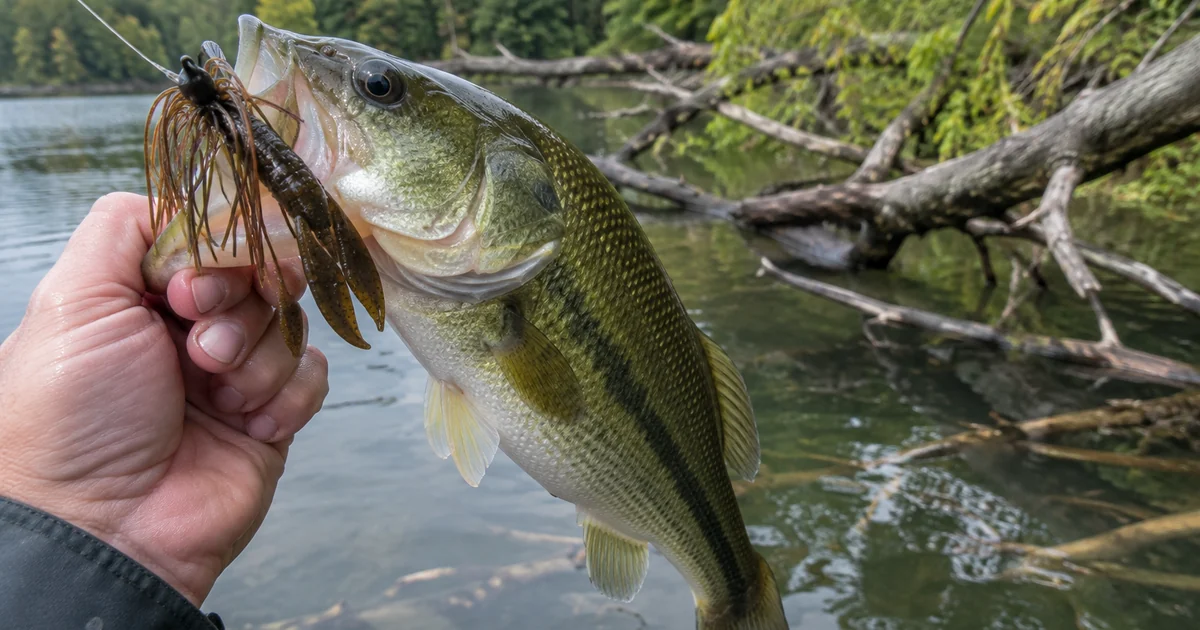
Jig fishing for bass rewards the angler who treats a jig as a system, not a lure. The head, the skirt, the trailer and the hook all have to work together. Get one wrong, like a skirt that hides the hook or a trailer too big for the head, and the best cast in the world turns into a missed fish.
The ebook calls the jig the trophy lure, and this guide builds one from the head up: which jig for which job, how to customize it, the rod and line behind it, and how to present it in cover and on deep structure. It’s all drawn from the jig chapters of Bass Fishing Mastery.
Bass Fishing Mastery: the complete 86-page bass guide behind this article. See the guide →
Pick the Jig by the Job
The ebook sorts jigs into types by weight and purpose. Choose the type first, then customize it.
| Jig type | Weight | Where it works | Trailer |
|---|---|---|---|
| Casting jig | 3/8 to 3/4 oz | All-purpose. Pitch to docks, flip into grass, cast to laydowns | Beaver bait or craw |
| Football jig | 1/2 to 1 oz | Dragged slowly on rocky ledges, rock piles and gravel bars, deadly on deep summer structure | Large craw or swimbait |
| Swim jig | 3/8 to 1/2 oz | Swum along grass edges, through sparse vegetation and around visible cover, spring through fall | Swimbait tail when swimming open water |
| Finesse jig | 1/8 to 1/4 oz | Clear water, cold water and post-cold-front conditions | Finesse craw or small swimbait |
The casting jig has a weed guard that lets you fish heavy cover. The swim jig uses a lighter wire hook and a smaller weed guard so it can swim through the water column. The football jig’s head keeps it upright on hard, rocky bottom. The finesse jig is small and compact, built for light line.
Customize the Jig: Head Shape and Skirt
Head shape
The rigging workshop in the ebook matches each head shape to a presentation:
- Round head: all-purpose, and the best shape for swimming.
- Football head: for rocky bottom. The shape keeps the jig upright instead of tipping and wedging.
- Arky or flat head: for flipping and pitching. It has the best snag resistance of any shape.
- Stand-up head: for finesse applications.
Here’s the logic. The bottom you’re fishing chooses the head. Rock wants a football. Wood and grass you’re flipping into want an Arky. Open water where the jig swims wants a round head.
Skirt trim and hook exposure
A factory skirt is often too long. The ebook’s rule: trim the skirt so it extends 1/4 to 1/2 inch beyond the hook bend. Overly long skirts obscure the hook and reduce hookups.
How to do it:
- Use sharp scissors.
- Make a clean, angled cut so the strands end 1/4 to 1/2 inch past the bend of the hook.
Then check hook exposure after the trailer is on. The hook point and gap must not be blocked by the trailer. The hook should be clearly accessible through the trailer. If it isn’t, trim the trailer’s head.
Check your hook point before every trip. Run it across your thumbnail at a 45-degree angle. A sharp point catches; a dull one slides. Recheck after fishing rock or hard structure, which is brutal on hook points.
The Trailer System: Size, Action and Color
The trailer is how you tune a jig to the day. The ebook gives three levers.
Action
| Conditions | Trailer | Why |
|---|---|---|
| Cold water or finicky fish | Small craw, about 3 inches | Slow fall, subtle action |
| Warm water or heavy cover | Large beaver bait, 4 inches or more | Bigger profile, slower fall through cover |
| Open water swimming | Swimbait tail | Gives the jig a baitfish profile |
Size
Always match trailer length to jig head size. A tiny jig with a massive trailer looks unnatural. If you’re on a 1/8 oz finesse jig, think small craw. If you’re on a 3/4 oz casting jig in the brush, the big beaver bait fits.
Color
Match the dominant color in the skirt to the trailer’s base color. You can add contrasting accents, like orange tips or blue flecks, as trigger points. The ebook’s rule of thumb: keep it natural or keep it bold, and avoid muddy, mixed palettes.
For the base color, the ebook’s master chart works:
- Clear water: green pumpkin, watermelon red.
- Stained or murky water: black/blue.
- Muddy water: black/blue or solid black.
- Spring craw season: brown/orange or green pumpkin/orange.
- Night: solid black for maximum silhouette. The ebook’s night lineup includes a black jig with a craw trailer.
Rod and Line for Each Jig
| Setup | Rod | Line |
|---|---|---|
| Casting jig | 7’0″ to 7’3″, heavy power, fast action | Matched to cover, see below |
| Flipping and pitching | 7’3″ to 7’11″, heavy, fast (the matrix’s flipping spec) | Fluorocarbon 17 to 20 lb, or braid 50 to 65 lb |
| Finesse jig | Spinning gear | Fluorocarbon 8 to 12 lb |
The line choice for flipping follows the water. The ebook says fluorocarbon for clear water and braid for heavy cover. Braid has zero stretch and is very strong for its diameter. Fluorocarbon is near-invisible and abrasion resistant.
The fast action matters. A fast blank bends only through the top 25%, which gives maximum sensitivity. High-modulus graphite adds to that sensitivity, which is what you need to feel bites through the line. Set your drag at 25 to 30% of your line’s rated breaking strength.
How to Fish a Jig in Cover: Flip, Pitch, Fall
In heavy cover, the ebook’s delivery systems are pitching and flipping.
Pitching (15 to 40 feet)
Reel down until you have 18 to 24 inches of line between the rod tip and the jig. Hold the jig in your non-dominant hand. Swing the rod forward while releasing the jig so it pendulums toward the target. Feather the spool with your thumb to stop it exactly on target. The goal is entry with minimal splash.
Flipping (8 to 20 feet)
Strip off 8 to 10 feet of line and hold it in your free hand. Use the rod to pendulum the jig to the target, releasing line from your free hand to extend the reach. It’s almost completely silent, which matters when fish are spooky in shallow, clear water.
The fall is the strike zone
After the jig enters the water, stop. Let it fall on a completely slack line and watch the line. If it moves sideways or jumps, that’s a bite. Don’t engage the reel until the jig has hit bottom. The ebook notes that most of the largest bass caught by flipping anglers come on that initial unimpeded fall.
For the hookset, the ebook’s direction is an upward sweep for jigs.
Where to put it
On wood, target the root ball first. It’s the deepest, most complex part of the tree and holds the largest fish. Then work out along the trunk. Position yourself so you can cast parallel to the length of the log. On sunny days, bass sit on the shaded side of any cover.
Jig Fishing by Season
The jig shows up in almost every month of the ebook’s calendar. What changes is the type.
| Period | Water temp | Jig play |
|---|---|---|
| Winter (Dec to Feb) | Roughly 38°F to 54°F | Slow finesse jigs on deep structure, retrieve impossibly slow |
| Pre-spawn | 58°F to 65°F | Jig on channel edges. Trophy pattern: football jigs on 15 to 20 ft channel edges near major spawning coves |
| Spawn | 65°F to 75°F | 1/4 oz finesse jig worked slowly past the bed, 14 lb fluorocarbon leader |
| Summer midday | Up to the 80s | Football jig on ledges, humps and channel edges at 15 to 25 ft |
| Fall cold snap | Below 58°F | Swap speed lures for jigs, Texas rigs and medium-diving crankbaits |
| November | 50°F to 62°F | Jig, Texas rig, medium crankbait as bass transition deeper |
Two special cases from the ebook. After a cold front, the playbook calls for finesse jigs on the shady, dense side of the best cover. When the lake turns muddy after heavy rain, it calls for a black/blue jig fished tight to cover, slow and methodical.
For trophy fish specifically, the ebook lists big jigs, 1/2 to 3/4 oz, with large trailers. See how to catch big bass for where those fish live.
Turn One Jig Bite Into a Pattern
The ebook uses a jig to explain pattern fishing. You catch a bass at 8 feet, next to a laydown, on a rocky bank, on a 3/8 oz green pumpkin jig worked slowly. That’s one data point. Catch a second fish in the same situation with the same jig and you have a pattern. Now find every similar spot on the lake and fish each one.
That’s how a jig turns 2 or 3 fish into 10 to 20. After each fish, note the depth, cover type, retrieve speed and time of day, then go find the next matching spot.
If the jig isn’t producing because the fish are up and chasing, switch to a search bait. See spinnerbait fishing for bass and jerkbait fishing for bass for the cold-water alternative, or the summer bass lure guide for the deep-ledge game.
Quick Answers
What size jig is best for bass?
It depends on the job. Casting jigs run 3/8 to 3/4 oz, football jigs 1/2 to 1 oz, swim jigs 3/8 to 1/2 oz, and finesse jigs 1/8 to 1/4 oz.
How long should a jig skirt be?
Trim it so it extends 1/4 to 1/2 inch beyond the hook bend. A longer skirt obscures the hook and reduces hookups.
What trailer should I put on a jig?
Use a small craw for cold water or finicky fish, a large beaver bait for warm water and heavy cover, and a swimbait tail when you’re swimming the jig in open water. Match trailer length to the jig size.
What rod do you need for jig fishing?
The ebook’s matrix calls for a 7’0″ to 7’3″ heavy-power, fast-action casting rod for a standard casting jig.
Tight lines,
— David