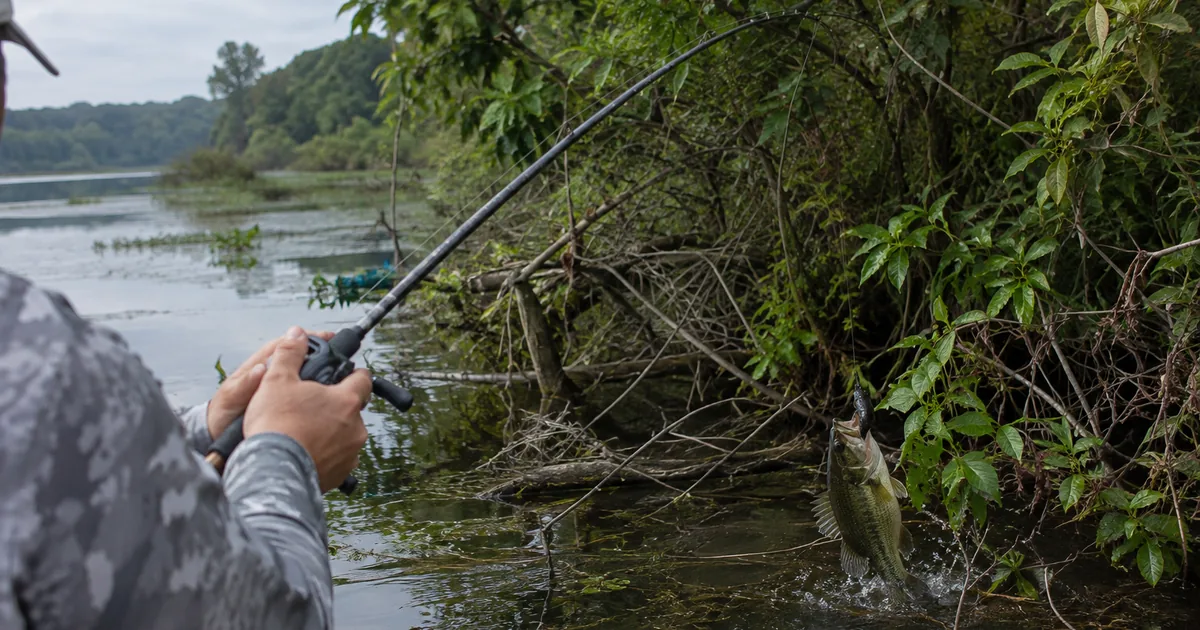
Flipping and pitching are the two short-range casting strokes that put a bait inside heavy cover quietly, and the distance tells you which one to use: pitching covers 15 to 40 feet, flipping covers 8 to 20 feet.
Neither is a cast in the overhead sense. Both are pendulum deliveries designed to drop a lure through a hole in wood or grass with almost no splash, because the fish you are after is sitting a foot away from where the lure lands.
This page breaks down both strokes, the rig behind them, and the cover worth the effort, straight from the heavy-cover system in Bass Fishing Mastery.

Bass Fishing Mastery: the complete 86-page bass guide behind this article. See the guide →
Two Strokes, Two Distances
| Element | Pitching | Flipping |
|---|---|---|
| Working range | 15 to 40 feet | 8 to 20 feet |
| Where the slack sits | Cranked in tight, 18 to 24 inches dangling under the tip | A coil of 8 to 10 feet pulled off the spool, gathered in your off hand |
| The stroke | Rod drives forward as your fingers let go; the lure arcs in low and flat | The rod swings the lure over and the held coil pays out to stretch the reach |
| Stopping it | Thumb rides the spool the whole flight and clamps over the hole | Nothing is spinning, so there is nothing to brake |
| Picked for | Docks, laydowns and grass edges at ordinary casting range | Jumpy fish in a foot or two of clear water, almost under the rod tip |
Pitching is an underhand, bottom-up delivery. Cradle the lure in your off hand and crank the reel until only a foot and a half to two feet of line hangs below the rod tip; 18 to 24 inches is the window that works. From there it is one motion. The rod drives forward, your fingers open at the same instant, and the lure arcs across the surface rather than over it. Your thumb never leaves the spool: it rides along for the whole flight and clamps down the moment the lure arrives above the hole you picked. What you are managing is splash, not yardage.
Flipping hands the line job to your hand instead of the reel. Peel 8 to 10 feet off the spool, gather it loosely in your free hand, then let the rod swing the lure over while you feed that coil out behind it to reach further than the rod alone could. Nothing is turning, nothing clicks, nothing has to be thumbed correctly. That is why this is the delivery for a fish sitting in a foot of clear water that will be gone at the first wrong noise.
Accuracy beats volume every time. The angler who puts the first attempt in the right hole will always out-fish the one who sprays a dozen near misses at the same bush.
The Dead Bait Pause
Here is what separates anglers who flip from anglers who catch while flipping. Once the bait is through the hole, do nothing at all. Hands off the handle, line left loose, eyes on the few feet of line where it meets the surface.
A fish taking it on the way down tells you one of two ways: the line drifts off to one side, or it twitches back up toward you. Neither of those feels like a thump, which is the whole problem. Leave the reel out of it until you are satisfied the bait reached bottom untouched, because every turn of the handle made too soon erases a drop bite you never knew you had. The heaviest fish this technique produces are, more often than not, taken during that free, uninterrupted descent.
When the line does load up, crank until everything comes tight, let the fish’s weight register in the blank, then drive the rod up in one long sweep. The error that costs the most cover fish is reacting to the first faint tick: a bass will grab a plastic and carry it a short way before it is genuinely inside the mouth, so a hookset fired at that first signal drags the bait right back out past an open jaw.
Pegged or Free-Sliding: the Rig Decision
The weight placement is a deliberate choice, not a default.
- Pegged. A bobber stopper snugged down behind the sinker locks the two pieces into one rigid projectile. That is what punches a canopy: it goes in as a single object, nothing hinges open halfway down, nothing catches on the way through.
- Free-sliding. Leave the stopper off and the sinker outruns the plastic the instant the rig lands. The bait then drifts down on its own, slower and looser, and out in open water that longer, lazier descent draws far more strikes than a locked rig ever will.
The rest of the build:
| Component | Setting |
|---|---|
| Weight | 1/2 to 3/4 oz tungsten for depth, heavy cover or wind; 3/4 to 1 oz under a beaver-style bait |
| Hook | Flipping hook, 4/0 to 5/0, heavy gauge wire that resists bending in cover |
| Bait | Beaver-style flipping baits and craw imitations; a lizard near spawning areas |
| Punching mats | A punch rig: 1 to 2 oz tungsten with a bead and a heavy hook, under a compact creature bait |
| Hook point | Just barely sub-surface — touching the skin from below without poking through |
That last line is worth re-reading. A point buried too deep costs penetration on the set; a point left too proud turns a weedless rig into a snag magnet. And the bait should hang perfectly straight — any bend creates an unnatural spinning action that reduces bites.
Heavy gauge wire is not optional. A standard worm hook will flex open under the pressure this technique applies, which is the whole reason a dedicated flipping hook exists.
Rod, Line and the Free Stuff
Flipping tackle is built around one job: move a fish out of cover before it can wrap you.
- Rod: 7 feet 3 inches to 7 feet 11 inches, heavy power, fast action. The length gives reach and leverage; the backbone does the extraction.
- Line: 40 to 65 lb braid for heavy cover — maximum strength and zero stretch for hooksets at close range. For jig work in clearer water, 17 to 20 lb fluorocarbon is the alternative.
- The ninety-second check: dial the drag to 25 to 30 percent of rated line strength before the first pitch, drag each hook point over a thumbnail and retire anything that glides instead of biting, and soak every knot before you seat it — the three details that quietly decide more cover fish than any lure choice, all worked through in bass fishing knots alongside the Palomar and improved clinch these rigs are built on.
Where to Put the Bait
Flipping and pitching are cover techniques, so the target selection is the strategy.
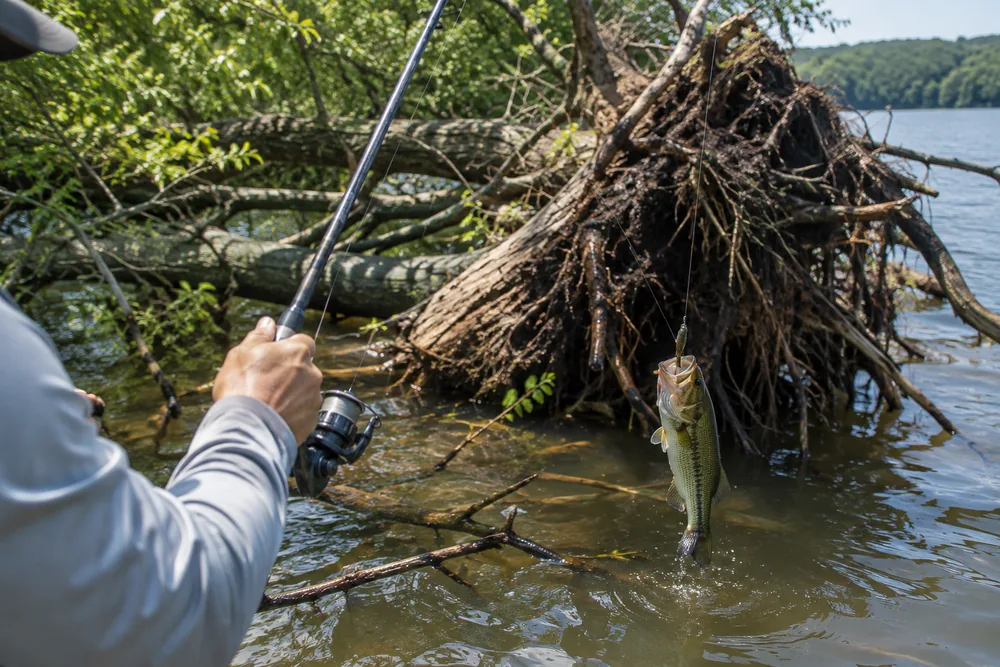
Wood. Laydowns, stumps, brush piles and standing timber are about as good as bass cover gets, and the messier the limb structure the more it holds: branches running off in four directions give four fish four separate places to wait. Begin where the tree is thickest and sitting deepest, down at the stump end and the mass of roots around it, because that is where the best fish of the piece will be, and only then follow the trunk out toward the tips. Under a high sun they tuck into whichever face of the wood is throwing shade; in cold water they press right against it, since the timber itself runs a shade warmer than the bottom beside it.
Grass. Uniform grass is not uniform to a bass — fish use its edges and irregularities, not its middle. Work the outside deep edge parallel, the points and inside turns of the grass line, the pockets and holes in a mat, and any transition where one vegetation type meets another or grass meets a different bottom. Pockets inside a solid mat are made for a punch rig.
Docks. Position parallel to the dock at casting distance and pitch at an angle so one pass covers several sections. Parking perpendicular lets you fish exactly one angle.
Boat position decides how many of those targets you actually cover. On a laydown, set up so you can present along the entire length of the log — one parallel presentation covers more fish-holding wood than a dozen perpendicular ones. On a grass edge, move parallel and work at a 45-degree angle to keep the bait in the productive zone longer. Points get the same logic, covered in detail in fishing points for bass.
If a jig is your flipping bait of choice, jig fishing for bass covers head shapes and trailer matching.
Match the Hook System to the Cover
One rule saves a lot of lost baits and lost fish: when there is a canopy above the grass, a lipless crankbait ripped through it is the play; when there is grass above the bait, it is a single hook or stay out.
Trebles thrown into a matted flat or a laydown are donations to the lake. Flip the error around and it costs just as much: when bass are chasing out where nothing can snag you, a weedless single is the wrong tool and the treble-hook bait sitting unused in the tray is a missed limit. Read the cover, then choose the hook system from it — never the other way round, and never from whichever rod happens to be in your hand. More habits in that family are collected in bass fishing mistakes.
Real-World Scenario: Grass Everywhere, All of It Identical
You pull up on a flat where the grass runs for several hundred yards and every foot of it looks the same. The read: it is not the same. Bass use the edges and irregularities of a grass bed, not the middle of it.
The play is to hunt the differences. Fish the outside deep edge parallel to it first. Then the points and inside turns of the grass line, which concentrate bass exactly the way a land point does. Then the pockets and holes in the mat, where a punch rig or a frog gets underneath. Finally any transition where the grass changes character or meets a different bottom. Over submerged grass, tick the tops; against a thick mat, single hooks only. That sequence turns a featureless flat into five distinct spots — and flipping and pitching are how you fish four of them.
Quick Answers
What is the difference between flipping and pitching?
Range, and what is holding the line. A pitch runs 15 to 40 feet and feeds off the reel with the lure cradled in your off hand; a flip covers 8 to 20 feet using a hand-held coil of 8 to 10 feet, and it goes in without a sound.
What rod do I need for flipping?
A 7 foot 3 inch to 7 foot 11 inch heavy-power, fast-action rod. The length gives reach and hookset leverage, and the power moves fish out of cover.
Should I peg the weight when flipping?
Yes in heavy cover, where a stopper turns sinker and bait into one rigid object that cannot come apart inside a canopy. Pull the stopper for open water: the plastic then drifts down behind the weight, and that slower descent gets eaten more often.
Why do I keep missing bites in cover?
Usually the hookset. Let the drop happen on loose line, watch for that sideways drift or upward twitch, then crank tight and sweep up rather than snapping at the first tick — no other single habit converts as many bites in flipping and pitching.
Tight lines,
— David