May is the trickiest month on the bass calendar, because it isn’t one season. It’s three at once. In the Deep South the spawn is long over. In the Mid-South the fish are coming off the beds. Across the Midwest they’re spawning, and in the Great Lakes and the North many are still staging.
That’s why a “best lures for May” list that ignores your water is useless. The right bait depends on which stage your bass are in, and the stage depends on your water temperature. This guide sorts the lures by stage, with the rigging details from Bass Fishing Mastery.
Bass Fishing Mastery: the complete 86-page bass guide behind this article. See the guide →
First, Find Your Stage
| Your water | Stage | What to throw |
|---|---|---|
| 58 to 65°F | Late pre-spawn | Lipless crankbait, swimbait, medium crankbait, jig |
| 65 to 75°F, fish on beds | Spawn | Ned rig, drop shot, 1/4 oz finesse jig |
| 65 to 75°F, beds empty, fry visible | Post-spawn | Topwater, wacky rig, frog near the fry; finesse deeper for females |
The spawn is triggered when the water reaches 65 to 75°F. If your thermometer says 62°F, it doesn’t matter that it’s May: your fish are still in pre-spawn.
Late Pre-Spawn: Speed Baits (58 to 65°F)
Bass are staging near the spawning areas and feeding hard. This is the stage for lures that cover water:
- Lipless crankbait: rip it through early grass. Ripping it through vegetation is what triggers the reaction strike.
- Swimbait along grass edges. Match your retrieve to the tail: if it doesn’t beat, reel faster; if it spins, slow down.
- Medium-diving crankbait (6 to 12 ft) on points.
- Jig on channel edges, with a trailer sized to the conditions.
The biggest females stage deepest, on 15 to 20 foot channel edges near major spawning coves, where big swimbaits and football jigs are the trophy play.
On the Beds: Finesse and Patience (65 to 75°F)
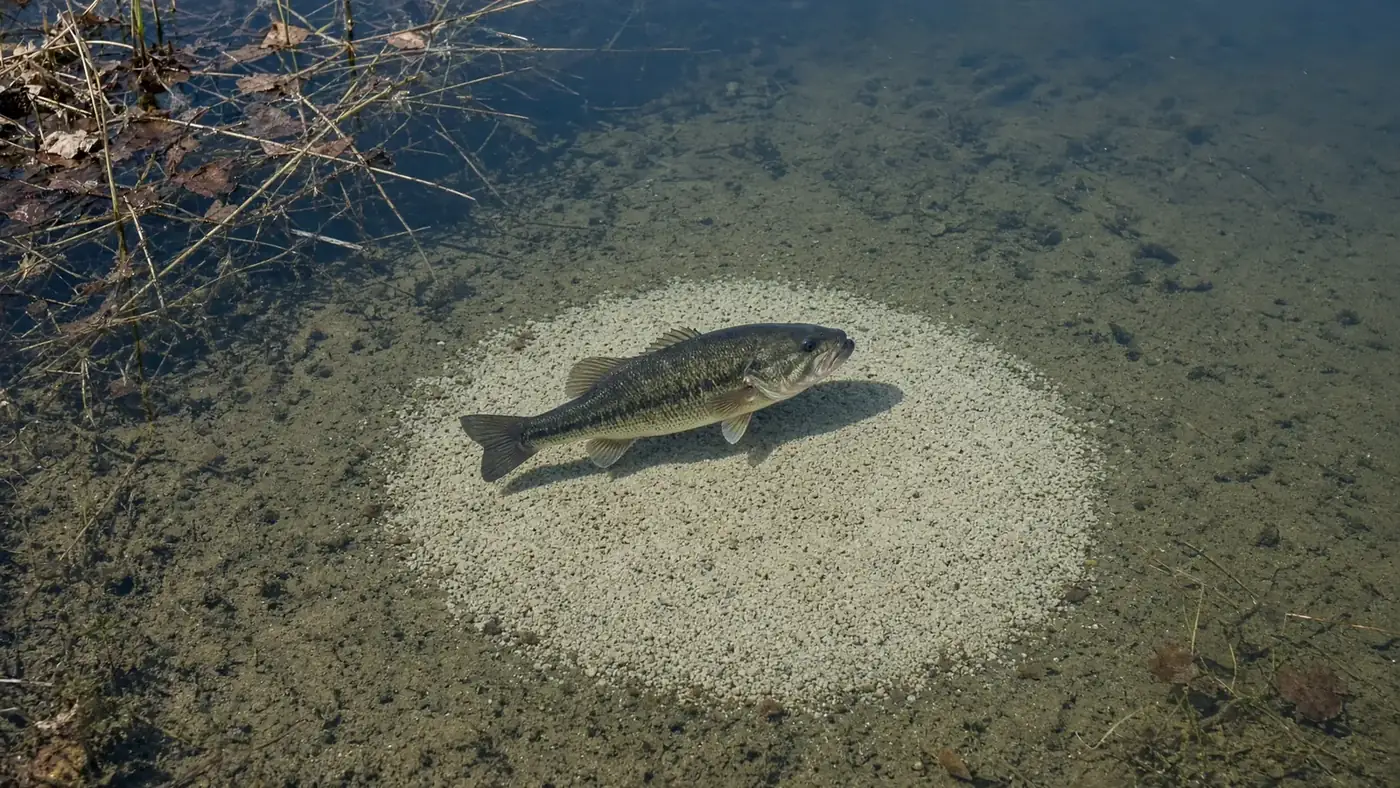
Look for circular depressions 2 to 4 feet across on hard bottom (sand, gravel, clay or shell) in 1 to 6 feet of water, in protected pockets and coves. Polarized glasses are essential.
The setup that works:
- Lures: a 1/4 oz finesse jig, a small swimbait or a Ned rig.
- Line: a 14 lb fluorocarbon leader.
- Approach: stay back 20 yards or more if the fish hasn’t spotted you, cast beyond the bed and work the bait slowly through it.
Expect to be ignored. A bedding bass may let your lure pass 30 times or more before it picks it up. That’s normal, and every pass moves the bait closer to the fish’s threshold.
No bed visible? Fish 1 to 4 feet of water over hard bottom in protected areas with a slow Texas rig or Ned rig. If a bass holds the lure and doesn’t run with it, it’s on a bed.
Males are smaller and more aggressive defenders; females are larger and more cautious. If you catch a 3 to 4 pound fish shallow, there’s often a bigger female nearby.
Post-Spawn: Baits for Two Different Fish
Once the fish come off the beds, you’re fishing for two populations. The males stay shallow guarding fry balls, dark moving clouds of baby bass in 1 to 4 feet, and they hit anything that threatens them. The females scatter to 10 to 20 foot transition zones to recover and feed only sporadically. (The full picture is in where bass go after the spawn.)
Topwater for the Shallow Males
- Popper: rod parallel to the water, pointed at the lure. A short downward snap makes it pop and spit. Pause 3 to 8 seconds, then pop again; shorter pauses when fish are aggressive, longer when they’re finicky.
- Walk-the-dog: rod at 45 degrees toward the water, short sharp wrist twitches (about 6 inches of rod movement) with a quarter-turn of line each time. Twitch, twitch, pause.
- The hookset: most strikes come on the pause, so don’t react to the splash. Wait until you feel the weight, then sweep the rod sideways, not up.
The Wacky Rig
A stick bait hooked through the center falls horizontally with both ends fluttering, a motion no other presentation makes. Fish it weightless in 1 to 8 feet near the fry or visible cover:
- Cast, let it fall on slack line and watch the line. A sideways jump is a bite.
- No bite? Let it sit 3 to 4 seconds, give one gentle twitch, and let it fall again.
- Slide a rubber O-ring around the middle and hook through the ring instead of the plastic. A bait lasts 10 to 20 casts instead of 1 or 2.
Natural colors like green pumpkin and watermelon in clear water; darker or brighter colors like black or watermelon red when it’s stained.
Hollow Frog
Around shallow grass and pads, a hollow frog walks over cover the other baits can’t touch. When a bass blows up on it, don’t set right away: wait until you feel solid weight, usually 1 to 2 seconds, then drive the hook with a hard side sweep. If the fish misses, stop the frog completely and wait. Bass often come back.
Finesse for the Recovering Females
- Drop shot: size 1 or 2 hook, Palomar knot, 18 to 24 inches to the weight, nose-hooked plastic. Shake without lifting the weight.
- Shaky head: a finesse worm on a 1/8 to 1/4 oz stand-up head, shaken in place with the wrist.
These keep a bait in front of fish that won’t chase, which is exactly what post-spawn females are.
Where Crankbaits Fit in May
Crankbaits earn their spot in the pre-spawn stage and around hard cover:
- Square bill (0 to 4 ft): the wide, blunt bill deflects off rocks, laydowns, stumps and shallow docks. That deflection triggers reaction strikes, and it’s the most snag-resistant crankbait style.
- Medium diver (6 to 12 ft): points and mid-depth structure.
Crankbait tip: make contact with the bottom or cover on every cast. If you’re never bumping anything, you’re not fishing deep enough.
A Simple May Box
- 1 lipless crankbait and 1 square bill
- 1 walk-the-dog topwater and 1 popper
- Stick baits with O-rings for the wacky rig
- Ned rig heads and baits, plus a drop shot setup
- 1 finesse jig (1/4 oz)
- 1 hollow frog if you fish grass
Carry all of it, then let your thermometer and your eyes choose.
When your water climbs into the 70s and the beds empty for good, move on to the best bass lures for June.
Quick Answers
What do bass bite on in May?
It depends on the stage. Speed baits like lipless crankbaits and swimbaits for pre-spawn fish, finesse baits like the Ned rig and drop shot for bedding fish, and topwater, wacky rigs and frogs for post-spawn males.
Are bass on beds in May?
In the Midwest, often yes. In the Deep South they’re usually past it, and in the far North they may not have started. Water between 65 and 75°F is the trigger.
What color lure for May bass?
In clear water, green pumpkin and watermelon red. In stained or murky water, chartreuse and white or black and blue. For soft plastics on a wacky rig, natural colors in clear water and darker or brighter ones in stained water.
Tight lines,
— David