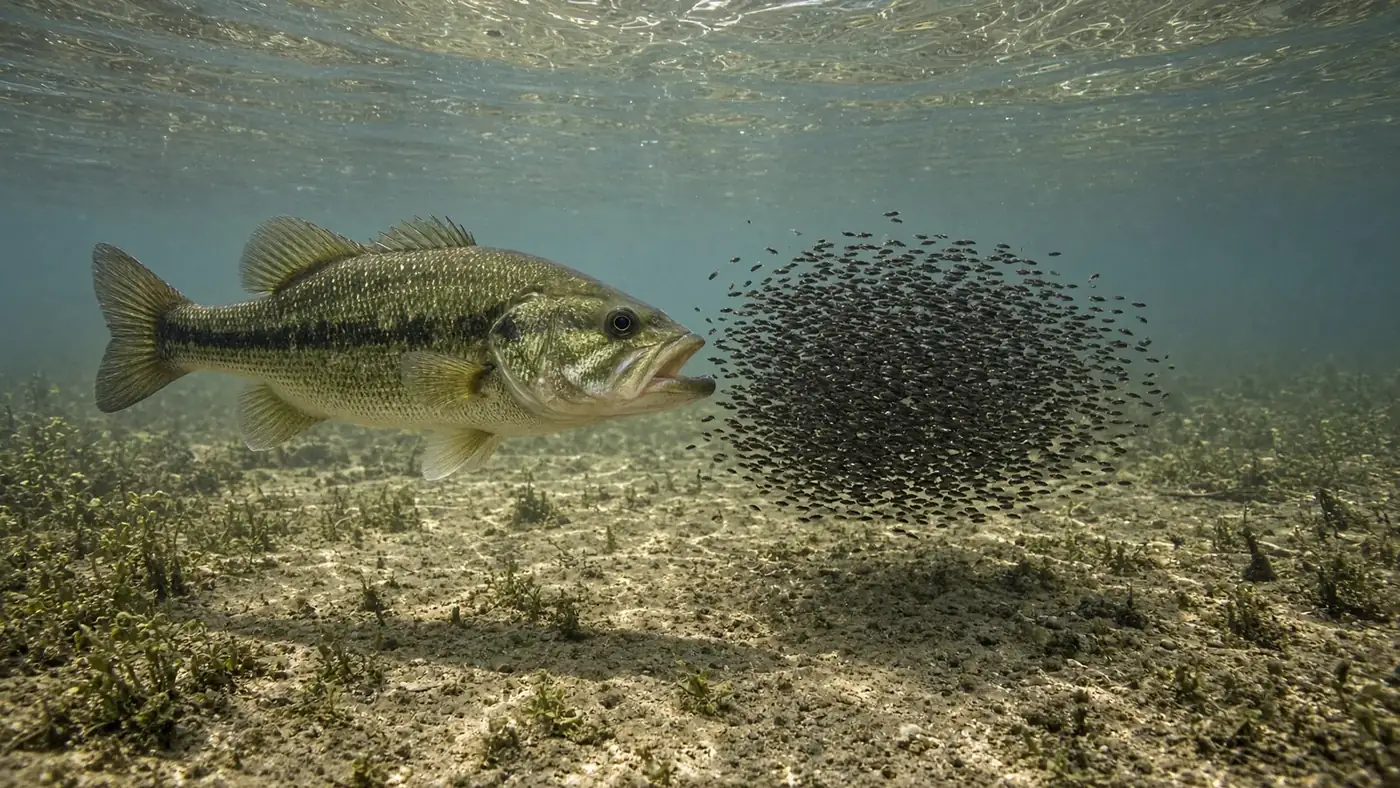
Every spring, the same complaint comes back: the bass were everywhere on the beds, and then they vanished. They didn’t. After the spawn the population splits into two very different fish, living at two very different depths, and each one needs its own approach.
Here’s how post-spawn really works, following the seasonal system in Bass Fishing Mastery.

Bass Fishing Mastery: the complete 86-page bass guide behind this article. See the guide →
When Post-Spawn Happens
The spawn is triggered by water temperature reaching 65 to 75°F, so post-spawn follows the latitude, not the calendar:
| Region | Typical spawn |
|---|---|
| Florida and the Deep South (Alabama, Mississippi, Louisiana) | February to March |
| Mid-South (Tennessee, Arkansas, Georgia, the Carolinas) | March to April |
| Midwest (Missouri, Illinois, Kansas, Ohio) | April to May |
| Great Lakes and Northern states | May to June |
Post-spawn follows right behind, as each area finishes. On a typical mid-latitude lake, it’s the June transition: the water is climbing through the 70s and the fish are moving from the spawning flats toward their summer homes. Check your water temperature, not the date. The water temperature chart shows what comes before and after.
Why Bass Seem to Stop Biting After the Spawn
The females are exhausted. Spawning costs them enormous energy, and once they drop their eggs they leave the flats and scatter into 10 to 20 foot transition zones, where they feed sporadically while they recover. They’re hard to locate and harder to trigger. That’s the fish most anglers are missing.
The males are the opposite. They stay shallow and guard the eggs, then the fry, for up to three weeks. And they strike anything that looks like a threat.
So the lake didn’t die. The easy females from the beds became difficult females in deeper water, and the aggressive males are sitting in 1 to 4 feet waiting for you.
Where the Females Go
Start with the 10 to 20 foot band closest to the coves and flats where the fish spawned. The females retreat from the flats to deeper recovery water.Within that band, favor the places that concentrate bass in any season: points, channel edges and depth breaks, especially where structure meets cover. A point with rock at the base, a laydown at mid-depth and grass at the tip is the kind of spot that produces fish year-round.
Post-spawn females won’t chase much. Put a bait in front of them and keep it there:
- Drop shot: the single most effective technique for pressured fish and bass that won’t chase. It holds a soft plastic at a precise depth indefinitely. Size 1 or 2 hook tied with a Palomar knot, 18 to 24 inches of tag end to the weight, and the lightest weight that keeps bottom contact: 3/16 oz shallow, 1/4 to 3/8 oz deeper. Shake without lifting the weight.
- Shaky head: a finesse worm on a 1/8 to 1/4 oz stand-up head. Drag it to the spot, let it settle, then shake with your wrist, not your arm, so the tail waves without the lure moving forward.
- Ned rig: cast, let it fall completely, shake two or three times, pause 5 to 8 seconds, drag 6 inches, repeat. Fish it slower than feels natural.
Where the Males Are: Fry Balls
This is the easiest bite of the post-spawn period. Look for fry balls: dark, moving clouds of juvenile bass near the surface in 1 to 4 feet of water. The male guarding them is close by, and he’s in defense mode.
That’s an aggression strike, the territorial bite from the three strike types every angler should know. The fish isn’t hungry; he’s protecting his space. What triggers it is a slow, persistent presentation near the threat, not a fast pass.
- Topwater: a popper worked around visible cover with pause-pop-pause, or a walk-the-dog bait with a twitch-twitch-pause cadence.
- Wacky rig: a stick bait hooked through the middle, dropped near the fry and allowed to fall on slack line. Most strikes come on the fall, so watch your line for a sideways jump.
- Swim jig or hollow frog around shallow grass and cover.
The Daily Program in the Transition
In the post-spawn transition, the day splits in two:
- Morning: frog, topwater and swim jig in the shallows, where the males and the first recovered females feed.
- Afternoon: jig and drop shot deeper, in the transition zone.
As the water keeps warming toward the upper 70s, this becomes the classic summer split: shallow for the first and last two hours of light, 15 to 25 feet at midday. For the lures that carry you through that stage, see the best bass lures for June.
Two Post-Spawn Problems, Solved
Fish follow your lure and turn away. They’re interested but not convinced, usually in clear water after too long a look. Pull two levers in this order. First, speed up and add an erratic trigger: a rip, a direction change, a kill-and-restart. If they keep following, downsize and go natural.
You can see the bass and it won’t eat. A visible bass in calm water has usually seen you too; the staring contest is already lost. Leave, mark it, and come back in 20 minutes: stay far back, keep your profile low with the sun in your face, and make one cast well beyond the fish, swimming a small natural bait past it at an angle. One shot. Visible fish reload when the pressure lifts.
Handle Them With Care
Post-spawn fish are worn out, and the water is warming. At water temperatures above 75°F, more than 30 seconds out of the water significantly raises the odds a released fish dies later, even if it swims off looking fine. Unhook with pliers, wet your hands, take one photo, and get the fish back in. Hold it upright in the water, move it gently to push water through the gills, and let go only when it kicks away on its own.
Rules around the spawn vary: some states restrict bass fishing during peak spawn. Check your state’s regulations before you go.
Quick Answers
How long does the post-spawn period last?
Males guard eggs and fry for up to three weeks after spawning. The overall transition then blends into the summer pattern as the water warms through the 70s.
How deep do bass go after the spawn?
Females typically scatter into 10 to 20 foot transition zones. Males stay in 1 to 4 feet guarding fry.
What is the best lure for post-spawn bass?
For the shallow males, topwater, a hollow frog or a wacky rig near the fry. For the recovering females, finesse: drop shot, shaky head or Ned rig in the transition zone.
Tight lines,
— David