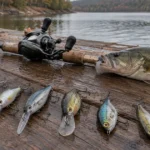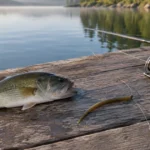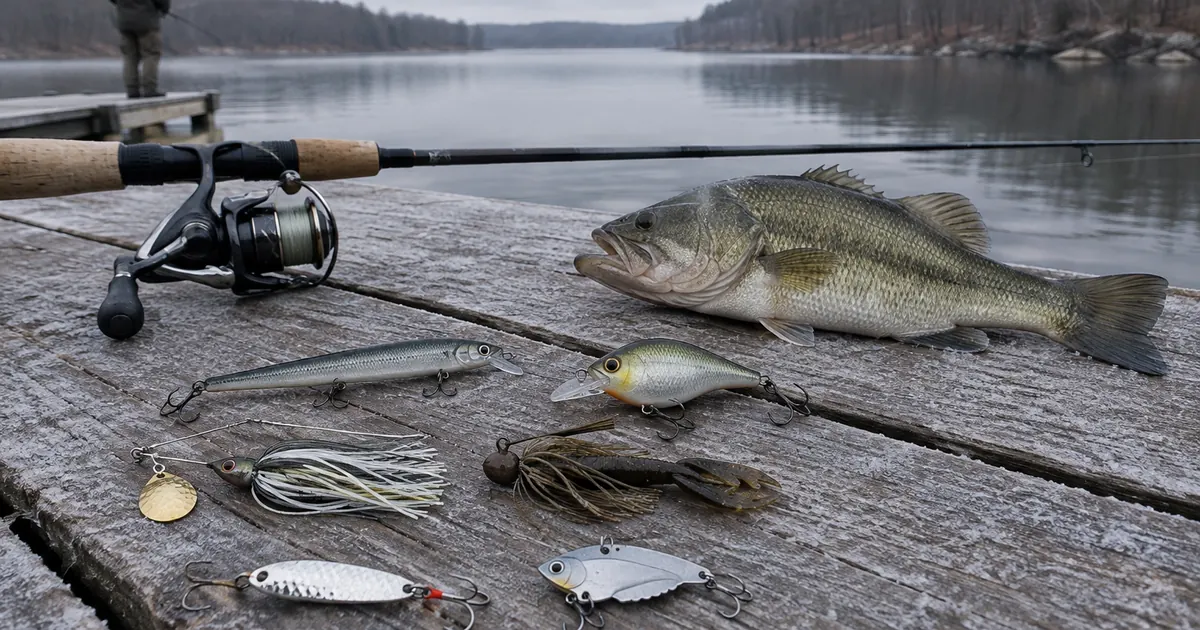
The best bass lures for cold water are the ones that move the least and hang the longest: a suspending jerkbait, a flat-sided crankbait, a slow-rolled Colorado-blade spinnerbait, a finesse jig, a drop shot, a Ned rig, and, once the water falls into the 40s, blade baits and jigging spoons worked straight down. Which one goes on first depends on a single number: the temperature of the water you’re standing on.
“Cold water” isn’t only January. It starts the day your lake slides under 60°F, a date that can be weeks apart from one end of the country to the other, and it comes back in March when bass begin to stage. This guide sorts the cold-water box by that number, using the lure system from Bass Fishing Mastery, so you know what to tie on whether it’s late fall, deep winter or the first warming weeks of spring.
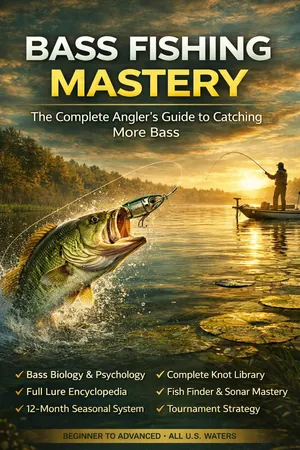
Bass Fishing Mastery: the complete 86-page bass guide behind this article. See the guide →
Sort the Box by Water Temperature
As the water cools, bass metabolism drops, they feed less often, and a cold fish can need 10 to 15 seconds just to move toward a bait and commit. Every lure choice below follows from that: smaller movements, tighter actions, longer pauses.
| Water temp | What bass are doing | Lures that fit | Speed |
|---|---|---|---|
| Falling through 58°F (late fall) | Leaving the shad, sliding toward deeper water | Casting jig, Texas rig, medium-diving crankbait | Slower than September; bites get lighter but bigger |
| 50–60°F (late fall, pre-spawn) | Active but cautious | Flat-sided crankbait, suspending jerkbait, slow-rolled Colorado spinnerbait | Jerkbait pauses of 3–5 seconds |
| 45–55°F | Waking up or shutting down, depending on the month | Deep jigs, slow jerkbaits, drop shot | Jerkbait pauses stretch toward 8–12 seconds below 50°F |
| Below 45°F | Near-dormant, schooled on the deepest stable structure | Jigging spoons, blade baits, slow finesse jigs | Vertical, minimal, painfully slow |
If you only remember one column, make it the last one. A thermometer reading tells you how long a bass is willing to look at a bait before it commits, and the colder the reading, the longer that look gets. Our water temperature chart covers the warmer bands too.
The Hard Baits: Jerkbait, Flat-Side and Spinnerbait
These three are the cold-water search tools. They let you cover a bank or a point while still giving a sluggish fish time to react.
1. Suspending jerkbait
Nothing in the box is built for cold water like a jerkbait. It’s long, slim, and when it’s tuned right it sits motionless in the water column after each jerk, like a baitfish too chilled to swim. Bass eat it on that stop.
- Cadence: jerk, jerk, pause. Let the thermometer set the pause: 3 to 5 seconds between 50 and 60°F, 8 to 12 seconds once you drop under 50°F.
- Tuning: many jerkbaits come out of the package floating up or sinking slightly. Add thin adhesive weight strips to the belly of a floater until it hangs level; perfect suspension matters most in cold water.
- Setup: 6’8″ to 7’0″ medium rod with a moderate-fast action, 10 to 14 lb fluorocarbon (its slight sink helps the bait hang), and a non-slip loop knot so the lure can swing freely.
Our full jerkbait fishing guide goes deeper on rods and pause timing.
2. Flat-sided crankbait
A round crankbait rolls wide. A flat-sided crank has a tight, subtle wobble instead, and that smaller movement looks more natural to a bass in 50 to 60°F water. It’s also a strong pick for pressured fish that have seen every wide-wobbling bait on the lake.
Fish it slower than you would in summer, along the same points and channel swings you’d hit with a jerkbait. On the rod side, the ebook’s shallow-crankbait spec works: 7’0″ to 7’3″, medium power, moderate action, with 12 to 15 lb fluorocarbon. Fiberglass blanks have the extra flex crankbaits like.
3. Slow-rolled Colorado-blade spinnerbait
A Colorado blade is round. It turns slowly and pushes a lot of water, so you can crawl it near the bottom and it still thumps. That makes it the spinnerbait for cold temperatures and for stained water, where bass find food with their lateral line more than their eyes.
Two small adjustments help. Bend the wire arm to a narrower angle so the blade rides lower and the bait stays down on a slow retrieve. And run it on a 7’0″ to 7’3″ medium-heavy rod with 15 to 17 lb fluorocarbon. More on blades and trailers in our spinnerbait guide.
Cold-water speed rule: slow your retrieve by 30 percent, then slow it another 30 percent. If it still feels fast, cut it in half.
The Bottom Baits: Finesse Jig, Drop Shot and Ned Rig
When the hard baits stop drawing strikes, or the fish are holding tight to the bottom, switch to baits you can keep in one spot.
4. Finesse jig
The finesse jig is the compact one, 1/8 to 1/4 oz. Its job list is short: cold lakes, clear lakes, and the bluebird day after a front. It belongs on a spinning rod spooled with 8 to 12 lb fluorocarbon.
The trailer is where most anglers get it wrong in winter. Cold, finicky fish want a small craw trailer around 3 inches, with a slow fall and little action. Save the big beaver baits for warm water and heavy cover, and keep the trailer length in proportion to the head. Our jig fishing guide has the full trailer system.
5. Drop shot with a finesse worm
The drop shot holds a soft plastic at one depth for as long as you want, which is exactly what a cold bass that won’t chase needs. Tie a size 1 or 2 drop shot hook with a Palomar knot, leave 18 to 24 inches of tag below it, and use the lightest weight that keeps contact: 3/16 oz shallow, 1/4 to 3/8 oz deeper. Nose-hook a finesse worm and shake it in place without lifting the weight.
On the deepest winter schools, in 30 to 50 feet or more, go to a heavier weight and a shorter leader, with braid as the main line so you can still feel the bottom, plus a 10 lb fluorocarbon leader at the bait.
6. Ned rig and shaky head
Both keep a small plastic in the strike zone with almost no movement, which is the whole idea in cold water.
- Ned rig: a buoyant soft plastic on a 1/15 to 3/16 oz mushroom head, so the bait stands up off the bottom between moves. The rhythm: bottom contact, a couple of light shakes, a pause of 5 to 8 seconds, then a short drag of about half a foot before starting over. If that tempo feels lazy, it’s about right.
- Shaky head: a stand-up head of 1/8 to 1/4 oz carrying a small finesse worm. Keep it pinned to the bottom and work only the rod tip with little wrist flicks; the worm quivers upright while the lure itself never moves forward.
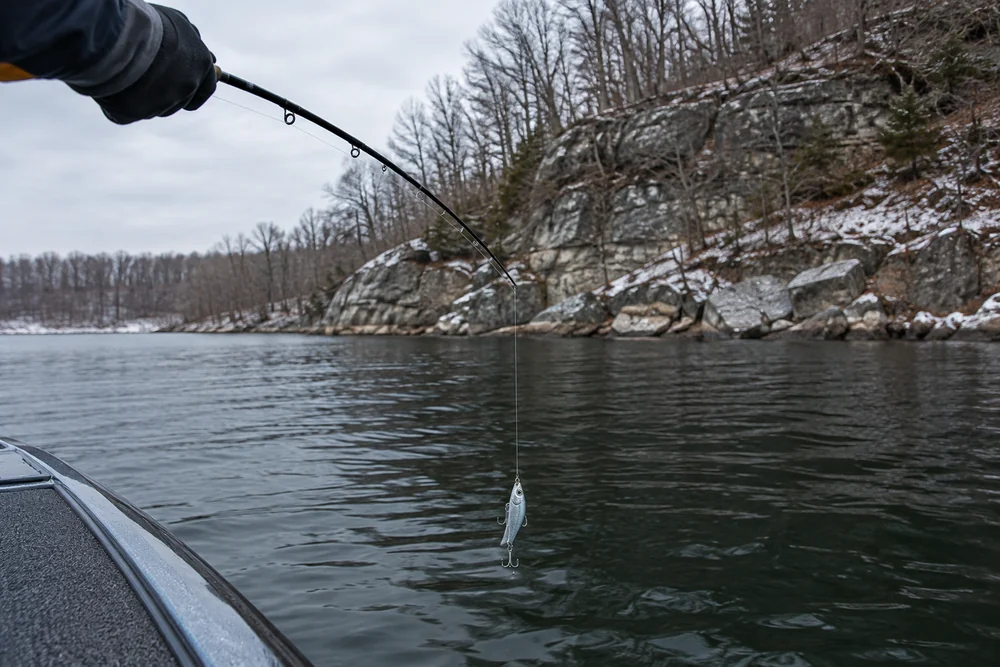
The Deep-Winter Baits: Blades, Spoons and the Glide Bait
Below 45°F, bass are close to dormant and packed together on the deepest stable structure: 20 to 40 feet on many Southern reservoirs, shallower on Northern lakes. Look for creek channel bends, main lake humps and steep bluff walls.
7. Blade baits and jigging spoons
These are vertical tools. Once your electronics put you over the school, drop a blade bait and jig it straight up and down over the fish, or lift a jigging spoon and let it flutter back down. The ebook names them as the top choices for January and keeps blade baits in the lineup from December through February. If you need help finding the school in the first place, see winter bass on sonar.
8. Glide bait
A glide bait is a hard-bodied lure that slides side to side on a sweep-and-pause retrieve. Most run 4 to 6 inches, and the ebook flags them as extremely effective in clear water and in winter. Keep one for clear lakes when bass ignore the finesse baits.
When to Throw Each One: Late Fall to Early Spring
The same eight baits rotate through the cold months in a predictable order.
| Month | Water usually reads | First bait | Backup |
|---|---|---|---|
| November | Low 60s down to 50°F | Medium-diving crankbait | Jig or Texas rig |
| December | Mid 50s to mid 40s | Drop shot | Finesse jig, then a blade bait |
| January | Upper 30s to upper 40s | Jigging spoon or blade bait | A slow jig |
| February | Low 40s to low 50s | Slow finesse jig | Drop shot or blade bait |
| March | 50 to 60°F | Jerkbait | Colorado spinnerbait, swimbait |
Two timing rules make every lure on this list work better:
- Fish the warm hours. In winter, the best window is noon to 4 PM, after the sun has warmed the surface a little and nudged bass metabolism up with it.
- Stay on a school once you find it. When you catch one cold-water bass, there are usually more in the same small area. Work it thoroughly before you move.
December is the swing month: depending on the day, fall lures or winter lures can work. Our December bass fishing and winter bass fishing guides cover where the fish sit in those months.
Real-World Scenario: A 52-Degree December Afternoon
Here’s how the system plays out on a typical early-winter day, built from the ebook’s seasonal chapters. You launch at 11 AM. The surface reads 52°F, the shad that bass chased all fall have thinned out, and the sky is clear after a front.
- Start where the season says. At 52°F the fall shad pattern is ending, so skip the backs of the creeks and go to deeper structure close to them: a channel bend or a point that drops fast.
- Search with the jerkbait first. Make long casts along the point with 3 to 5 second pauses, and stretch them toward 8 to 12 seconds if the fish only follow.
- Slow down when it stays quiet. After a few honest casts per spot, switch to a finesse jig with a small craw trailer and drag it down the same slope.
- Go vertical if your sonar marks a school. Hover over it with a drop shot or a blade bait.
- Plan the best hour. Save your most productive water for the noon to 4 PM window, when the sun has warmed the surface slightly.
There’s no promise of a big day in cold water. Bites are fewer, and the payoff is that the fish you do catch are often good ones.
Quick Answers
What is the best lure for bass in cold water?
The suspending jerkbait is the most versatile, because it can hang still in front of a cold bass for 8 to 12 seconds below 50°F. Below 45°F, blade baits and jigging spoons fished vertically over a school take over.
What water temperature is cold for bass fishing?
Treat anything under 60°F as cold-water fishing. Between 50 and 60°F bass are cautious but active; under 45°F they are near-dormant and schooled deep.
Do bass bite in cold water?
Yes. They feed less often and in short windows, usually the warmest part of the day, so slow your presentation and fish the midday hours.
How slow should you fish for bass in cold water?
Slower than feels right. Cut your normal retrieve by about 30 percent, then cut it again, and lengthen every pause. If the bait feels slow, it is probably still too fast.
The best bass lures for cold water all share one trait: they give a slow fish time to decide.
Tight lines,
— David