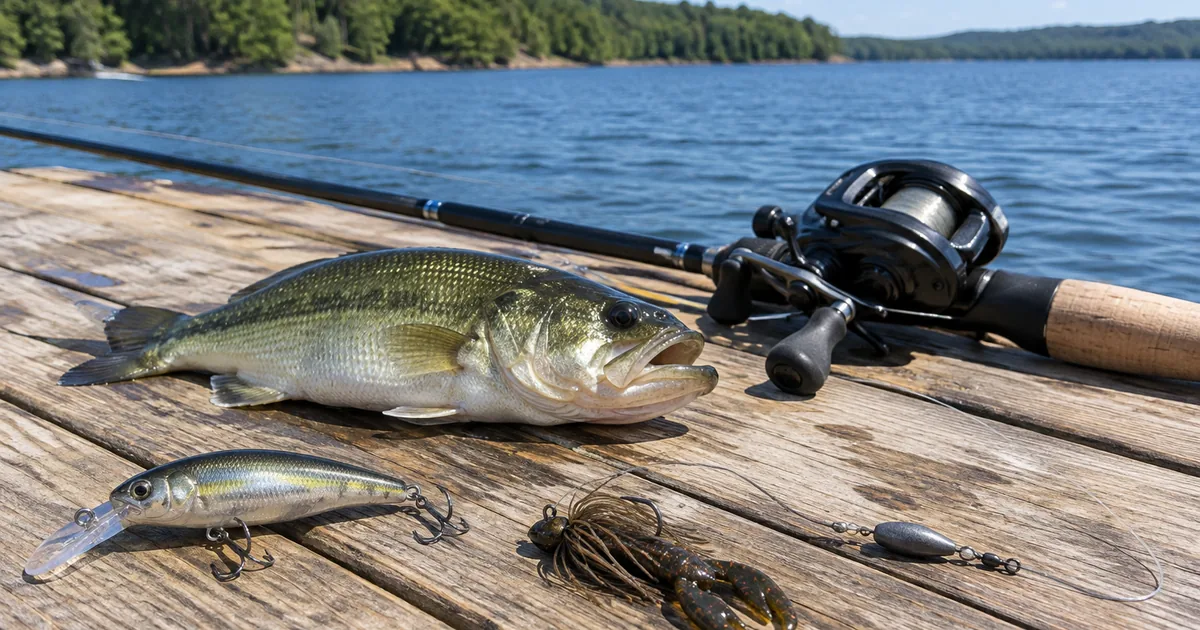
Deep water bass fishing comes down to three decisions: knowing when the fish have left the shallows, finding the structure they’re using, and picking a lure that gets down to them and stays there. Bass go deep in two main seasons, for opposite reasons: in summer to escape midday heat and light, in winter to pack into the most stable water in the lake.
Each depth band has its own tools. This guide sorts them by depth and season, with every spec taken from Bass Fishing Mastery.
Bass Fishing Mastery: the complete 86-page bass guide behind this article. See the guide →
When Bass Live Deep
“Deep” isn’t a fixed number. It depends on the month, the hour and the weather. The book puts bass in deeper water in these situations:
- Summer midday (July and August). Bass feed shallow early and late, roughly the first and final two hours of light, then slide down to cooler structure. On most lakes, that means 15 to 25 feet along channel edges, ledges and humps from about noon to 5 PM.
- Winter (December through February). Bass school tightly on the deepest structure that holds a stable temperature. On Southern reservoirs that usually means 20 to 40 feet; up north, less. They feed in short bursts, usually during the warmest hours, from around noon into mid-afternoon.
- Early post-spawn (June). Worn-out females scatter into transition zones of 10 to 20 feet and feed only now and then.
- Pre-spawn trophies. Before the spawn, the heaviest females hold deepest of all the staging fish. Look for them where channel edges outside big spawning coves reach 15 to 20 feet.
- After a cold front. When the barometer jumps, bass drop deep and hold tight. The fix: downsize, slow way down and fish the deepest water available.
- Bright, calm, high-pressure days. Fish retreat deep at midday, and finesse baits in deep water become the play until the light fades.
And if you keep catching small bass, the book’s advice is to go deeper, or to look for lone pieces of complex cover. Big bass seldom feed alongside a crowd of small ones.
Why the thermocline matters
Summer layers many lakes. The thermocline appears on sonar as a horizontal band at the depth where warm surface water meets colder water below. Bass often suspend just above that band. Below it, oxygen runs too low for comfortable fish activity, so don’t spend time there. The thermocline is your floor: it tells you how deep “deep” can go on your lake this week.
How to Find Deep Bass
Deep fish bunch up. Big stretches of the lake hold nothing, while a handful of spots hold most of the bass.
The four structures to check first
| Structure | What it is | Why bass use it |
|---|---|---|
| Ledges | An abrupt drop from a flat into a channel, sometimes 15 feet of depth over 10 horizontal feet | Summer schools stack on Southern reservoir ledges and feed on passing shad |
| Humps | A rise in the bottom that never reaches the surface | Bass treat it like an underwater island: rest on top, feed on the deep water around it |
| Creek channels and channel bends | The original streambed, flooded when the reservoir filled | Bass travel these routes between shallow feeding flats and deep holding water; outside bends cut deepest |
| Main lake points | Underwater ridges running out from the bank | The most consistent bass location in fresh water; primary points produce best |
The best deep spot stacks features: say, a pile of rock where a sunken point ends, right above a creek channel. That convergence holds fish in several seasons.
Read the screen, not the surface
Scout at home first. A contour-mapping app, a state agency contour PDF, or historical satellite imagery taken at low water will reveal the old creek beds, roads and timber lines that now sit far below the surface. Mark them as waypoints before you launch.
On the water, your fish finder does the rest:
- Bottom hardness. A thick, dark or doubled bottom line means rock, gravel or clay: good bass habitat. A thin, fuzzy line means mud or silt.
- Arches. Several arches at the same depth mean a school.
- Bait. Baitfish clouds next to structure mean bass are almost certainly close. When bait hangs above and bass sit below it, target the fish’s depth rather than the bait’s.
- Side imaging. It covers 50 to 150 feet off both sides, so you see brush and rock without driving over the fish.
For summer ledges, idle at low speed down the 18 to 25 foot depth line with your eyes on the screen for fish and bait. Across many reservoirs in the South and Midwest, largemouth schools set up where creek channels break, at 18 to 22 feet. Mark each productive one on GPS and link your best ledges into a route you can run all season.
In winter the search is slower and more precise, and the fishing turns vertical: you sit over the school and drop baits straight down. That workflow is covered in how to find winter bass on sonar.
Lures and Rigs by Depth Band
Rod and line specs come from the book’s rod matrix and line chart. A dash means the book gives no specific spec for that bait.
| Depth band | Season | Lure or rig | Rod | Line |
|---|---|---|---|---|
| 6 to 12 ft | Fall below 58°F, pre-spawn points | Medium-diving crankbait | — | — |
| 12 to 25 ft | June through August, midday | Deep-diving crankbait (6XD class) | 7’4″–7’8″ MH, mod-fast | Mono, 10–12 lb |
| 15 to 25 ft | Summer ledges, pre-spawn channel edges | Football jig, 1/2 to 1 oz | 7’0″–7’3″ H, fast (casting jig spec) | — |
| 15 to 25 ft | Summer midday | Carolina rig, 1/2 to 1 oz weight | 7’6″–8’0″ MH, mod-fast | 17 to 20 lb fluoro or 30 lb braid main, 12 to 17 lb fluoro leader |
| 15 to 25 ft | Summer midday, trophy hunting | Big swimbait | 7’6″–8’0″ H or XH, mod-fast | Fluoro, 17–25 lb |
| Any depth (fish on the screen) | Year-round, especially winter | Drop shot, 1/4 to 3/8 oz | 6’10″–7’2″ ML spinning, fast | Fluoro, 8–12 lb; deep: 30 lb braid with 10 lb fluoro leader |
| 20 to 40 ft | January and February | Blade bait or jigging spoon, fished vertically | — | — |
| Deep structure | December through February | Finesse jig, 1/8 to 1/4 oz | Spinning | 8 to 12 lb fluorocarbon |
6 to 12 feet: the medium diver
A medium-diving crankbait is the standard reservoir crank. It covers points, mid-depth humps and channel edges, and it’s the depth band bass use in transition: fall fish that slip off the flats once the water drops below 58°F, and pre-spawn fish on points as the water climbs toward 65°F.
12 to 25 feet: deep cranks, football jigs and big swimbaits
Deep-diving crankbaits run 12 to 25 feet and are the primary tool for deep structure bass from June through August. Three details make them work:
- Cast long. The lure needs distance to reach full depth. The book’s deep-crank rod is a longer 7’4″ to 7’8″ stick, and longer rods cast farther.
- Use mono. The book puts deep cranks on 10 to 12 lb monofilament. The slight stretch keeps trebles from tearing out, and it lets the lure run deeper.
- Hit bottom. Every cast should bump bottom or cover. If a crank comes back clean every time, it isn’t reaching the zone. Hold the rod low and angled sideways to keep the bait down.
Football jigs weigh 1/2 to 1 oz. The football-shaped head stays upright on rock, so you can crawl it across ledges, gravel bars and rock piles. The book pairs it with a large craw or a swimbait trailer. Jig selection, trailers and skirts get their own page in our jig fishing guide.
Big swimbaits round out the midday box and are the book’s top trophy category: fewer bites, bigger fish.
Boat position matters on deep structure. On a ledge or channel edge, position the boat so you cast down into the channel and work the bait back up over the lip. On a point, sit in deep water off the tip and cast up the point, then work deeper.
15 feet and beyond: the Carolina rig and the drop shot
The Carolina rig searches. A 1/2 to 1 oz tungsten weight, a glass bead and a swivel sit ahead of an 18 to 36 inch fluorocarbon leader and a floating soft plastic. Drag it with slow sweeps along points, flats and channel edges, with longer leaders in deeper water. Once a spot produces, switch to a Texas rig (1/2 to 3/4 oz for depth) and pick it apart.
The drop shot closes on fish you can see. It parks a soft plastic at a fixed depth, which makes it the book’s top choice for bass on the screen that won’t chase. Use 1/4 to 3/8 oz deeper. Past 30 feet, go heavier with a shorter leader and braided main line for feel.
20 to 40 feet in winter: blades, spoons and slow finesse
Cold deep water has its own short list:
- Blade baits, worked straight up and down above the school.
- Jigging spoons, lifted so they flutter up, then allowed to fall back. Below 45°F, spoons are the book’s pick.
- A slow finesse jig or a drop shot with a finesse worm for fish that won’t move far.
Speed is the variable that matters most. A fish in cold water can take 10 to 15 seconds just to decide. Whatever speed seems slow to you, halve it. And one winter bass usually means a school of around 20 nearby, so stay and grind the spot before moving.
Gear That Works at Depth
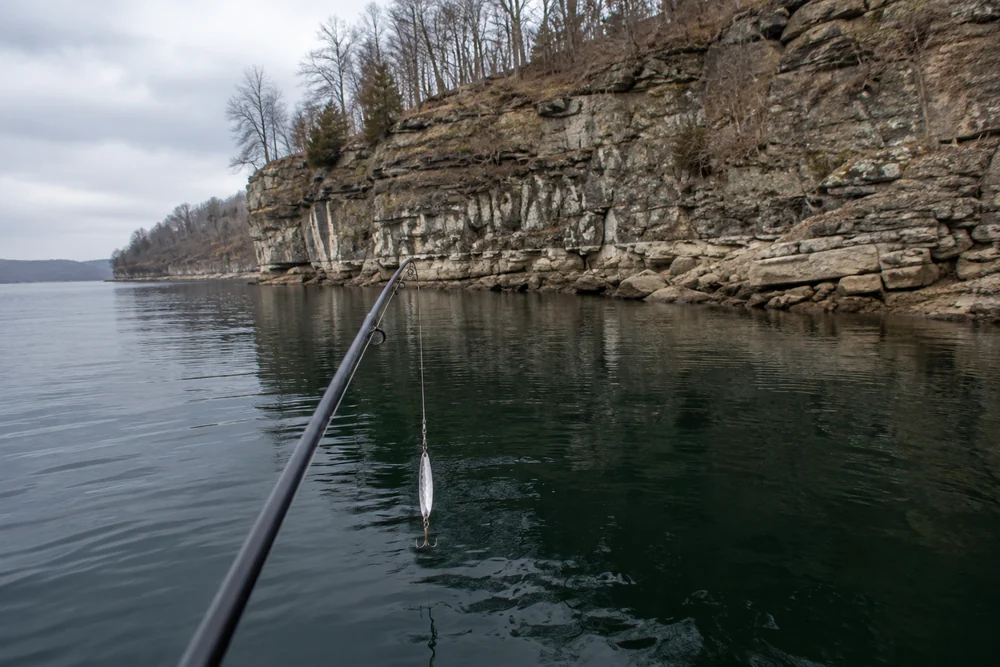
- Longer rods. Rods of 7 feet and up give longer casts and better leverage on hooksets.
- Braid for feel, fluoro near the bait. Zero-stretch braid transmits bites from far below. Fluorocarbon sinks and is nearly invisible, so it makes the right leader.
- Tungsten weights. They’re smaller than lead for the same weight and give more sensitive bottom contact. On a Carolina rig, tungsten against a glass bead also makes a click that can draw fish.
- Sharp hooks and a set drag. Check points after dragging rock, and keep the drag around 25 to 30 percent of what the line is rated for.
Real-World Scenario: The Late-Summer Shutdown
This one comes from the book’s situational playbook. You’ve had a good midsummer run. Then, almost overnight in late summer, half the lake quits producing.
The read: the water below the thermocline has run out of oxygen. The usable part of the lake is now just the upper layer, plus the zones the wind keeps mixed and oxygenated.
The play: stop fishing the dead depths. Work 25 feet and shallower, with the 15 to 25 foot zone as your core. Add weed beds, which produce oxygen, wind-exposed banks and inflows with moving water. When fall turnover mixes the lake again, the deep map opens back up. Until then, fish where the bass can actually breathe.
Depth only matters when fish can live there. For the full summer lineup, shallow and deep, see the best bass lures for summer.
Quick Answers
How deep do bass go in the summer?
On most lakes, summer bass hold in 15 to 25 feet at midday, near channel edges, ledges and humps. On a lot of Southern and Midwestern reservoirs, the schools sit on channel ledges at 18 to 22 feet.
How deep are bass in the winter?
On Southern reservoirs, usually 20 to 40 feet; Northern lakes hold them shallower. Look for schools on steep bluffs, main-lake humps and creek channel bends, where the temperature stays steady.
What are the best lures for deep water bass?
In summer: a deep-diving crankbait, a 1/2 to 1 oz football jig, a Carolina rig and a big swimbait. In winter: blade baits, jigging spoons, a slow finesse jig and a drop shot.
How do you fish deep water for bass?
Find the structure first with a contour map and your fish finder: ledges, humps, channel bends and points. Then pick a bait that reaches and holds that depth, slow down, and in winter fish vertically over the school: that’s the core of deep water bass fishing.
Tight lines,
— David