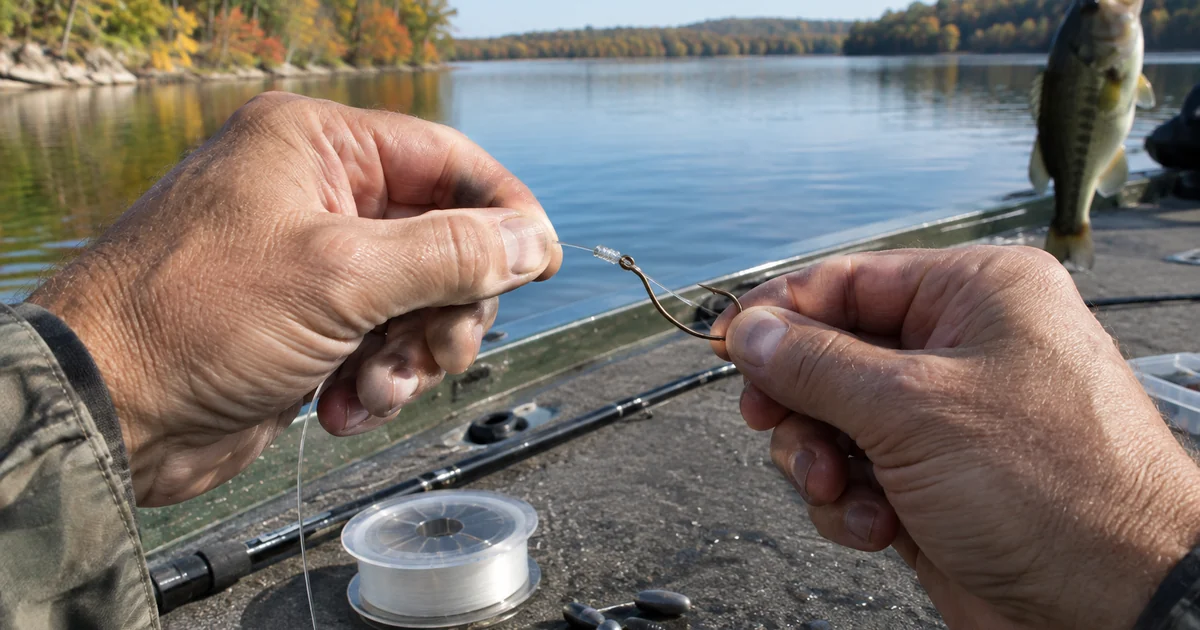
Six bass fishing knots cover every rig in this sport: the Improved Clinch, the Palomar, the Non-Slip Loop, the Alberto, the Double Uni, and the wacky rig O-ring method. Learn those six and you will never stand on the bank wondering how to connect something.
That list is shorter than most anglers expect, and there is nothing missing from it. What separates anglers is not how many knots they know. It is whether they tie the right one for the line in their hand, and whether they tighten it properly.
That second half matters more than it sounds. Most lost fish are lost at the knot, and most knot failures come from knots that were never properly cinched rather than from knots that were formed wrong. Below is the full system from Bass Fishing Mastery, knot by knot, plus the pre-trip routine that fixes the three free things no lure can make up for.
Bass Fishing Mastery: the complete 86-page bass guide behind this article. See the guide →
The Six Knots at a Glance
| Knot | What it joins | Why you tie it |
|---|---|---|
| Improved Clinch | Line to a hook or lure eye | The fundamental all-purpose knot. 95%+ strength, best on monofilament and fluorocarbon |
| Palomar | Line to a hook or lure eye | Near 100% strength. Works on all line types, especially braid. The preferred knot for drop shot and finesse |
| Non-Slip Loop | Line to a hard bait | Leaves a permanent loop so the lure swings freely, which dramatically improves its action |
| Alberto | Braided main line to a fluorocarbon leader | The most reliable braid-to-leader connection, and slim enough to pass cleanly through the guides |
| Double Uni | Any two lines | The simpler alternative when the Alberto feels like too much. Joins similar or different diameters |
| Wacky O-ring | Nothing, technically | Not a knot at all, but the rigging step that makes a stick bait last 10 to 20 casts instead of 1 or 2 |
How to Tie Each One
Improved Clinch Knot
Start here. This is the knot you will tie more often than all the others combined.
- Thread 6 inches of line through the eye, and hold the eye in one hand.
- Wrap the tag end around the main line 5 to 7 times. Use 5 wraps on heavy line, 7 on light line.
- Pass the tag end through the small loop sitting just above the hook eye.
- Pass the tag end back through the large loop you just created.
- Wet it thoroughly, then pull both the main line and the tag end to tighten. Trim.
Strength runs 95% and up, and it is at its best on mono and fluorocarbon. If you only ever learn one knot, learn this one.
Palomar Knot
The strongest option on the list, and the one to reach for with braid.
- Double 6 inches of line and pass the doubled loop through the hook eye.
- Tie a simple overhand knot in the doubled line, and do not tighten it.
- Pass the entire hook back through the resulting loop.
- Wet thoroughly and pull the tag end and main line at the same time to tighten.
Strength is near 100%. It is the preferred knot for every finesse presentation, and it is not optional on a drop shot: the Palomar is what lets you leave an 18 to 24 inch tag end below the hook and then pass that tag back up through the hook eye so the hook stands at 90 degrees to the line. Without that angle, hook penetration suffers. There is more on the full rig in drop shot fishing for bass.
Non-Slip Loop Knot
This is the knot that buys you lure action for free, and it is a must-know for any hard bait.
- Measure 8 to 10 inches of tag, tie a loose overhand knot there, and leave the loop open.
- Run the tag through the lure eye, then bring it back into that open overhand.
- Take four or five turns with the tag up the standing line, staying above the loop.
- Come back down into the overhand, entering it the same way you did in step two.
- Wet everything, hold the loop at the size you want, and draw the standing line tight.
The result is a permanent loop that lets the lure swing freely instead of being locked to a tight knot. That matters most on topwater, on swimbaits, and on the suspending hard baits covered in jerkbait fishing for bass, where the lure’s side-to-side freedom is the presentation. If you fish a walking bait, tie this knot before you blame the lure, and see how the cadence in topwater bass fishing changes.
Alberto Knot
The professional standard for joining braided main line to a fluorocarbon leader. The Alberto produces a slim connection that passes cleanly through rod guides without hanging up, which is exactly what a leader knot has to do.
This one is best learned from a video tutorial rather than from written steps. Practice it at home with scrap line until you can tie it in under 60 seconds, because you will be tying it on the water with wet hands and a fish schooling 30 feet away.
Double Uni Knot
A versatile, reliable method for joining two lines of similar or different diameters. Use it for braid to mono or braid to fluoro when the Alberto feels too complex. It is two Uni knots tied facing each other and then pulled together, and the result is a small, strong connection point that works for joining any two line types.
The Wacky Rig O-Ring Method
Not technically a knot, but an essential rigging skill. Slide a small rubber O-ring around the center body of a stick bait using a homemade tool: cut a pen tube to 1 inch, stretch the O-ring around it, then push the stick bait through the tube to slide the ring on. Hook through the O-ring rather than through the soft plastic body.
Each bait now lasts 10 to 20 casts instead of 1 or 2. On a day when the wacky fall is the only thing getting bitten, that is the difference between fishing the pattern all afternoon and running out of baits by lunch.
Matching the Knot to the Line
Anglers love to blame line visibility for everything. Meanwhile the error that actually costs fish goes untouched: a line whose type was never suited to the job in hand. No-stretch braid tearing trebles free. Sinking fluorocarbon drowning a topwater. Stretchy mono on a long hookset.
Match the line to the technique, not to paranoia, and the knot choice follows automatically.
| Technique | Line type | Pound test |
|---|---|---|
| Texas rig, open water | Fluorocarbon | 12-15 |
| Texas rig, heavy cover | Braid | 40-65 |
| Drop shot | Fluorocarbon | 8-12 |
| Ned rig and finesse | Fluorocarbon | 6-10 |
| Carolina rig | Braid main line with fluorocarbon leader | 17-20 braid, 12-17 leader |
| Crankbait, deep | Monofilament | 10-12 |
| Topwater | Monofilament or braid | 14-17 or 50 |
| Hollow frog | Braid | 50-65 |
Read that table and the knots sort themselves. Fluorocarbon and mono tied straight to the hook or lure: Improved Clinch, or Palomar when you want the extra strength. Braid tied straight to a frog hook: Palomar. Braid to a fluorocarbon leader on a Carolina rig or a finesse spinning setup: Alberto, or Double Uni. A hard bait that needs to swing: Non-Slip Loop.
Three line properties are behind all of it. Monofilament stretches 25 to 30%, which absorbs shock, and it floats, which is why it belongs on topwater and on deep crankbaits where that stretch keeps you from pulling trebles. Fluorocarbon stretches 12 to 15%, sinks, resists abrasion and is nearly invisible underwater because its refractive index is close to water’s. Braid has zero stretch for maximum sensitivity and enormous strength for its diameter, but it is highly visible, which is why it usually runs to a fluorocarbon leader. The full breakdown sits in bass fishing gear for beginners.
Tie 3 or 4 fresh knots at home before every trip, under good lighting. Line weakens over time and with use, so retie any knot that has been fished for more than one hard session.
The Two Checks That Matter as Much as the Knot
A perfect knot on a dull hook still loses fish. Two checks belong in the same ninety seconds.
Hook sharpness. Set the point on your thumbnail, tip leaning back around 45 degrees, and pull it toward you. A point still worth fishing bites into the nail and resists, and you can feel that tiny grab. A worn one skates across and grabs nothing. Anything that skates gets filed or gets replaced. The tool is a tungsten carbide hook file; the dose is three to five passes down each side of the point, held at that same angle. Leave the ordinary metal file in the garage, because it cuts far too fast and eats away steel the hook needs. Rock, concrete and hard structure wreck points, so inspect after any session spent on them.
Drag setting. The number to hit is 25 to 30 percent of what your line is rated to break at. On 15 lb fluorocarbon that lands at 4 to 5 lbs of pressure; on 30 lb braid, 7 to 9 lbs. A handheld scale turns the setting into a measurement instead of a guess. Clip it to the hook, raise the rod to the angle you would really fight a fish at, roughly 45 degrees, take up the slack, then pull steadily until the spool gives. The front knob on a spinning reel and the star wheel on a baitcaster both move that number: turn either until the spool starts slipping where you want it. Repeat the check each trip, because washers pack down as you use them and the setting wanders.
One more piece of housekeeping, once a year: respool your reels at the start of every season. Old line develops memory, loses strength and costs you bites.
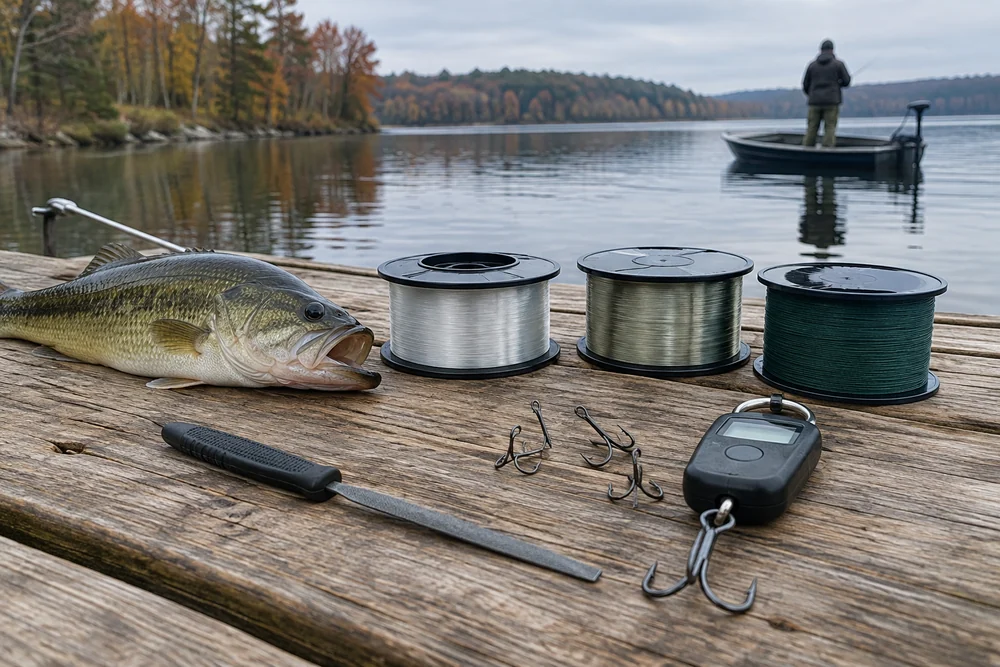
Real-World Scenario: The Pre-Trip Ninety Seconds
Real-world scenario, straight out of the deadliest-mistakes list in the guide. An angler has the right lure, the right spot and the right season, and still loses the two best fish of the day. Nothing in the tackle box was the problem. The guide is blunt about where those bass went: a spool screwed down too tight, a point that had gone soft, and a knot pulled shut dry account for more lost fish than every bad lure choice put together.
Ninety seconds of work fixes all three, before the boat leaves the trailer or your boots hit the bank:
- Scale the drag. Pull line against a handheld scale and set the slip point at the percentage above.
- File every point, then run the thumbnail test on each one.
- Wet each knot before you close it, and cut off anything that worked hard last trip and tie it fresh.
Free things, all three. The fish notice them more than they notice your lure color. If you want the other nine errors that quietly cost fish, they are collected in the most common bass fishing mistakes.
Quick Answers
What is the best all-purpose bass fishing knot?
The Improved Clinch Knot. It holds 95% or more of your line’s strength, it is at its best on monofilament and fluorocarbon, and it ties fast enough to redo on the water without thinking about it.
Is the Palomar knot better than the Improved Clinch?
It is stronger, at close to 100%, and it is the better choice on braided line and for every finesse presentation, including the drop shot. The Improved Clinch is still the faster knot for general mono and fluorocarbon work.
Which knot do I use for braid to a fluorocarbon leader?
The Alberto knot. It is the most reliable braid-to-leader connection and slim enough to pass through the rod guides. Use the Double Uni instead if the Alberto feels too fiddly.
Why does my knot keep breaking?
Almost always because it was not tightened properly rather than tied wrong, so wet every knot before cinching it. Old line is the other culprit, so respool each season and retie after any hard session: these bass fishing knots are only as strong as the line and the ninety seconds you give them.
Tight lines,
— David