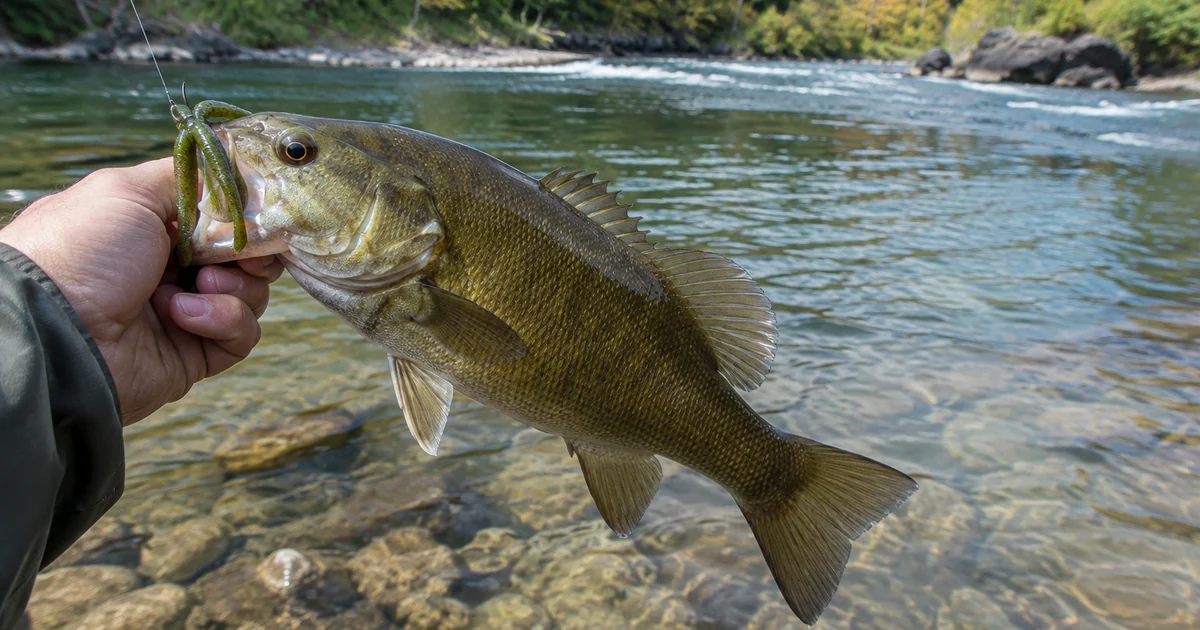
To catch smallmouth bass, fish clear, cool, rocky water, think like a crawfish, and go light. Smallmouth live in highland rivers, streams and clear reservoirs. They’re more selective than largemouth and more technically demanding, and pound for pound they’re the strongest fighter in the bass family.
Three tools do most of the work: the tube, the drop shot and the Ned rig, all on light spinning gear. In rivers, add one skill that beats any lure: reading the current seam. Here’s the full system from Bass Fishing Mastery, from where smallmouth live to how to set up each rig.
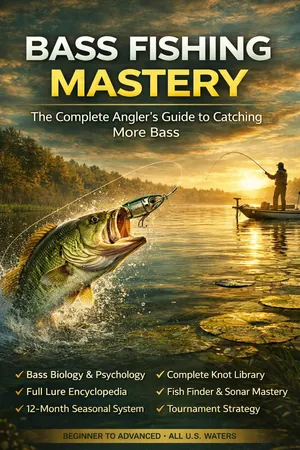
Bass Fishing Mastery: the complete 86-page bass guide behind this article. See the guide →
Where Smallmouth Live
Smallmouth want three things: clear water, cool water and rock. That points you to:
- Highland rivers and streams. Hundreds of thousands of miles of productive smallmouth rivers exist from Maine to California, many with very light fishing pressure.
- Clear reservoirs. Deep, clear lakes such as Shasta Lake in California hold smallmouth alongside spotted bass, and the clear water calls for finesse.
- The Great Lakes and their rivers. The finest smallmouth fishing in the world, covered below.
On many lakes, largemouth, smallmouth and spotted bass all coexist, each in a slightly different niche. Identifying which one you’re after changes where you look, what you throw and how you present it. If you’re coming from largemouth, start by forgetting the weedy, warm backwaters: the smallmouth is on the rock. For the largemouth side of the family, see how to catch largemouth bass.
The Smallmouth Tackle Setup
Light gear for most situations. The ebook’s river baseline is a 6’10″ to 7’ medium spinning rod, a 2500 spinning reel and 10 to 12 lb fluorocarbon. The exception: river largemouth in heavy cover still get standard baitcasting gear.
| Technique | Rod | Line | Weight / hook |
|---|---|---|---|
| Tube (river) | 6’10″ to 7’ medium spinning | 10 to 12 lb fluorocarbon | 3/16 to 1/4 oz internal tube jig head |
| Drop shot | 6’10″ to 7’2″ medium-light, fast, spinning | 8 to 12 lb fluorocarbon | Hook size 1 or 2; weight 3/16 oz shallow, 1/4 to 3/8 oz deeper |
| Drop shot (deep) | Same | 30 lb braid + 10 lb fluorocarbon leader | Heavier weight, shorter leader |
| Ned rig | 6’8″ to 7’0″ light or medium-light, fast, spinning | 6 to 10 lb fluorocarbon | 1/15 to 3/16 oz mushroom head |
| Craw (river) | 6’10″ to 7’ medium spinning | 10 to 12 lb fluorocarbon, one class up around wood and rock | Texas-rigged, 3/8 oz |
Why fluorocarbon? Its refractive index is close to water, so it’s near-invisible, and it’s the line for clear water. That’s smallmouth water by definition. One river caveat: go up one line class around wood and rock. Current plus cover plus a fish using the flow against you punishes light line, and abrasion resistance matters more there than anywhere.
Tubes: The Premier Smallmouth Lure
If you only carry one smallmouth bait, make it a 4 to 5 inch tube. The hollow body with tentacle tails, rigged on an internal tube jig head, falls in a spiraling, crawfish-like motion. Smallmouth are crawfish specialists, so that fall is exactly what they’re built to eat.
How to fish it:
- Rig it on a 3/16 to 1/4 ounce internal jig head for river work.
- In current, cast upstream of the target and let the tube drift down naturally, the way a dislodged crawfish would arrive.
- Keep bottom contact. The goal is a bait that tick-tick-ticks downstream. Too light and you lose contact; too heavy and it anchors while the food drifts past. Carry three weights and let the river choose.
- Watch the line. Most river strikes show as the line ticking, pausing or sliding sideways during the drift, not as a thump.
Color: in clear water, the ebook’s chart says natural (green pumpkin, watermelon). For a crawfish match, the chart’s craw colors are brown/orange and watermelon/red. Tubes work for largemouth on rocky banks too.
Drop Shot: Precision in Clear Water
With the sinker on bottom and the plastic hovering above it, the drop shot keeps a bait at one depth for as long as you leave it there. The ebook rates it the top technique for clear water, for pressured fish and for fish that show on your electronics but won’t run down a lure. It’s a smallmouth staple, and the go-to on the Great Lakes waters and clear Western reservoirs alike.
The rig itself is the standard one: hook tied on with a Palomar knot, an 18 to 24 inch tag below it for the sinker (the lightest that holds bottom), and the plastic nose-hooked so it lies flat. For smallmouth, that plastic can be a finesse worm, a small minnow bait or a Ned body. The step-by-step tie is in winter bass on sonar. Work it with gentle wrist shakes that leave the sinker where it is; when a fish loads the rod, reel down and sweep.
Drop shot in current. Holding straight over the fish rarely works in a river. Set up or cast upstream of the spot and let the current carry the rig down to it, with enough extra weight to keep ticking bottom. Fishing 30 to 50+ feet down? Go heavier on the sinker, shorten the leader and switch the main line to braid so you can still feel what’s happening.
Ned Rig: The Bait That Works When Nothing Else Does
The Ned rig is a small ElaZtech bait (the Z-Man TRD is the common one) on a 1/15 to 3/16 ounce mushroom head. Since the plastic floats, the tail rises off the bottom every time you stop. No season, water color or weather shuts it off completely, and it keeps getting bit behind a cold front, when most baits go dead.
For smallmouth rivers, the ebook puts it on gravel bars. The cadence:
- Cast near structure and let it fall completely.
- Shake it 2 to 3 times.
- Leave it still for 5 to 8 seconds.
- Move it 6 inches with a slow drag, then start over.
Fish it slower than feels natural. The bluebird-day version of this approach is in bass fishing after a cold front.
River Smallmouth: Fish the Seams
Moving water makes bass more predictable, not less. A river bass lives by one equation: calories in must beat calories out. So it holds in slow water and eats from fast water, nose into the current, letting the river deliver food.
Find the seam
A seam is the visible line where fast water meets slow water. The fish holds on the slow side; the fast side delivers insects, crawfish and stunned baitfish. Where seams form:
| Current break | Where the fish sits |
|---|---|
| Boulders and big rocks | The slow pocket behind the rock and the seams down both sides |
| Bridge pilings | Both side seams and the downstream pocket; the shaded seam is premium |
| Points and gravel bars | Along the long seam off the tip, working downstream |
| Eddies | The eddy line first, then the eddy itself |
| Creek mouths and inflows | The seam where flows meet, then the eddy pockets |
| Outside bends | Deepest water, undercut bank, fallen trees: the biggest residents |
Before your first cast, stand still for two minutes and count the seams. Most anglers find two. The river usually offers six or eight.
Present it like the river would
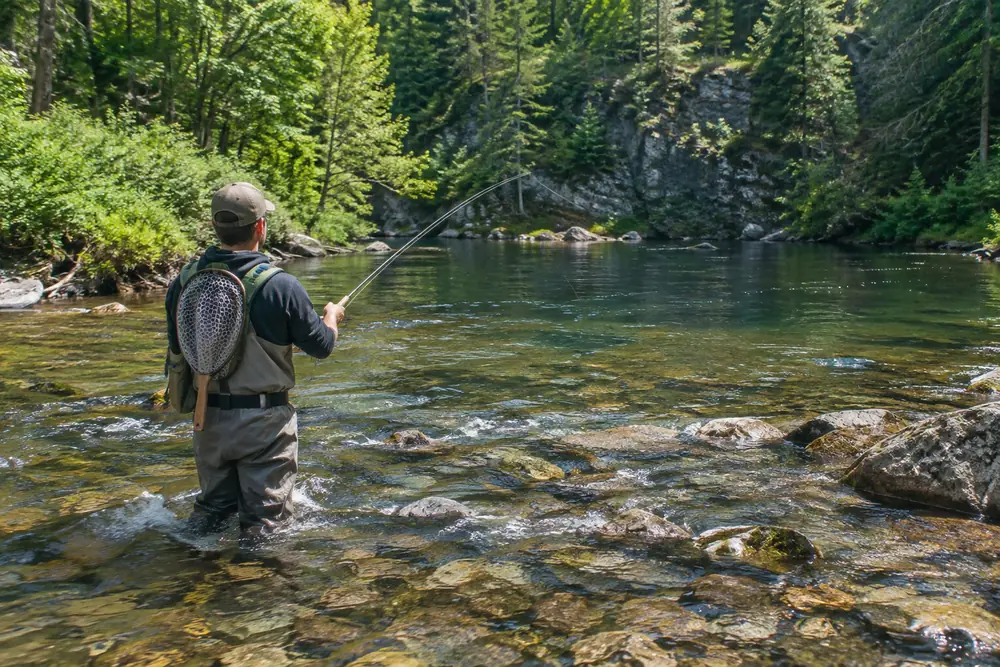
- Approach from downstream. River fish face upstream, essentially always. You come up behind them.
- Cast upstream of the target, never at it, and let the current carry the bait in.
- Manage the drift. Keep just enough tension to feel the bait. When the drift passes the target, let it swing below and hang a beat: the swing-and-hang triggers a surprising number of strikes.
- Make the first cast count. One spooked fish alarms the hole.
Creeks: the wading game
Small streams are the same system in miniature: pool, riffle, run. Bass hold in the pool and the head of the run, facing the riffle. The head of the pool, where the riffle’s current enters, is the prime seat, and the biggest fish usually owns it. Wade upstream, slowly, staying low. A single light rod, tubes, small soft plastics and a little topwater are all you need. Creek smallmouth punch far above their weight.
River seasons
Winter fish stack in the deepest, slowest pools, often outside bends and deep eddies: go slow, on the bottom, small. High spring water pushes fish out of the main flow to flooded banks, backwaters and creek mouths. In summer low flow, fish closer to the current than any other season, with dawn and dusk ruling. In fall, follow the bait to creek mouths and the first pools of tributaries. And watch the gauge: rising water pushes fish shallow toward the banks, falling water pulls them back toward the channel. For the temperature side, use the bass water temperature chart.
The Great Lakes: Smallmouth Kingdom
The Great Lakes and their tributary rivers are cold, clear and oxygen-rich, and they produce smallmouth of extraordinary size.
| Water | What makes it special | Best season | Where and how |
|---|---|---|---|
| Lake Erie (OH-PA-NY) | Arguably the finest smallmouth lake in the world; fish averaging 4 to 5 lb, regular 6+ lb catches | Late May through October | Fall tube and drop shot pattern |
| Lake St. Clair (MI-Ontario) | Largemouth and smallmouth; smallmouth on deep rock | Spring through fall | Deep rock for smallmouth |
| Niagara River (NY) | World-class smallmouth in moving water; 5 to 7 lb fish caught regularly | Late spring through fall | Tubes and drop shots; current seams hold fish year-round |
| St. Lawrence River (NY) | Enormous fish in clear, moving water | June through October; fall produces some of the largest fish | Drop shot and tubes in current |
Notice the pattern: tubes and drop shots, again and again, and current seams on the rivers. The system above is the Great Lakes system.
Size Limits and Release
Smallmouth size limits vary by state and sometimes by water. The ebook notes a common range of 12 to 15 inches in most states, but the only reliable source is your state’s official fishing regulations booklet. Read it for any new water, and measure doubtful fish.
For release in a river, hold the fish underwater, horizontal, facing into the current so water flows through the gills. Don’t let go until it kicks firmly on its own.
Quick Answers
What is the best lure for smallmouth bass?
The tube. Its spiraling, crawfish-like fall matches what smallmouth eat most, and it’s the premier smallmouth lure. The drop shot and Ned rig are close behind.
Where do smallmouth bass hide in rivers?
On the slow side of current seams: behind boulders, around bridge pilings, off points and gravel bars, in eddies and along outside bends. They face upstream, waiting for the current to deliver food.
What line is best for smallmouth bass?
Fluorocarbon, because it’s near-invisible in clear water. River tubes and craws get 10 to 12 lb, the Ned rig 6 to 10 lb, and the drop shot 8 to 12 lb.
What is the size limit for smallmouth bass?
It depends on your state and the specific water, commonly 12 to 15 inches. Always check your state’s current regulations booklet before you keep a fish.
Tight lines,
— David