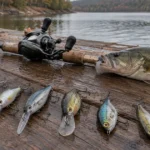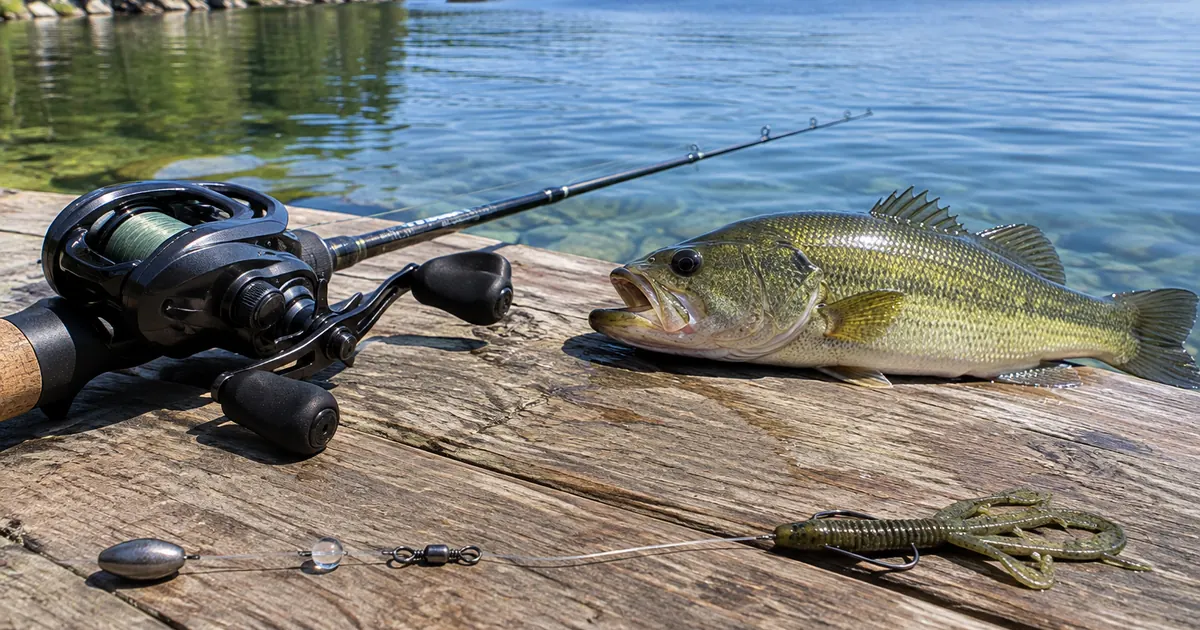
The Carolina rig for bass is a weighted bottom rig with a long leader separating the weight from the hook, and its job is covering deep structure fast until you find fish. Weight, bead, swivel, leader, hook, floating plastic, in that order, dragged slowly along points, flats and channel edges.
The separation is the entire idea. The weight rides the bottom and telegraphs what it is crossing, while the buoyant soft plastic floats 18 to 36 inches behind and above it, rising on every pause and settling on every drag. No other bottom rig shows a bass that much of a profile at that depth.
It is a search tool first and a catching tool second. Here is the complete build, the retrieve mechanics, and the structure to point it at, all from the deep-water system in Bass Fishing Mastery.
Bass Fishing Mastery: the complete 86-page bass guide behind this article. See the guide →
What the Carolina Rig Does That a Texas Rig Cannot
A Texas rig puts the weight against the bait. Pegged or free-sliding, the two arrive together and work the same few inches of water column. That is exactly what you want in heavy cover and when you are picking a spot apart.
The Carolina rig separates them, and three things follow.
- It covers water. A long cast and a slow sweep drags the whole rig across a wide swath of bottom, so you can audit a point or a flat in a handful of casts instead of thirty.
- It elevates the bait. The plastic floats off the bottom at a height you choose, which keeps it visible to fish holding slightly above the bottom instead of buried in it.
- It makes noise on purpose. Tungsten knocking into a glass bead creates a distinctive click that can attract bass from outside the range they would see the lure.
The honest way to use it: cover water systematically with the Carolina rig until something eats, then switch to a Texas rig and work that specific area thoroughly. Find with one, finish with the other.
The Seven-Step Setup
| Component | Spec |
|---|---|
| Main line | 17 to 20 lb fluorocarbon, or 30 lb braid |
| Weight | Tungsten bullet weight, 1/2 to 1 oz, with 3/4 to 1 oz the working range for real depth |
| Bead | 6mm glass bead, not plastic |
| Swivel | Barrel swivel, size 8 to 10 |
| Leader | 18 to 36 inches of 12 to 17 lb fluorocarbon |
| Hook | 2/0 to 3/0 offset EWG |
| Bait | Floating or buoyant soft plastic, rigged Texas-style |
Build it in this order:
- Spool up with 17 to 20 lb fluorocarbon or 30 lb braid. If you run braid as a main line, the fluorocarbon leader is doing the invisibility work down at the bait.
- Slide the tungsten bullet weight onto the main line. Tungsten is preferred over lead here for a specific reason beyond sensitivity: its knock against rocks creates the distinctive click that attracts fish. Tungsten is also significantly smaller than lead for the same weight, which means better bottom contact feel.
- Add the 6mm glass bead. Glass, not plastic, because glass against tungsten creates the loudest click. The bead does a second job as well: it protects your knot from being hammered by the weight.
- Tie on the barrel swivel with an Improved Clinch knot. Barrel swivels in the size 8 to 12 range are essentially a Carolina rig item in a bass angler’s tackle, and the swivel is what stops the whole rig from twisting your line on the retrieve. The Improved Clinch steps, and the rest of the knots worth knowing, are in bass fishing knots.
- Attach 18 to 36 inches of 12 to 17 lb fluorocarbon leader to the other eye of the swivel.
- Tie a 2/0 to 3/0 offset EWG hook to the end of the leader.
- Rig a floating or buoyant soft plastic Texas-style. A lizard, a floating worm, or a creature bait with appendages that wave freely are all correct. A curly-tail worm in the 5 to 6 inch range is another natural fit, because the tail works on every inch of the drag.
Leader Length Is the Dial You Actually Adjust
The leader is not a fixed number you set once. It is the control that decides how high your bait rides above the bottom, and it is the first thing to change when the rig is not producing.
- 18 inches creates a subtle presentation, with the bait tracking close to the bottom.
- 36 inches creates a dramatically elevated, highly visible bait.
- Longer leaders in deeper water. The deeper you fish, the more height helps the bass find the bait.
Think about what the fish are doing. Bass pinned to the bottom on a hard, clean ledge want the short leader. Fish holding a few feet off the bottom, or suspended just above a summer thermocline, want the long one. Change the leader before you change the bait.
Vary leader length based on the bait height you want, not out of habit. It is the fastest adjustment on the rig and the one most anglers never make.
Rod, Reel and Line
This rig asks for the longest rod in the bass lineup, and for good reason: you are moving a heavy weight, a long leader and a hook through deep water on one slow sweep, and you need the length to do it.
| Spec | Recommendation |
|---|---|
| Rod length | 7’6″ to 8’0″ |
| Power | Medium-heavy |
| Action | Moderate-fast |
| Line | 17 to 20 lb, fluorocarbon or braid main with a 12 to 17 lb fluorocarbon leader |
The moderate-fast action matters more than it looks. A full fast-action tip would rip the rig off the bottom on the sweep instead of dragging it, and would struggle to move that much hardware on a long-distance hookset.
The Retrieve, Step by Step
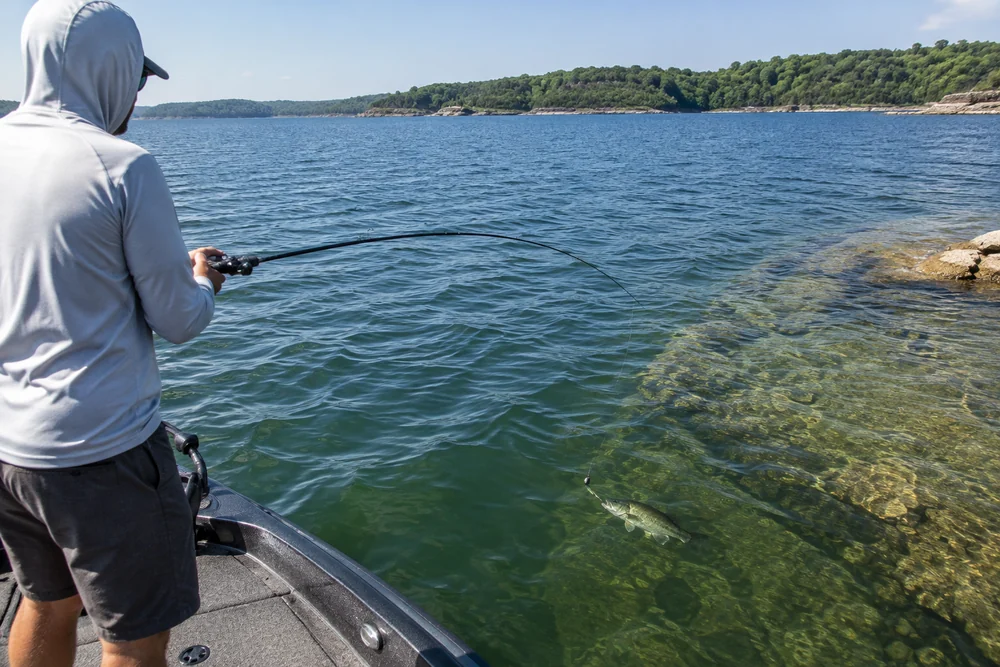
The motion is a slow sweep, not a lift and drop.
- Make a long cast. Distance is part of the rig’s value, so do not short-change it.
- Let everything settle until the weight is on the bottom.
- Sweep the rod slowly from 9 to 11 o’clock, dragging the entire rig forward along the bottom.
- Reel up the slack as the rod returns to 9 o’clock.
- Repeat, and pay attention to what the weight is telling you about the bottom.
Through that cycle, the floating lure rises on each pause and settles on each drag. That rise-and-settle is the action, and it happens whether or not you add anything. Over-working the rod does not improve it.
Because the bass is eating something 18 to 36 inches behind the sinker, the bite usually arrives as added weight or a shift in tension, not as a sharp thump. Crank the slack out, let the fish settle into the rod, and only then sweep up. Striking at that first faint tick is the standard bottom-rig error: the bait comes away before the point ever reaches the hard roof of the mouth.
Where to Fish It
The Carolina rig belongs on structure, and three types carry it.
Points. Points are the most consistent and versatile bass location in freshwater fishing. Primary points extending from the main lake body are the most productive, while secondary points inside coves and creek arms hold less-pressured fish. Sit off the end of it in deep water, throw up onto the shallow crown — higher than you think the fish are holding — and fan each following cast a little deeper, so a single boat position sweeps the whole depth range. Points carrying multiple cover types at different depths produce all year. There is a full breakdown in fishing points for bass.
Flats and channel edges. Old creek channels are the highways bass use to move between shallow feeding areas and deep holding water, and the outside bends of those channels, where the current originally carved deepest, are particularly productive. A flat next to a channel is prime Carolina rig water because you can drag a long way and stay in the zone the whole time.
Ledges. A ledge is the lip where a flat quits and falls away into the old channel; on the sharpest of them you lose 15 feet of water inside 10 feet of forward travel. In summer, massive schools of bass stack on Southern reservoir ledges, feeding on passing shad. Humps and submerged islands work the same way and get far less traffic, because they are invisible without a fish finder or a detailed contour map.
Depth and time of day pair up predictably in summer. From noon to 5 PM, the deep program takes over: football jig, deep-diving crankbait, big swimbait and Carolina rig, in 15 to 25 feet, on ledges, humps and creek channel edges. The jig side of that lineup is covered in jig fishing for bass, and the full midday rotation in the best bass lures for summer.
Real-World Scenario: Late Summer, Half the Lake Quits
Real-world scenario from the situational playbook in the guide. It is late summer, and water that produced all month goes cold overnight across half the lake.
The read: everything beneath the thermocline has run out of oxygen. What remains habitable is the band above it, plus any water the wind or a current is putting air back into. Those fish were not sulking, they relocated.
The play: write off the dead half of the water column. Work the 15 to 25 foot band and everything shallower than it, and inside that band favor three things — weed beds, which manufacture oxygen all day, banks taking the wind, and any inflow pushing moving water. Turnover in the fall stirs the lake back together and hands the deep structure back.
That 15 to 25 foot band is exactly the Carolina rig’s window, and the rig is the efficient way to audit it. Drag the ledges, humps and channel edges inside that depth range, and give each piece of structure your best 3 to 5 casts from the best angle before you move. If the deep crankbait is covering the same water faster on a given day, run it alongside, as described in crankbait fishing for bass.
Quick Answers
How long should a Carolina rig leader be?
Between 18 and 36 inches. An 18 inch leader keeps the bait close to the bottom for a subtle look, a 36 inch leader lifts it into a dramatically more visible position, and longer leaders work better the deeper you fish.
What weight do you use on a Carolina rig?
A tungsten bullet weight of 1/2 to 1 oz, with 3/4 to 1 oz being the working range for genuine deep water. Tungsten beats lead here because its click against rocks and the glass bead attracts fish.
What rod is best for a Carolina rig?
A 7’6″ to 8’0″ medium-heavy rod with a moderate-fast action. The length moves the heavy rig on a long sweep, and the moderate-fast tip drags it rather than ripping it off the bottom.
When is the Carolina rig the right choice?
When you need to cover deep structure and find fish: points, flats, channel edges, ledges and humps, especially in the 15 to 25 foot midday summer band. Once a bite comes, mark the spot and work it over with a Texas rig, because the Carolina rig for bass is built to locate fish rather than to pick a spot clean.
Tight lines,
— David