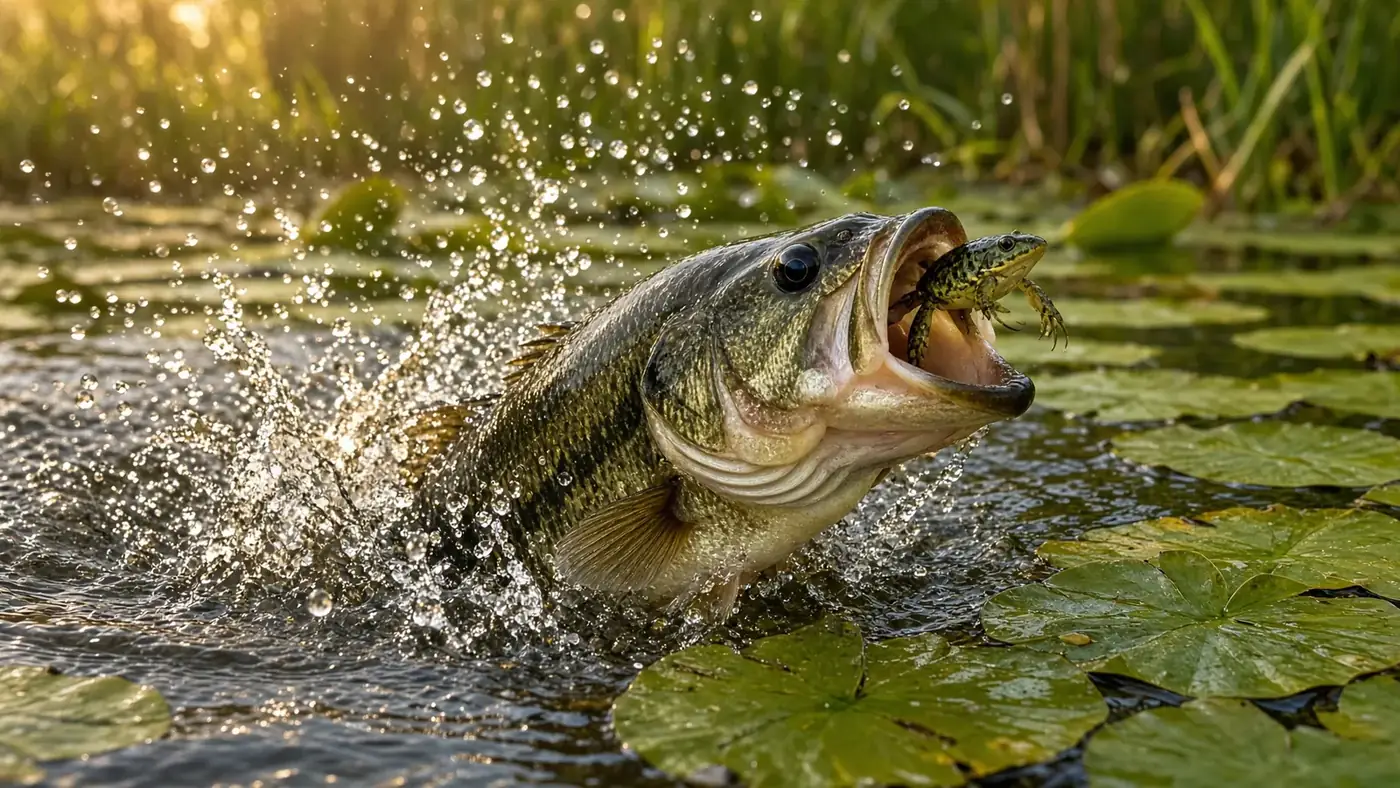
June is the month bass fishing changes gears. The water climbs through the 70s, the last fish come off the beds, and by the end of the month much of the population is sliding toward deep summer structure. On most lakes, June is shallow to transitional: frogs, topwater and swim jigs in the morning, jigs and drop shots in the afternoon.
That’s exactly why the four lures in the title belong together. Each one owns a depth zone, and in June you’ll need all of them in the same day. Here’s how to rig and fish each one, with the specs from Bass Fishing Mastery.
Bass Fishing Mastery: the complete 86-page bass guide behind this article. See the guide →
The June Day, Zone by Zone
| Time | Depth | Lures |
|---|---|---|
| Dawn to 9 AM | 1 to 6 ft: grass edges, docks, rocky banks | Hollow frog, walk-the-dog, buzzbait |
| 9 AM to noon | 4 to 12 ft: mid-depth structure, shaded banks | Spinnerbait, medium crankbait, swim jig, wacky rig |
| Noon to 5 PM | 15 to 25 ft: ledges, humps, channel edges | Football jig, deep crankbait, Carolina rig, drop shot |
| 5 PM to dark | 2 to 8 ft: the morning areas plus grass edges | Topwater, spinnerbait, swim jig |
Early in the month, some males are still guarding fry balls in 1 to 4 feet, and they’ll hit almost anything that threatens them. By late June, the midday fish are on deep structure.
1. The Hollow Frog
When the shallow grass mats up, the frog is the tool. It walks weedless across surface vegetation where every treble-hooked bait would load up with salad.
Setup
- Rod: 7’0″ to 7’3″, heavy power, fast action
- Line: 50 to 65 lb braid. Zero stretch is what drives the hook home through the mat.
- Baits: hollow-body frogs like the BOOYAH Pad Crasher or Zoom Horny Toad
How to fish it
Walk it over open vegetation with the same side-to-side twitch as a spook, just slower, or pop it with sharp pulls if it has a cupped face. Work the holes and pockets in the mat, where bass hold and ambush whatever passes.
The hookset
When a bass blows up on the frog, don’t set immediately. Wait until you feel solid weight, usually one to two seconds, then drive the hook with a powerful side sweep. If the fish misses, stop the frog dead and wait. Bass often come back.
The one-line grass rule: when the grass is above your bait, use a single hook or stay out. Treble hooks in matted grass are donations.
2. The Wacky Rig
The wacky rig is the June bait for fish that won’t commit to anything fast. A stick bait hooked through the center falls horizontally while both ends flutter, a motion no other lure makes.
Three ways to rig it
- Weightless: the standard. Falls horizontally at a natural speed. Best in 1 to 8 feet.
- Nail-weight wacky: a 1/32 to 1/16 oz nail weight in the head end gives a nose-down fall. Better for 6 to 15 feet.
- Wacky jig head: heavier and faster falling for deeper fish.
Slide a rubber O-ring around the middle of the bait and hook through the ring. The bait lasts 10 to 20 casts instead of 1 or 2.
How to fish it
Cast near visible structure and let it fall on slack line. Watch the line: a sideways jump is a bite on the fall. If nothing happens, let it sit 3 to 4 seconds, give one gentle twitch and let it fall again. Most strikes come on the fall.
Colors: natural green pumpkin or watermelon in clear water, darker or brighter like black or watermelon red in stained water.
3. Crankbaits: One Per Depth
Crankbaits are engineered to run at a specific depth. In June you move down the ladder as the day and the month go on:
| Crankbait | Depth | Where it shines in June |
|---|---|---|
| Square bill | 0 to 4 ft | Rocks, laydowns, stumps, shallow docks: deflection triggers reaction strikes |
| Medium diver | 6 to 12 ft | Points, mid-depth humps, channel edges |
| Deep diver | 12 to 25 ft | Summer ledges, the main deep-structure tool from June to August |
Setup
- Shallow cranking: 7’0″ to 7’3″ medium rod with moderate action, 12 to 15 lb fluorocarbon.
- Deep cranking: 7’4″ to 7’8″ medium-heavy, moderate-fast rod, 10 to 12 lb monofilament. The mono’s slight stretch keeps you from pulling the trebles out, and the thinner line helps the bait dig deeper.
How to fish them
- Bump the bottom or the cover on every cast. If you never touch anything, you aren’t fishing deep enough.
- Keep the rod low and to the side: the bait runs deeper and the hookup angles are better than with a high rod tip.
- Fish parallel to docks and grass edges whenever you can. Parallel casts get more bites than perpendicular ones.
A crankbait that runs to one side won’t produce. Tune it: if it runs left, bend the line tie slightly right with needle-nose pliers, and the reverse if it runs right. Small adjustments only.
4. Deep-Water Baits for the Midday Fish
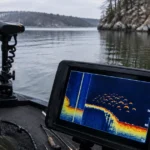
By late June the midday fish are on ledges, humps and channel edges in 15 to 25 feet. On many Southern and Midwestern reservoirs, huge schools stack on creek-channel ledges in 18 to 22 feet, and a single productive ledge can give up 50 fish in a day. Find them by idling slowly along the 18 to 25 foot contour and watching your sonar for fish and bait.
Football Jig
A 1/2 to 1 oz jig with a football-shaped head stays upright on hard, rocky bottom. Drag it slowly along ledges, rock piles and gravel bars, with a large craw or swimbait trailer.
Carolina Rig
The rig for covering deep flats and points:
- 3/4 to 1 oz tungsten bullet weight on the main line
- A glass bead (glass against tungsten gives the loudest click)
- A barrel swivel, size 8 or 10
- An 18 to 36 inch fluorocarbon leader, 12 to 17 lb
- A 2/0 to 3/0 offset EWG hook with a floating soft plastic like a lizard or creature bait
Long cast, slow sweep of the rod from 9 to 11 o’clock, reel up the slack, repeat. When you find fish, switch to a Texas rig and pick the spot apart.
Deep Drop Shot
The drop shot is the most effective answer for bass you can see on your electronics that won’t chase a moving lure: it holds the bait at their depth for as long as you want. The deeper you go, the heavier the weight and the shorter the leader, with 30 lb braid as the main line for feel and a 10 lb fluorocarbon leader for invisibility at the bait.
The Thermocline Warning
Late in the month, many lakes stratify. On your sonar, the thermocline shows up as a horizontal band where warm and cool water meet. Bass often suspend just above it. Don’t fish below it: the oxygen is too low for comfortable fish activity.
Your June Box
- 1 hollow frog, braid, heavy rod
- Stick baits with O-rings for the wacky rig
- 1 square bill, 1 medium diver, 1 deep diver
- 1 football jig with a craw trailer
- A Carolina rig and a drop shot
- 1 walk-the-dog topwater and a buzzbait for the low-light windows
Coming from May? See the best bass lures for May. Heading into the heat of July and August? Here’s what to throw when summer gets tough.
Quick Answers
What is the best bass lure for June?
There isn’t one, because June bass live at two depths. A hollow frog or topwater for the shallow morning bite and a football jig, deep crankbait or drop shot for the midday fish on deep structure.
How deep are bass in June?
Shallow, 1 to 6 feet, early and late in the day. At midday, especially late in the month, 15 to 25 feet on ledges, humps and channel edges.
What line should I use for frog fishing?
50 to 65 lb braid on a heavy, fast-action rod. It has the strength and zero stretch you need to set the hook through the grass.
Tight lines,
— David