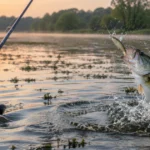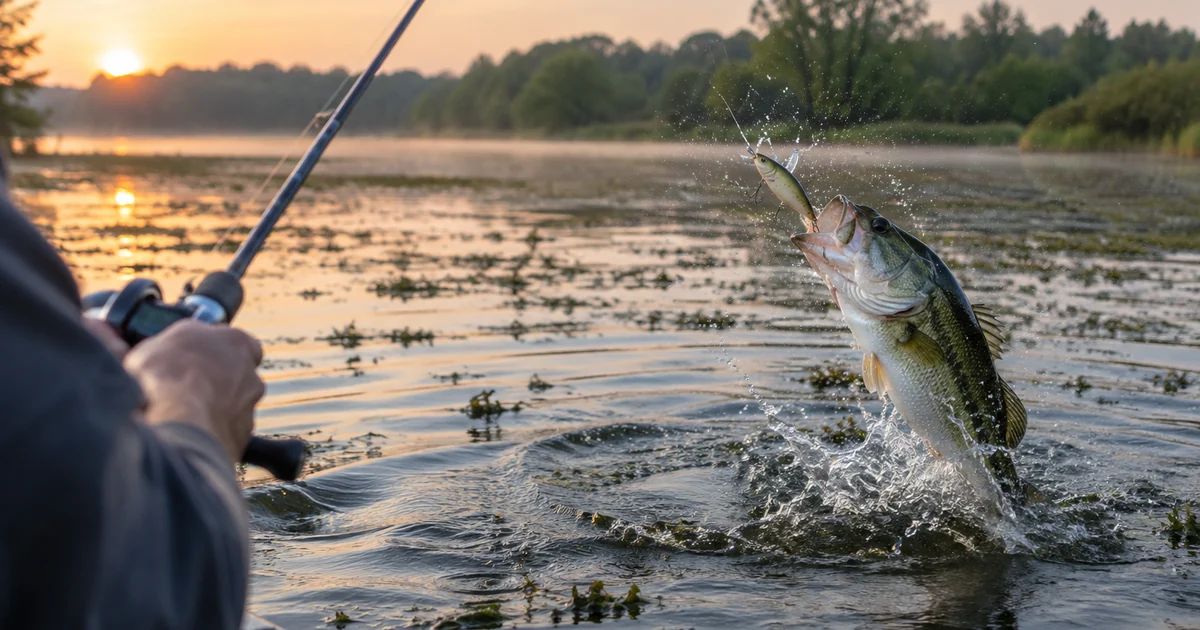
Topwater is the most visual bite in bass fishing, and the one anglers lose most often. The blow-up happens, the angler jerks, and the lure flies back at the boat. Almost every missed surface fish comes down to the setup or the hookset, not the lure.
So this guide goes type by type through the topwater bass lures that matter: what each one does, how to work it, and the rod, line, knot and hookset that turn explosions into landed fish. Every spec comes from the topwater sections of Bass Fishing Mastery.
Bass Fishing Mastery: the complete 86-page bass guide behind this article. See the guide →
The Topwater Lineup
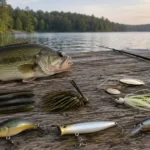
The book splits the surface family into eight types. Each one makes a different kind of commotion, and that commotion decides where it fits.
| Type | What it does | Where it fits |
|---|---|---|
| Walk-the-dog (spook) | Side-to-side zigzag | Open water and around cover, any time bass are shallow and aggressive. The most versatile |
| Popper | Cupped face spits and pops | Visible structure: docks, logs, grass edges |
| Buzzbait | Churns the surface nonstop | Run alongside weed lines and banks lined with timber |
| Hollow body frog | Weedless walk or pop | Over any surface vegetation |
| Prop bait | Propellers chug and spray | Calm water around visible structure |
| Whopper Plopper | Rotating tail gurgles | Long casts, medium speed |
| Waking crankbait | V-wake just under or breaking the surface | Night and low light |
| Surface swimbait | Large paddle-tail burned to wake | When bass want a baitfish moving fast up top |
Rod and Line by Type
Topwater gear is not one-size-fits-all. A walker wants a softer tip to work the cadence; a frog wants a broomstick to drive a hook through a mat.
| Type | Rod | Line |
|---|---|---|
| Walk-the-dog, prop bait | 6’10″–7’2″, medium, moderate-fast | Monofilament 14–17 lb |
| Buzzbait | 7’0″–7’3″, medium-heavy, moderate-fast | Monofilament 14–17 lb or braid 50 lb |
| Hollow body frog | 7’0″–7’3″, heavy, fast | Braid 50–65 lb |
The two numbers that matter most here are the line types. Monofilament floats, which keeps the nose of a walker or popper up and working. Its 25 to 30 percent stretch also cushions the hookset on treble-hooked lures. Braid has zero stretch, which is exactly what you need to drive a frog hook through vegetation.
One of the book’s ten deadliest mistakes is using the wrong line type for the job, and sinking fluorocarbon on a topwater is its example. Fluoro drags the nose down and kills the action.
The Knot: Non-Slip Loop
A topwater only moves right if it can swing freely. Cinch a tight knot on the eye and the lure’s head is locked to the line. For every hard bait, surface plugs included, the book reaches for one knot: the non-slip loop knot, with the full five-step tie walked through in our jerkbait guide.
What you get is a loop that never closes. Hanging on it, the plug pivots freely, so the walk swings wider, the popper spits harder and the wobble opens up. Do your tying at home ahead of each trip, and moisten the line every time before you snug a knot down.
How to Work Each Type
Walk-the-Dog
The most important topwater technique. Hold the rod at 45 degrees toward the water. Make a short, sharp downward wrist twitch, about 6 inches of rod movement, not 6 feet, while taking in a quarter-turn of line. The lure darts one way. An immediate second twitch sends it the other way. Then pause 1 to 3 seconds. The rhythm is twitch, twitch, pause, and most strikes come on the pause.
Popper
Point the rod at the lure, parallel to the water. Snap it down sharply to make the pop and the spit, then pause 3 to 8 seconds before the next pop. Go long on the pauses for finicky or cold-water fish. Shorten the pauses and speed up the pops when bass are aggressive and chasing bait. The rings spreading out from each pop pull bass in from surprising distances.
Buzzbait
A buzzbait only lives while the handle turns: stop cranking and down it goes, so burn it from splashdown to boat. Track it alongside weed lines and banks lined with timber, which keeps it in front of fish for every foot of the cast.
Hollow Body Frog
You have two ways to move it. Walking: give it the spook’s zigzag twitch, just at a lazier pace, across open pockets of vegetation. Popping: with a cupped-face model, yank it toward you hard enough to make it pop. Because a frog is weedless, it can go where any treble-hooked plug would hang up: matted grass and lily pads.
Prop Bait, Plopper and Waking Bait
- Prop bait: chug, pause, chug. Best on calm water around visible structure.
- Whopper Plopper: cast far and retrieve at medium speed. The rotating tail does the work.
- Waking crankbait: it runs just under or breaking the surface, pushing a V-wake. Deadly at night and in low light.
The Hookset: Wait, Then Sweep Sideways
This is where most topwater fish are lost, and the book is blunt about it: never set the hook the instant you see the explosion. Bass frequently miss a surface lure on the first strike.
- Ignore the explosion. Your cue is the load on the rod, not the water flying. Hold off until the fish’s weight is actually there.
- Swing the rod to the side, never overhead. On a short line, a side swing is far less likely to rip the trebles out. The book splits it simply: Texas rigs and jigs get the rod swept up, surface lures get it swept sideways.
- Give a frog an extra beat. After the blow-up, count off the 1 to 2 seconds it usually takes for the weight to load the rod, then bury the hook with a hard sideways sweep.
- If the fish misses, stop. Many bass miss a frog on the first strike. Stop the lure completely and wait. The bass often comes back.
After the hookset, watch for an instant jump: that fish is frequently pinned by a thin margin. Lean the rod to the side right away and keep its head in the water.
When Topwater Works (and When to Put It Away)
The book’s summer clock gives topwater two windows a day and one at night:
| Time | Depth | Topwater play |
|---|---|---|
| Dawn to 9 AM | 1–6 ft, shallow targets: docks, weed edges, rock banks | Walk-the-dog, buzzbait, hollow frog |
| 9 AM to 5 PM | 4–25 ft, moving deeper | Put it away for mid-depth and deep baits |
| 5 PM to dark | 2–8 ft: morning areas plus grass edges | Topwater again for the evening feed |
| Night | 1–6 ft, shallow targets: docks with lights, weedy points, rock banks | Spook, buzzbait, waking crankbait |
A few more rules from the book that shape the topwater day:
- Light rain is a green light. Surface disturbance reduces spooking and bass get very active. Fast topwater is one of the book’s picks.
- Overcast days keep bass active all day through the whole water column, and the book’s overcast pick is any fast lure at any depth.
- When the early bite shuts off all at once, the bass have dropped deeper. Stop pounding the surface and pick up a jig or a crankbait that dives further.
- At night, go dark and noisy. A solid black spook gives the strongest silhouette; a white buzzbait gives noise and flash.
- Spawn and post-spawn water (65 to 75°F) is listed with topwater and the frog in the book’s temperature chart. June’s lineup leans on both, as detailed in the June bass lures.
For the full midday-and-dusk summer program, see the summer bass lures. For how topwater fits with the rest of your box, see the best bass lures by type.
Schooling Fish on Top
Surface-feeding schools are the exception where a big plug usually comes up short. Those fish fixate on a single bait size, and it’s nearly always tinier than your lure. Go much smaller on the topwater, land it beyond the school, bring it through the middle, then work the outer edge, since that’s where the heavier bass clean up crippled baitfish. Still no takers up top? Let something sink beneath the commotion; the biggest fish are often down there. More on that in catching bass that are busting bait but won’t bite.
Quick Answers
When should you set the hook on a topwater lure?
Only once the rod loads with the fish’s weight, never at the splash itself, and then with a sideways sweep. With a frog, give it roughly 1 to 2 seconds for that weight to come tight.
What line is best for topwater bass fishing?
Monofilament (14 to 17 lb) for walkers, poppers and prop baits because it floats; 50 to 65 lb braid for hollow frogs over vegetation.
What time of day is best for topwater bass?
From dawn to about 9 AM and from 5 PM to dark in summer, plus at night with dark, noisy lures. Overcast days and light rain extend the bite.
What knot is best for topwater lures?
The non-slip loop knot. It leaves an open loop so the lure swings freely, which widens its walk and action.
Tight lines,
— David