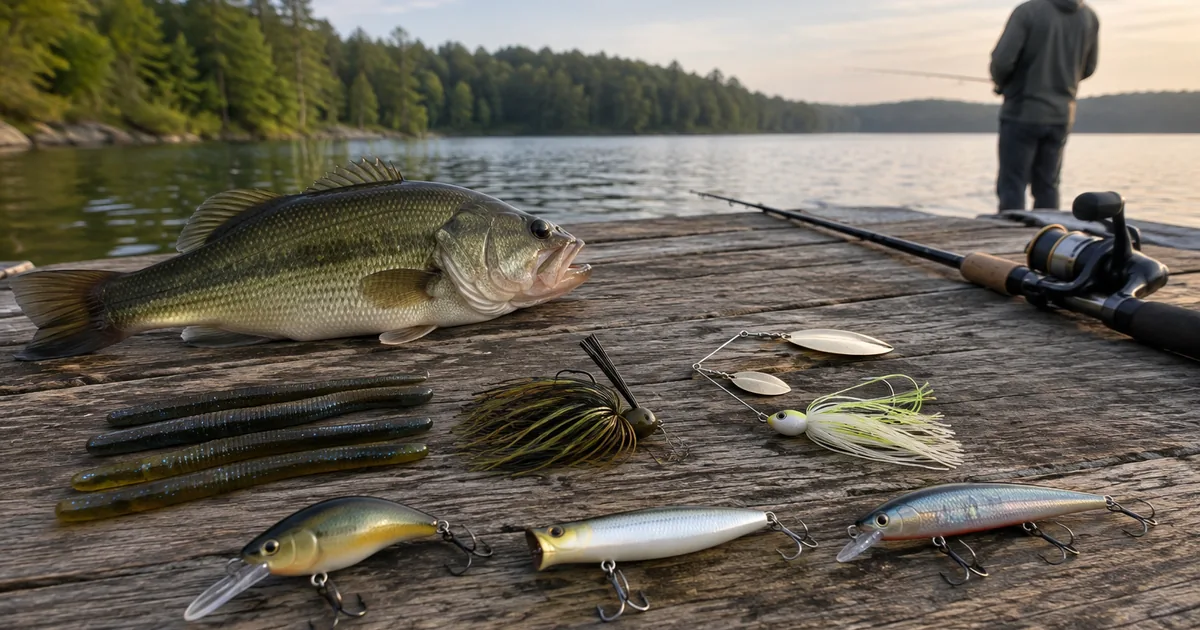
There is no single best bass lure. There is a best lure for each job: one that crawls the bottom, one that comes through cover, one that covers water fast, one that works the surface. Carry the right 12 and you have an answer for almost every situation a bass lake can throw at you.
This page is the reference. Each lure below comes with the rod, the line and the retrieve that make it work, straight from the lure chapter and the rigging tables of Bass Fishing Mastery. Read the summary table first, then jump to the type you need.
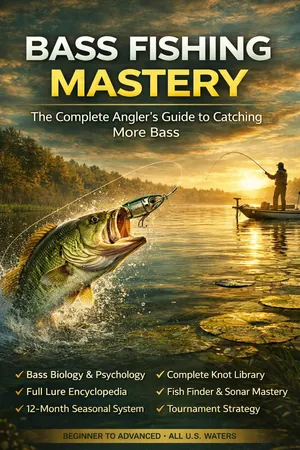
Bass Fishing Mastery: the complete 86-page bass guide behind this article. See the guide →
The 12 at a Glance
| Lure | Rod (length, power, action) | Line | When it shines |
|---|---|---|---|
| 1. Texas-rigged worm | 7’0″–7’3″, medium-heavy, fast | Fluorocarbon 12–15 lb | Year-round, around any cover |
| 2. Wacky stick bait | 7’ medium spinning | 12 lb fluorocarbon | Shallow cover (1–8 ft), clear or pressured water |
| 3. Flipped creature bait | 7’3″–7’11″, heavy, fast | Braid 40–65 lb | Dense cover, shallow fish |
| 4. Ned rig | 6’8″–7’0″, light or medium-light spinning, fast | Fluorocarbon 6–10 lb | Every season, and after cold fronts |
| 5. Drop shot | 6’10″–7’2″, medium-light spinning, fast | Fluorocarbon 8–12 lb | Clear water, pressured fish, fish on your sonar |
| 6. Jig (casting or football) | 7’0″–7’3″, heavy, fast | Fluorocarbon 17–20 lb or braid 50–65 lb | Cover, rock and summer ledges |
| 7. Spinnerbait | 7’0″–7’3″, medium-heavy, moderate-fast | Fluorocarbon 15–17 lb | Wind, stained water, fall shad |
| 8. Diving crankbait | Shallow: 7’0″–7’3″, medium, moderate. Deep: 7’4″–7’8″, medium-heavy, moderate-fast | Shallow: fluoro 12–15 lb. Deep: mono 10–12 lb | Squarebill on shallow wood and rock, deep diver on summer ledges |
| 9. Lipless crankbait | 7’ medium | 12 lb mono | Year-round: spring grass, fall open water |
| 10. Jerkbait | 6’8″–7’0″, medium, moderate-fast | Fluorocarbon 10–14 lb | Cold water and pre-spawn |
| 11. Walk-the-dog topwater | 6’10″–7’2″, medium, moderate-fast | Mono 14–17 lb | Dawn, dusk, shallow aggressive fish |
| 12. Paddle-tail swimbait | 7’ medium | 12 lb mono | Grass edges, baitfish-feeding bass |
Rods come from the book’s technique matrix and lines from its line-by-technique matrix. For the lipless crankbait, the wacky rig and the paddle-tail, the book’s own starter combo (a 7-foot medium rod with 12 lb line) handles them.
Soft Plastics: The Lures That Catch the Most Bass
1. The Texas-Rigged Worm
No lure in history has put more bass in the boat than the plastic worm, and it still draws all three kinds of strike: hunger, reaction and aggression. A 5 to 7-inch straight-tail in green pumpkin, watermelon red or black is the place to begin.
- Weight: go 3/16 oz when the water is calm and skinny, 3/8 oz once you add some depth or a light breeze, and 1/2 to 3/4 oz for deep water, thick cover or real wind.
- Hook: offset EWG, 3/0 for a 6-inch worm, 4/0 for 8 inches, 5/0 for 10 inches and up.
- Retrieve: lift with a sweep from the 9 o’clock to the 11 o’clock position, take up line while lowering back to 9, wait 2 to 4 seconds, then do it again.
In open water, don’t peg the weight. Let it slide: the worm parts company with the sinker as it sinks, falls more slowly, and that slower drop is where a big share of the strikes happen.
2. The Wacky Stick Bait
The stick bait is the most widely used soft plastic in professional tournament fishing. Hooked through the middle, both ends flutter as it falls horizontally, a motion no other lure copies. Without weight it covers 1 to 8 feet. For the 6 to 15-foot zone, push a 1/32 to 1/16 oz nail weight into the head.
Throw it next to something you can see, give it slack so it sinks freely, and keep your eyes on the line: a sideways jump is the bite. If nothing touches it, leave it on the bottom for a 3 to 4 count, twitch it once softly and let it settle again. A rubber O-ring around the middle takes a bait from 1 or 2 casts to 10 or more.
3. The Flipped Creature Bait
Beaver-style baits, with a flat body and paddle tails, are the benchmark flipping bait. Rig one on a 5/0 EWG with a 3/4 to 1 oz tungsten weight, pegged with a bobber stopper so bait and sinker enter the cover as one unit. Flip at 8 to 20 feet, pitch at 15 to 40 feet, and let the bait fall all the way on a slack line. Most of the biggest bass caught flipping eat on that first, unimpeded fall.
Finesse: For Bass That Won’t Chase
4. The Ned Rig
A small buoyant ElaZtech bait on a 1/15 to 3/16 oz mushroom head. Because the plastic floats, the tail points up at the surface every time the head rests. Work it like this: a full fall to the bottom, 2 or 3 shakes, a 5 to 8-second rest, a 6-inch drag, and again. Whatever speed feels right, go slower. It produces in all four seasons and in any water color, and it is one of the few baits still getting bit on the tough days behind a cold front.
5. The Drop Shot
Here the weight sits on the bottom and the plastic hangs above it, suspended at one depth for as long as you care to hold it there. The hook (size 1 or 2) goes on with a Palomar, with 18 to 24 inches of tag left below it for the sinker: 3/16 oz in shallow water, 1/4 to 3/8 oz when it’s deeper. Nose-hook a finesse worm so it lies flat, and shake the rod tip gently while the sinker stays put. Fishing deep? Spool 30 lb braid and add a 10 lb fluorocarbon leader. When it loads up, reel down to the fish before you lift.
Jigs: The Bottom Bait for Bigger Fish
6. The Jig
The jig is the book’s trophy lure, and two head shapes cover most of the work:
- Casting jig (3/8 to 3/4 oz): the all-purpose jig. Its weed guard lets you pitch docks, flip grass and cast to laydowns.
- Football jig (1/2 to 1 oz): its wide head keeps it from tipping over on hard bottom, so you can crawl it across gravel bars, rock piles and ledges. Few baits beat it on deep summer structure.
Match the trailer to the water. Cold water and finicky fish get a small 3-inch craw. Warm water and heavy cover get a 4-inch-plus beaver bait. Keep trailer length in proportion to the head: a tiny jig with a massive trailer looks wrong.
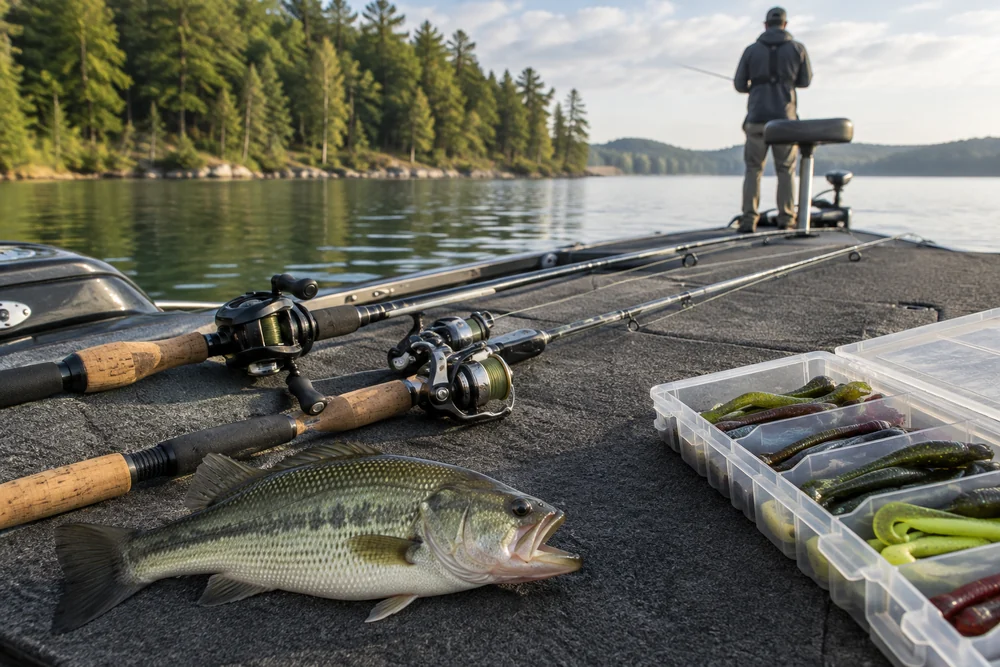
Moving Baits: Cover Water, Trigger Reactions
7. The Spinnerbait
A spinnerbait talks to the bass’s lateral line, the sense that picks up vibration beyond the range of its eyes. The blade sets the message:
- Colorado: maximum thump. Murky water, slow-rolling in cold water, night.
- Willow leaf: lots of flash, not much thump. Fast retrieves in clear water.
- Indiana: the in-between, the choice when you’re unsure.
- Tandem: two blades, the default tournament setup for most conditions.
8. Diving Crankbaits
Every crankbait is built to run at one depth band. Pick the bill for the depth you need to hit:
| Style | Running depth | Best use |
|---|---|---|
| Squarebill | 0–4 ft | Rocks, laydowns, stumps, shallow docks. The most snag-resistant |
| Shallow diver | 2–6 ft | Grass lines, sandy banks, shallow points |
| Medium diver | 6–12 ft | Channel edges, humps in the middle depths, points |
| Deep diver | 12–25 ft | Summer ledges, June through August |
| Flat-sided | Any | Cold water (50–60°F) and pressured fish |
What makes them catch fish is contact. The bill should bump bottom or cover on each cast, and a crankbait that never hangs up is running too shallow. Hold the rod tip down and off to one side and it will dig a little deeper.
9. The Lipless Crankbait
No bill, a tight vibration, and it sinks, so you can fish it at any depth and any speed. It works year-round, and its signature move is ripping it free when it ticks the top of submerged grass. The book’s rule for hooks and grass: when there’s open water above the grass, rip a lipless; when grass is above the bait, switch to a single hook.
10. The Jerkbait
A suspending stickbait fished jerk-jerk-pause. The strike comes on the pause, and water temperature sets its length: 8 to 12 seconds below 50°F, 3 to 5 seconds from 50 to 60°F, 1 to 2 seconds above 65°F. Tie it on with a non-slip loop knot so it can swing freely.
Topwater and Swimbaits: The Upper Water
11. The Walk-the-Dog Topwater
The most versatile surface lure. Rod at 45 degrees toward the water, a short downward wrist twitch, twitch again, then pause 1 to 3 seconds. Most strikes come on the pause. Don’t react to the splash; wait for weight, then sweep sideways. Poppers, buzzbaits, frogs and the rest of the surface family each need their own rod and hookset, covered in the complete topwater guide.
12. The Paddle-Tail Swimbait
The most versatile swimbait, 3 to 5 inches, on a weighted swimbait hook (4/0 to 7/0) or a jig head. The weighted keel keeps it upright. Before you fish it, hold it at the surface and reel at your planned speed. The tail should beat steadily. If it doesn’t beat, go faster; if it spins, go slower. The big multi-jointed swimbaits are a different tool for a different fish, explained in how to catch big bass.
Which Lure When: The Season Decides
The lure is only right if the timing is. The book’s month-by-month chart, in short:
- Winter (Dec–Feb): blades and spoons jigged vertically, finesse jigs and the drop shot, all fished impossibly slow.
- Pre-spawn, 50–58°F: jerkbait, flat-sided crankbait, slow-rolled Colorado spinnerbait. 58–65°F: lipless ripped through early grass, swimbait on grass edges, medium crankbait on points, jig on channel edges.
- May: sight fishing with a Ned, drop shot or finesse jig. Full breakdown in the best May bass lures.
- June: frog, topwater and swim jig early; jig and drop shot later. See the June lure lineup.
- July–August: football jig, deep diver, big swimbait at midday; topwater at dawn and dusk. See the summer bass lures.
- Fall: lipless, swim jig, spinnerbait and swimbait in shad colors; jigs, Texas rigs and medium crankbaits once the water drops below 58°F. See the best fall bass lures.
Color in One Paragraph
Clear water: natural greens like green pumpkin and watermelon. Stained water: chartreuse/white and black/blue. Muddy water: black/blue, solid black or bright chartreuse. Spring leans craw (brown/orange); fall leans shad (chrome/blue, white/silver, pearl). And buy fewer lures in more colors: color range is worth more than lure variety while you learn.
If You Only Start With a Few
The book’s starter box is short: a Ned rig, a straight-tail worm for the Texas rig, a paddle-tail swimbait, a lipless crankbait in chrome/blue, a chartreuse spinnerbait, a squarebill and a 3/8 oz jig with a craw trailer. From the bank, cut it further: one spinnerbait to find fish, Texas-rigged plastics to finish them, one topwater for dawn and dusk.
Learn one lure at a time. The book’s first-trips plan starts with nothing but a Texas rig for two trips, then adds a spinnerbait, then a topwater. Depth beats breadth.
Quick Answers
What is the best all-around bass lure?
The Texas-rigged plastic worm. Nothing has a longer record of catching bass, it goes through almost any cover, and it draws every kind of strike.
What lures should every bass angler have?
A Texas-rig worm, a Ned rig, a jig, a spinnerbait, a squarebill, a lipless crankbait and one topwater cover the bottom, the cover, the middle and the surface.
What is the best bass lure for cold water?
A jerkbait with long pauses (8 to 12 seconds below 50°F), plus blade baits, jigging spoons and slow finesse jigs in the deepest stable water.
What color lure is best for bass?
Match the water: natural greens in clear water, chartreuse/white or black/blue in stained water, black/blue or solid black in mud.
Tight lines,
— David