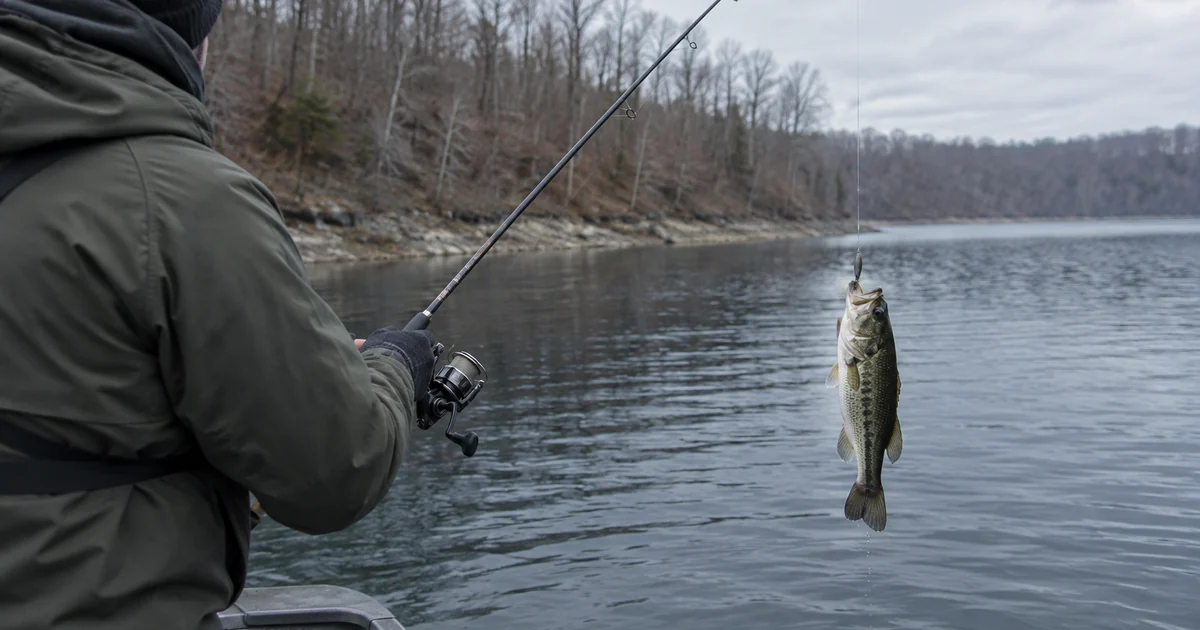
Cold water doesn’t empty a lake. It packs the bass together. From December through February, they slide down to the deepest stable water they can find, bunch up tight, and spend most of the day doing almost nothing. Then, for a short stretch during the warmest hours, they eat.
That changes the job. Winter bass fishing is less about covering bank and more about three decisions: which depth, which hours, and how little you move the bait. Get those right and one small patch of bottom can give up several fish in a row.
This guide covers the winter side of the seasonal system in Bass Fishing Mastery: the temperature bands, where schools set up, the baits with their rod and line specs, and the speed numbers that keep a lure in front of a cold fish long enough to get bit.
Bass Fishing Mastery: the complete 86-page bass guide behind this article. See the guide →
Winter by the Thermometer
Seasons begin in the water, not on the calendar. A $10 thermometer or the temperature readout on your electronics tells you which winter you’re actually fishing, and January in Texas is not January in Ohio.
| Month | Typical water temp | Where the fish are | Baits that fit |
|---|---|---|---|
| December | 44°F to 54°F | Deep structure, returning from fall areas | Blade bait, drop shot, finesse jig |
| January | 38°F to 48°F | Deepest structure, 20 to 40 ft | Jigging spoons, blade baits, slow jigs |
| February | 42°F to 52°F | Channel bends and deep points | Drop shot, slow finesse jig, blade bait |
Two temperature bands sit underneath that calendar:
- Below 45°F: bass are near-dormant on the deepest structure. Jigging spoons are the match.
- 45°F to 55°F: fish are waking up. Deep jigs and slowly worked jerkbaits take over.
As the water warms past the 40s and heads for 55°F, metabolism speeds up and fish start moving toward spawning areas. Serious pre-spawn movement begins around 53°F to 55°F. December has its own split personality, covered in detail in December bass fishing. For every other band of the year, keep the bass fishing water temperature chart handy.
Where the Schools Set Up
A bass in January runs on the slowest metabolism of its year, so it settles where the water changes least: the deepest stable structure. Expect 20 to 40 feet on most reservoirs in the South, and less depth on Northern lakes.
The three primary spots
- Creek channel bends. Old creek channels are the highways bass use between shallow feeding water and deep holding water. The outside bends, where the original current cut deepest, are the best stretches.
- Main lake humps. A hump rises from the bottom without reaching the surface. You can’t see it, so it gets fished far less than it should. Bass treat it like an underwater island.
- Steep bluff walls, the third primary location on the winter list.
The secondary spots
- Docks with deep water nearby. The cables and floats themselves act as structure.
- Outflows that add warm water, such as power plants and industrial discharges.
- Banks that catch the most winter sun.
Wood deserves its own note. In winter, bass hold tight against timber, where the bottom temperature runs marginally warmer. A cast that lands a few feet off the trunk can miss the fish entirely.
The best of all these spots is where structure meets cover: a rock pile on the tip of a point next to a creek channel holds fish in several seasons, winter included.
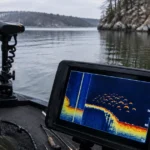
Here’s the rule that matters most: finding the school is 90% of the battle. One fish usually means many more in the same small area, often around twenty. So stay and pick the spot apart before you leave it. Locating that school is mostly an electronics job, and finding winter bass on sonar walks through the screen-reading side step by step.
The Cold-Water Lineup, With Specs
You don’t need a big box in winter. Six baits cover nearly everything, and most of them work either straight down or close to it.
| Bait | How to work it | Setup notes from the book |
|---|---|---|
| Blade bait (the Heddon Sonar is one example) | Jig it vertically right over the school | The January and February staple |
| Jigging spoon | Flutter it up, let it fall back | The pick when water drops below 45°F |
| Finesse jig, 1/8 to 1/4 oz | Crawl it, slower than seems reasonable | 8 to 12 lb fluorocarbon on spinning gear; 3-inch craw trailer for a slow fall and subtle action |
| Finesse worm on a drop shot | Shake in place, weight never leaves the bottom | Size 1 or 2 hook, Palomar knot; 6’10″ to 7’2″ medium-light fast spinning rod; 8 to 12 lb fluoro, or 30 lb braid with a 10 lb fluoro leader when deep |
| Suspending jerkbait | Jerk, jerk, then a long pause | 6’8″ to 7’0″ medium rod; 10 to 14 lb fluorocarbon; non-slip loop knot for free action |
| Glide bait | Sweep and pause | Called out as extremely effective in clear water and in winter |
A few details make these baits work better in cold water:
- Tune the jerkbait. Many factory jerkbaits aren’t truly neutral. Adhesive tungsten strips on the belly of a floater bring it to a dead hover, and perfect suspension makes a real difference in cold water. The full tuning routine is in jerkbait fishing for bass.
- Keep the jig small and quiet. The finesse jig is built for clear water, cold water and post-front days. Match trailer length to head size; a tiny jig with a huge trailer looks wrong.
- Add scent in clear, cold water. A touch of garlic or anise on soft plastics won’t replace a good presentation, but it can be what keeps a hesitant fish holding on.
Speed: Put Numbers on “Slow”
“Fish slow” is advice everyone hears and almost nobody follows, because slow feels like doing nothing. The book gives you numbers instead.
- 10 to 15 seconds. That’s the time a fish in cold water can take before it decides to eat. If your lure passes through its window in three seconds, the fish never had a chance to decide.
- Minus 30%, then minus 30% again. Slow your normal retrieve by 30%. Then take another 30% off. Cold bass need the lure in their face for an extended period.
- Still feels slow? Halve it. That’s the winter rule. A retrieve that already feels too slow is still a candidate for halving.
- Jerkbait pauses by temperature. Below 50°F, hold the pause 8 to 12 seconds. Between 50°F and 60°F, 3 to 5 seconds is enough.
- Before swapping baits, stretch the pause. Most fish commit while the lure sits still, on jerkbaits and plenty of other baits.
The finesse principle behind all of this is simple: keep the bait in the strike zone as long as possible with as little movement as possible. A drop shot does it best of all, because the bait quivers at one fixed depth and never leaves the fish.
Plan the Day Around the Warm Hours
Forget beating the sun to the ramp. Cold bass don’t eat often, but they eat on a schedule: brief, intense bursts once the day has warmed up, generally from noon to 3 PM and sometimes stretching to 4 PM. By then, a few hours of sunshine have marginally warmed the surface water and nudged metabolism up a little.
That gives your winter day a shape:
- Morning: idle the structure on your list, read the screen, and mark every school you find. Few fish feed now, so you lose little by searching.
- Noon to 4 PM: sit on your best school and fish it thoroughly.
- Between bites: stay put. Winter feeding windows come with long periods of complete inactivity in between, and the fish haven’t left.
Weather can shift that plan. Stable high pressure (30.0+) is hard fishing: bass sit tight to the deepest cover and want finesse only, with long pauses. A sharp pressure rise after a cold front is the toughest scenario of all, and the answer is the smallest lures, the slowest retrieves and the deepest water. The full playbook for those days is in bass fishing after a cold front, and the hour-by-hour picture for every season is in the best time to fish for bass.
Winter Is Also Big-Fish Season
Winter is one of the two best seasons to target trophy largemouth. The fish are consolidated, and the big ones mix in with smaller fish on deep structure. If a school is giving up 2-pounders, a much bigger fish may be in the same group.
The famous trophy waters back this up:
- Lake Fork, Texas: winter and pre-spawn (January to March) is when giants feed in transition areas.
- Santee-Cooper, South Carolina: giant bass in winter on deep ledges.
- Castaic Lake, California: winter and spring pre-spawn produce its largest fish, on big swimbaits fished with extreme patience.
Go in with the trophy mindset: fewer total bites, bigger presentations, and the confidence to keep fishing through long quiet spells.
No Boat? Bank and River Adjustments
From the bank, choose spots by how close deep water comes to shore: bluffs, dam faces and marina edges. Save your trips for warm afternoons and work every cast slowly. You’ll go out less often, but winter fish that eat tend to be good ones.
On rivers, winter flow is the enemy of a resting fish. Rivers run cold, often low and clear, and bass pile into wintering holes: the deepest, slowest pools, most often where a bend’s outside edge has dug deep or a big eddy turns slowly. Fish crowd into them. Drift jigs and finesse baits through the hole slowly along the bottom, again and again. Let the current choose your weight: heavy enough to tick bottom, light enough that the bait still drifts.
Quick Answers
Do bass bite in the winter?
Yes. They eat less often, but they still feed in brief, predictable bursts, most reliably between noon and about 4 PM.
How deep are bass in the winter?
On most Southern reservoirs, 20 to 40 feet; on Northern lakes, less. Start with creek channel bends, humps in the main lake and steep bluffs.
What is the best lure for winter bass?
Blade baits and jigging spoons worked vertically over a school, a slow finesse jig, and a finesse worm on a drop shot. Below 45°F, jigging spoons are the best match.
What water temperature do bass stop biting?
They don’t fully stop. Below 45°F bass are near-dormant on the deepest structure and bite only on slow, vertical presentations like jigging spoons.
Tight lines,
— David