December is the month bass can’t make up their minds, so you have to make it up for them, one day at a time. The water keeps cooling, the fall feeding spree winds down, and fish drift back toward deep winter structure. But they don’t all move at once, and they don’t move on a schedule.
That’s why December bass fishing rewards anglers who carry two playbooks. Any given day might belong to the fall program or the winter one, and the water temperature, the weather and the bait tell you which one to open.
Here’s how to read the transition with the seasonal system from Bass Fishing Mastery: the temperature line where the shad bite ends, the baits that work on both sides of it, and a simple way to decide each morning.
Bass Fishing Mastery: the complete 86-page bass guide behind this article. See the guide →
Why December Is Two Seasons in One
Look at the month on either side and you can see the handoff.
| Month | Typical water temp | Where bass are | What they eat best |
|---|---|---|---|
| November | 50°F to 62°F | Transitioning deeper | Jig, Texas rig, medium-diving crankbait |
| December | 44°F to 54°F | Deep structure, returning | Finesse jig, drop shot, blade bait |
December’s range overlaps November’s on the warm end and reaches toward January’s cold. A lake at 54°F in early December is still fishing like late November. The same lake at 44°F three weeks later is fishing like deep winter. Which is why the month name on your phone means very little.
The key line: under 52°F to 55°F, the fall shad pattern shuts off abruptly. Above it, bass can still be chasing bait. Below it, they move toward deeper, stable structure and the winter rules apply.
The Temperature Ladder: Pick Today’s Tactics
Read the water before you tie anything on. Every rung below comes straight from the book’s temperature bands.
| Water temp | What’s happening | Best approach |
|---|---|---|
| Above 58°F | Fall pattern still alive | Follow the shad: lipless crankbaits, spinnerbaits, swimbaits in shad colors |
| Dropping below 58°F | Cold-snap transition | Put the fast lures away and pick up a jig, a Texas rig or a crankbait that dives to mid depth |
| 52°F to 55°F | Shad pattern shutting down | Fish both: a moving bait on the bait, a jig on the first deep water |
| Below 52°F | Winter mode | Finesse jig, drop shot, blade bait on deep structure |
| Below 50°F | Cold water | Jerkbait pauses stretch to 8 to 12 seconds |
When the water first slides under 58°F, bites get less aggressive, but quality improves. That’s a trade worth taking in December.
If you fish in the South and your water is still warm in December, don’t force winter tactics. Fall isn’t a date. It creeps southward one lake after another, only as fast as the cool nights let it. Run the program your water temperature calls for, and check when fall bass fishing really starts to see where your lake sits.
When the Fall Bite Is Still On
On the warm side of the line, fall logic still holds: locate the shad, and the bass won’t be far from them.
- Shad colors dominate: chrome/blue, white/silver and pearl.
- Match the size of the local shad. The young-of-the-year shad run 2 to 3 inches long. Short strikes and swipes mean it’s time to change lure size, not location.
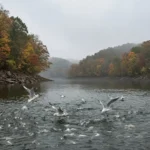
- Watch the birds. Gulls, terns and great blue herons spot bait long before any angler. When baitfish leap, they’re fleeing the predator, so expect the bass to be on the side opposite the direction they jump.
- Know where the bait has been. The shad spent the fall moving into the creek arms and their back flats, and the creek-arm migration maps every stage. As the water cools, bass leave those flats for deeper, stable structure.
The cold-front opportunity
When the first serious cold snap knocks 5 degrees or more off the water, the next 24 to 48 hours can be the top fishing of the whole year. Fast late-fall fronts can also kill threadfin shad by the thousands, and that die-off brings bass up to the surface in large, chaotic feeding schools. If your lake gets its hard snaps in December and you see shad struggling and twitching on top, don’t leave. A frenzy like that is over quickly.
When the Winter Bite Takes Over
Below the line, think deep, schooled and slow.
- Where: bass move toward deeper, stable structure. Creek channels are the routes they travel between shallow feeding areas and deep holding areas, so follow the channel out from the flats to the first bends and deep points.
- What: the December trio of finesse jig, drop shot and blade bait, all fished close to the bottom on deep structure.
- How fast: much slower than in November. Once the water is truly cold, a fish can need up to 15 seconds to commit to a lure.
- When: the clock flips. Cold fish do their feeding at midday, after the sun has warmed the surface slightly.
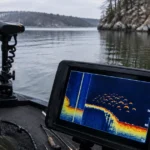
Once fish are grouped on deep structure, your electronics do most of the finding. The screen-reading and vertical-fishing method is in winter bass on sonar, and the full January-February program is in the winter bass fishing guide.
Two Baits That Work on Both Sides of the Line
Some baits don’t care which season the fish think it is. In December, they earn a permanent spot on the deck.
The flat-sided crankbait
A flat-sided crankbait has a tight, subtle wobble instead of a wide roll. That looks more natural in cold water, and the book pins it to 50°F to 60°F water, pressured fish, and days when bass want a subtle presentation. The Bandit Flat Maxx is one of the examples it names. It still covers water like a fall bait, but it doesn’t overwhelm a cooling fish.
The suspending jerkbait
The jerkbait’s pause clock follows the thermometer down through December:
| Water temp | Pause length |
|---|---|
| 50°F to 60°F | 3 to 5 s |
| Below 50°F | 8 to 12 s |
Fish it on a 6’8″ to 7’0″ medium rod with 10 to 14 lb fluorocarbon, tied with a non-slip loop knot so the bait swings freely. As the month cools, stretch the pause instead of switching lures. Rigging, tuning and the full cadence are in jerkbait fishing for bass.
Reading a December Day
Because the month swings, the weather decides more than usual.
- Falling pressure ahead of a system often produces the top bite of the week. Bass are at their most aggressive in the window from 12 to 36 hours ahead of a big low, so lean on the fall side: fast baits, cover water.
- Rising pressure after a cold front is the hardest scenario. Bass move deep and tight. Go to the winter side: smallest lures, slowest retrieves, deepest water.
- Overcast days keep bass active through the water column, and search baits can work all day.
- Bright, calm high pressure pushes fish deep at midday. Finesse in deep water is the play.
The practical answer is to keep a second rod rigged at all times: one moving bait for the fall side, one finesse bait for the winter side. When conditions shift mid-day, you switch rods, not knots.
Then let the first fish set the plan. Note its depth, cover, bait and speed, and go find the same combination elsewhere on the lake. In a transition month, that one data point tells you which season the bass are living in today. And when a pattern dies, the fish haven’t vanished. Bass in the same lake tend to move the same direction at the same time, so ask where they logically went, usually one step deeper along the same channel.
December From the Bank
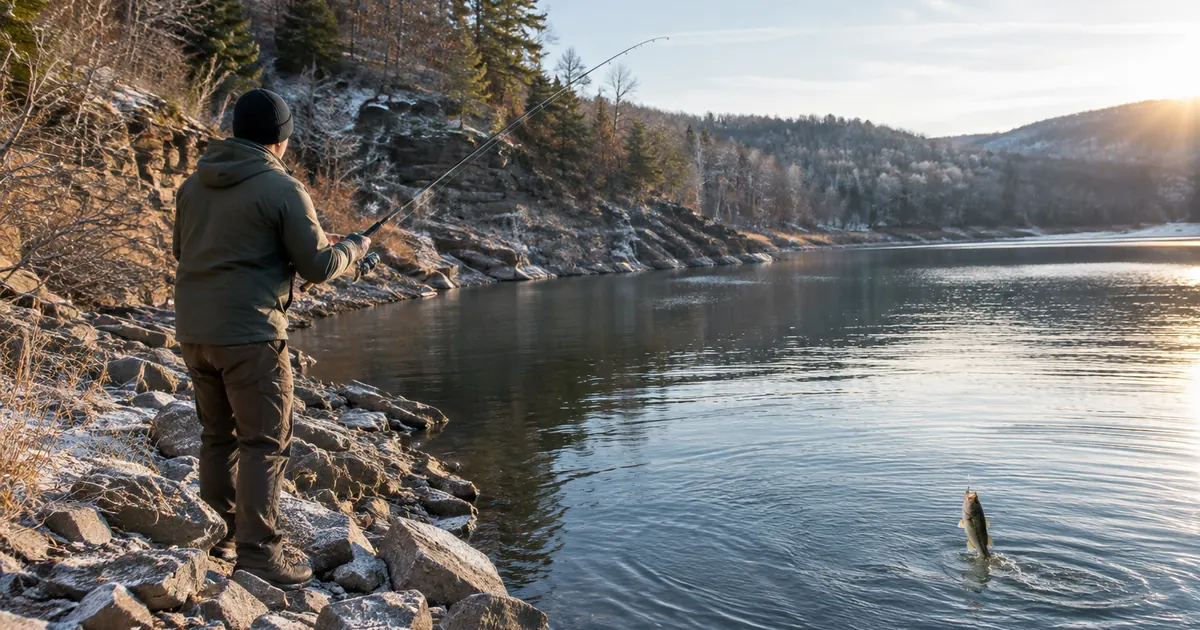
Bank anglers get the tail end of their best stretch. September through November, fall pushes bait and bass into casting range, and early December can still deliver some of that. As the water cools, shift toward spots with quick access to depth, like bluffs, the dam and marina edges, and give your afternoons the most time. If you fished the bank through fall, fall bank fishing for bass shows which of those spots carry over.
Quick Answers
Is December a good month for bass fishing?
Yes, if you fish by water temperature. It’s a transition month, so some days call for fall tactics and others for winter ones.
What lures work best for bass in December?
A finesse jig, a drop shot and a blade bait once the water is cold. Flat-sided crankbaits and suspending jerkbaits work on both sides of the transition.
Where do bass go in December?
They move from fall feeding areas toward deeper, stable structure, often following creek channels out to deep points and channel bends.
At what water temperature does the fall bite end?
Once the water falls under the 52°F to 55°F range, the shad pattern ends abruptly and bass shift to winter holding patterns.
Tight lines,
— David