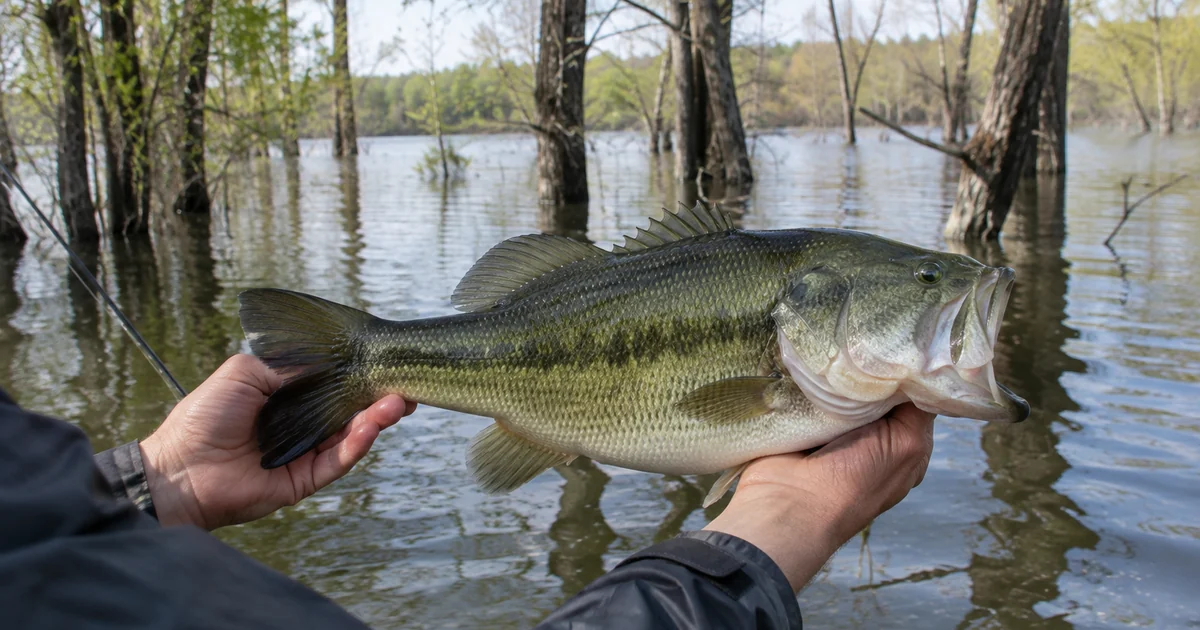
Catching big bass is not regular bass fishing done harder. It’s a different discipline. A trophy largemouth, the 7 to 8-pound-plus class, lives in different water, at a different address on that water, and eats a bigger meal than the 2-pounders you catch every trip.
The good news is that big fish are predictable once you know their requirements. Here is how to catch big bass using the trophy system from Bass Fishing Mastery: the right lake, the right season, the right spot, the right bait, and the patience to wait for the bite.
Bass Fishing Mastery: the complete 86-page bass guide behind this article. See the guide →
What a Trophy Bass Needs
Before you pick a lure, pick the water. The book lists three things a lake must offer to grow giants:
- Abundant deep structure nearby. No deep water close by, no giants.
- Significant forage: large bluegill and shad populations. Big bass key on big prey.
- Some form of fishing pressure management: selective harvest or a catch-and-release tradition on that water.
Some of the best-known trophy waters in the book:
| Water | What makes it special | Best season |
|---|---|---|
| Lake Okeechobee (FL) | Shallow, vegetation-choked, fish over 12 lbs. Frogs, mats and flipping | January to April |
| Kissimmee Chain (FL) | Some of the most reliable 10-lb-plus fishing outside Southern California | Peak January to March, pre-spawn giants |
| Lake Fork (TX) | Timber-filled; the current Texas state record came from here | Winter and pre-spawn, January to March |
| Clear Lake (CA) | Consistent 8 to 10-lb fish, regular 10 to 12-lb catches | Spring through fall |
| Castaic Lake (CA) | A trophy fishery built on big swimbaits and extreme patience | Winter and spring pre-spawn |
The book also names Casitas and Folsom in California, Sam Rayburn and Toledo Bend in Texas, Lake Seminole in Georgia, and Cherokee and Douglas in Tennessee.
Don’t overlook small water either. A 2-acre farm pond managed for 20 years without much fishing pressure can hold largemouth that make reservoir fish look small. The catch is access: ask the landowner, politely and in person.
When Big Bass Are Easiest to Catch
Trophy fishing has seasons, and the book singles out three windows.
| Window | Why big fish are catchable | Where to look |
|---|---|---|
| Pre-spawn (February to April) | The heaviest females of the year are on the move and eating to stock up before spawning | Channel edges of 15 to 20 ft beside the main spawning coves |
| Winter | Fish bunch up, so the big ones sit in among the small ones on deep structure | On Southern reservoirs, the deepest structure that stays stable, 20 to 40 ft |
| Summer nights | Big fish that sat in 20+ ft all day slide up shallow to eat once it’s dark | Docks with lights, and the very banks that looked dead at midday |
Of the three, pre-spawn matters most. From the moment water temperatures leave the low 40s behind until they reach the mid-50s, the females feed heavily, and the book rates it as a prime season for heavy fish on moving baits. Jerkbaits, swimbaits and lipless crankbaits worked through 8 to 15 feet, close to where the spawn will happen, fit the bill. For the true giants, the book narrows it down: the biggest females hold in the deepest part of the pre-spawn zone. That means big swimbaits and football jigs on channel edges of 15 to 20 feet beside the main spawning coves.
Spawning season gives you a hint as well. The males guarding beds are the smaller, more combative fish; the females are bigger and warier. So when a 3 to 4-pound bass comes out of shallow water, a heavier female is frequently holding close by.
Once spawning is over, the big females spread out through transition water of 10 to 20 feet and eat only now and then. That’s the hardest time to target them, as explained in where bass go after the spawn.
Where Big Bass Hold on Any Water
Big fish claim the best real estate. Smaller bass get the leftovers. Four rules from the book point you to the best address:
- Go deeper and more isolated. If you’re catching small fish consistently, move deeper or to more isolated, complex cover. Big bass rarely share feeding spots with large numbers of small fish.
- Hit the root ball first. On a laydown, the root ball is the deepest, most complex part, and it holds the largest fish. Cast it first, then work out along the trunk.
- Fish the lonely cover. Isolated cover in otherwise featureless water usually beats abundant cover along a rich bank. Bass concentrate on the unique feature.
- On rivers, find the outside bend. Current digs the deepest water there, undercuts the bank and stacks wood, and the main flow delivers food all day. The biggest, most dominant residents claim it. One good outside bend is worth a mile of straight bank.
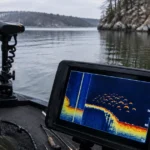
Your electronics help confirm the target. On 2D sonar, a wider, more complete arch means a larger fish, and the brightest, most solid returns come from large, dense fish or hard surfaces.
What Big Bass Eat, and What to Throw
Big bass key on big prey: large bluegill and shad, and, on Southern fisheries with dense bass populations, juvenile bass. Your lure should look like a meal worth the trip. The book’s trophy lure list:
| Lure | Size | Notes |
|---|---|---|
| Large swimbait | 6 to 10 in | The #1 trophy lure category |
| Multi-jointed hard swimbait | 6 to 12 in and up | Produces the largest bass in the lake. Very slow, deliberate retrieve |
| Big jig with a large trailer | 1/2 to 3/4 oz | Football jig on deep pre-spawn and summer structure |
| Large worm | 10 to 12 in ribbon tail | Big profile for big fish in spring and summer |
| Juvenile bass imitation | Varies | Southern fisheries with dense bass populations |
Gear for the Big Baits
Big swimbaits call for dedicated tackle. Go with a heavy or extra-heavy rod of 7’6″ to 8’0″ in moderate-fast action, spooled with 17 to 25 lb fluorocarbon, which has the strength to handle both oversized lures and the fish that eat them. Hard swimbaits go on with a non-slip loop knot so they can swing. Soft paddle-tails ride on a weighted swimbait hook (4/0 to 7/0) that keeps them upright and swimming.
Then check the free stuff, because a trophy punishes every shortcut. Sharpen hooks (a dull point slides across your thumbnail instead of catching). Set the drag at 25 to 30 percent of the line’s breaking strength. Retie any knot that has seen a hard session. Trophies get away far more often because of a drag cranked down too tight, a point that’s gone blunt or a knot pulled snug without wetting it than because of lure choice.
At Night
Summer darkness does half the work, because the heavy fish come shallow on their own. Every lure on the book’s night list is large and dark-profiled: a solid black spook that throws a clear silhouette, a black jig dressed with a craw trailer, a 10 to 12-inch worm in a dark color, plus a white buzzbait for flash and noise. At lit docks, work the edge where the glow ends and the shadow begins. New moon nights beat moonlit ones. One condition: night fishing runs on clear water. On stained or muddy water, darkness plus murk blinds the fish twice. For the surface side of this, see the topwater bass lures guide.
The Trophy Mindset
This is the part most anglers skip. Trophy fishing often means 1 to 3 bites a day, on bigger presentations that smaller fish ignore. You are trading numbers for size on purpose.
- Commit to the big bait. Bigger presentations are how you filter out the small fish.
- Make the first cast count. The first cast to new water is the highest-percentage cast of the day. Position perfectly and execute before you make the follow-ups.
- Set a size goal, not a count goal. The book’s example is a first 5-lb largemouth this season. A goal like that changes where you fish and what you tie on.
Patience and confidence in the presentation matter as much as technique. Pick the right water and the right window, then let the big bait work.
Landing and Releasing a Giant
Trophy fisheries exist because anglers put the big ones back. Handle them like it:
- Past 4 lbs, use both hands: grip the lip with your strong hand and support the belly with the other. A heavy bass dangling straight down by its jaw can end up with that joint dislocated, so don’t hold it that way.
- Under 30 seconds out of the water. Once the water is above 75°F, every extra moment in the air raises the odds the fish dies after release, even if it swims away looking healthy.
- Revive until it kicks. Hold it horizontally underwater, one hand on the jaw and one under the belly, and move it gently forward and back until it swims off on its own.
- When the water tops 85°F, the book’s advice is to take the fish down to 10 to 15 feet before letting it go, since that depth can run 8 to 12 degrees cooler.
Some trophy lakes carry slot limits or special catch-and-release rules. Check your state’s regulations booklet before you fish a new water.
For the lures that cover the rest of your day, see the best bass lures by type. And to time the pre-spawn window on your own lake, use the water temperature chart.
Quick Answers
What is the best lure for big bass?
Large swimbaits in the 6 to 10-inch range are the book’s #1 trophy lure category, followed by big jigs with large trailers and 10 to 12-inch worms.
What time of year are big bass caught?
Pre-spawn, roughly February to April, when large females are at their heaviest and moving. Winter and summer nights are the other trophy windows.
How deep do big bass live?
Usually deeper than the average fish. Before the spawn, the biggest females hold on channel edges of 15 to 20 feet beside the main spawning coves.
How many bites should I expect when trophy fishing?
Often only 1 to 3 a day. Bigger presentations filter out small fish, so fewer bites is part of the plan.
Tight lines,
— David