The calendar lies. A lake enters spring, summer or fall when the water temperature says so, and that can be weeks apart from Florida to Minnesota. Anglers who plan their trips by the date end up throwing April baits at bass that are still in winter mode, or fall baits at fish that are still living in July.
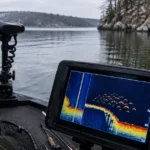
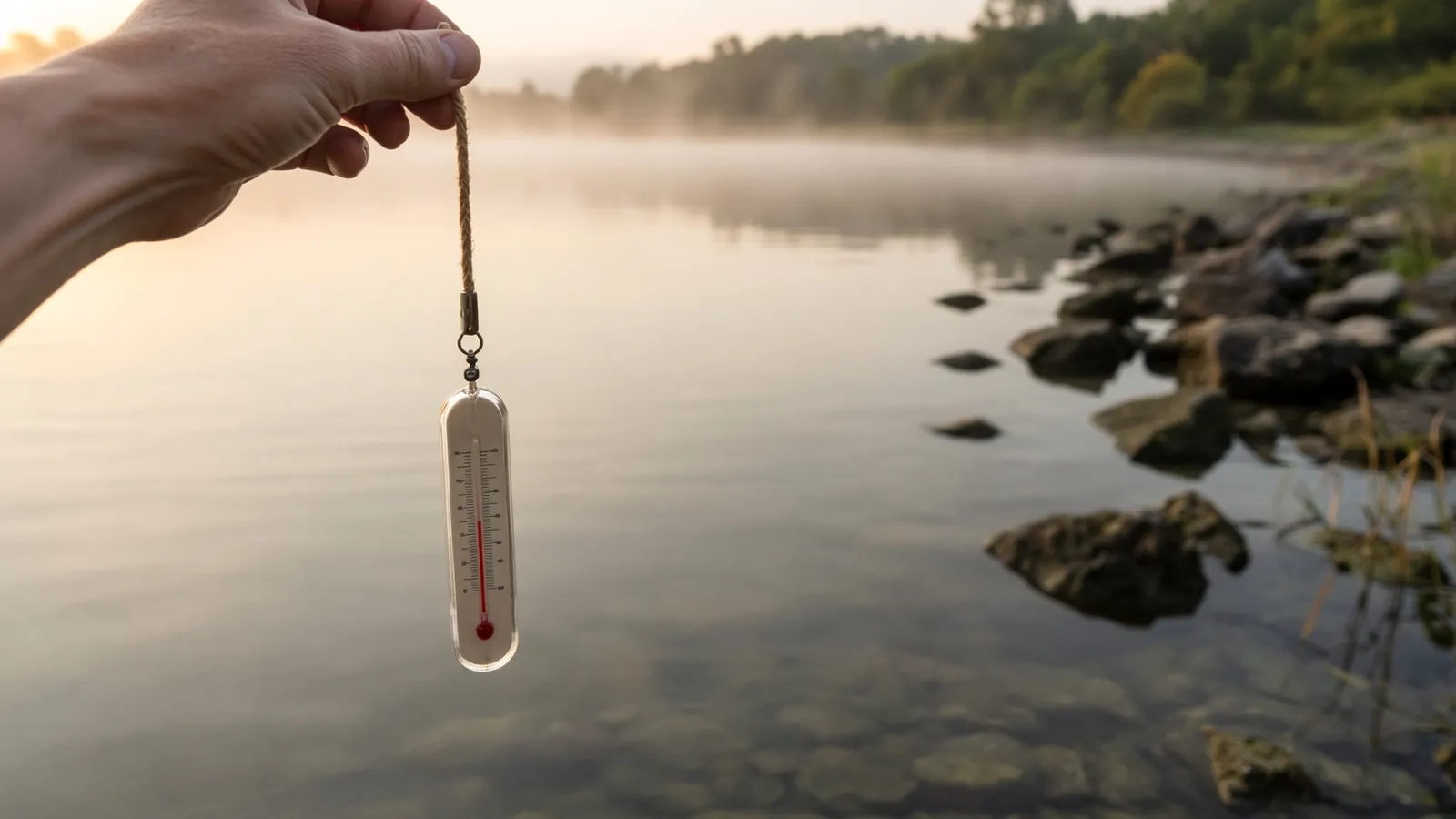
The fix costs about ten dollars: a thermometer, or the temperature readout on your electronics, checked every single trip. Different month, same number. The temperature bands below are the real calendar, and they come straight from the seasonal system in Bass Fishing Mastery.
Bass Fishing Mastery: the complete 86-page bass guide behind this article. See the guide →
The Chart at a Glance
| Water temp | What bass are doing | Where to look | What to throw |
|---|---|---|---|
| Below 45°F | Near-dormant, tightly schooled | Deepest stable structure: 20 to 40 ft on Southern reservoirs, shallower in the North | Jigging spoons, blade baits, slow finesse jigs |
| 45–55°F | Waking up | Deep points, channel bends, then staging areas | Deep jigs, slow jerkbaits, flat-sided crankbaits |
| 55–65°F | Pre-spawn, aggressive and feeding | Secondary points 8 to 15 ft, channel edges near spawning coves | Jerkbaits, crankbaits, swimbaits, lipless crankbaits |
| 65–75°F | Spawn and post-spawn | Hard-bottom flats in 1 to 6 ft, then 10 to 20 ft transition zones | Sight-fishing finesse, topwater, frogs |
| 75–85°F | Summer pattern | Shallow at dawn and dusk, 15 to 25 ft at midday | Topwater early and late, football jigs and deep crankbaits midday |
| 85°F and up | Heat stress | The coolest water and the best oxygen you can find | Slow presentations in shade, depth and moving water |
Now the details that make each band work.
Below 45°F: Near-Dormant, Not Dead
Bass metabolism is at its lowest point of the year. The fish pack tightly into the deepest water with the most stable temperature, usually 20 to 40 feet on Southern reservoirs and somewhat shallower in Northern lakes: creek channel bends, main-lake humps, steep bluff walls.
They still eat, just rarely and on a schedule. The feeding windows are short and intense, typically during the warmest part of the day, from about noon to 3 or 4 PM, when the sun has warmed the water a fraction of a degree. Finding the school is 90% of the battle. Once you find one fish, you have likely found twenty, so work the spot thoroughly before moving.
- Lures: blade baits and jigging spoons jigged vertically over the school, slow finesse jigs, a drop shot with a finesse worm.
- Speed: impossibly slow. A cold bass may need 10 to 15 seconds to move and commit. If your retrieve feels slow, cut it in half.
45 to 55°F: Waking Up
This is the band where a jerkbait earns its reputation, and the pause is everything. The strike comes while the bait hangs motionless, and water temperature dictates how long it has to hang:
| Water temp | Jerkbait pause |
|---|---|
| Below 50°F | 8 to 12 seconds |
| 50 to 60°F | 3 to 5 seconds |
| Above 65°F | 1 to 2 seconds |
Flat-sided crankbaits belong here too. Their tight, subtle wobble looks more natural in cold water than a wide-rolling crankbait, and they shine from 50 to 60°F and on pressured fish. Deep jigs worked slowly on points and channel bends round out the box.
Serious pre-spawn movement starts at 53 to 55°F. That number, not a date, tells you the fish are about to leave their winter homes.
55 to 65°F: Pre-Spawn, the Big-Fish Window
Bass have been largely dormant for months. Now they’re hungry, aggressive and building energy for the spawn, and the big females are at their heaviest of the year.
They stage along predictable routes between winter water and the spawning flats: secondary creek-arm points in 8 to 15 feet, channel edges next to spawning coves in 12 to 20 feet, and the first significant depth break below the flats.
Here’s the detail most articles leave out: the largest females stage in the deepest part of that range, on 15 to 20 foot channel edges near the major spawning coves. That’s where big swimbaits and football jigs earn their keep.
- 50 to 58°F: jerkbait with long pauses, flat-sided crankbait, slow-rolled spinnerbait with a Colorado blade.
- 58 to 65°F: lipless crankbait ripped through early grass, swimbait along grass edges, medium-diving crankbait on points, jig on channel edges.
Fish the warmest water first. Protected shallow coves warm fastest, and on a sunny spring afternoon the water can climb 3 to 5 degrees. The fish respond in real time, so work slightly deeper as the day warms.
65 to 75°F: Spawn and Post-Spawn
The spawn is triggered by water temperature reaching 65 to 75°F. That’s why it happens in February and March in Florida and the Deep South, March and April in the Mid-South, April and May in the Midwest, and May and June in the Great Lakes and Northern states.
Males fan circular nests 2 to 4 feet across on hard bottom (sand, gravel, clay or shell) in 1 to 6 feet of water in protected coves and pockets. Females move in, spawn quickly, then retreat to deeper recovery water while the males guard eggs and fry for up to three weeks.
- On beds: sight fishing with a Ned rig, a drop shot or a 1/4 oz finesse jig. A bedding bass may ignore your lure 30 times before it picks it up. That’s normal.
- After the spawn: frogs and topwater for the shallow males guarding fry, finesse baits for the females recovering in 10 to 20 feet.
Full breakdown: where bass go after the spawn.
75 to 85°F: The Summer Split
Summer creates the most predictable daily pattern of the year. Bass feed shallow for the first and last two hours of daylight, then retreat to deeper, cooler structure at midday. On most lakes, deeper means 15 to 25 feet near channel edges and submerged structure.
- Dawn and dusk: walk-the-dog topwater, buzzbaits, hollow frogs, spinnerbaits along emerging cover.
- Midday: football jig, deep-diving crankbait, big swimbait, Carolina rig on ledges and humps.
- Night: big dark topwater, black jig with a craw trailer, lighted docks.
On many Southern and Midwestern reservoirs, huge schools stack on creek-channel ledges in 18 to 22 feet all summer. Full lure lineup: best bass lures for summer.
85°F and Up: Heat Stress
Above 85°F, bass seek the coolest available water and the oxygen that comes with it. In late summer, deep water below the thermocline can go oxygen-dead, and the lake’s livable space shrinks to the upper band: the 15 to 25 foot zone and above, weed beds, wind-exposed banks and moving-water inflows. Stop fishing the dead half of the lake.
Handle fish differently too. Above 75°F, more than 30 seconds out of the water significantly raises post-release mortality, even when the fish swims away looking fine. When the water passes 85°F, lower the fish to 10 to 15 feet before release, where the water can be 8 to 12 degrees cooler.
The Same Number Means Two Different Things
A reading of 60°F in April and 60°F in November put bass in opposite moods. In spring the water is rising and fish are moving up toward spawning areas. In fall it’s falling and fish are gorging, then sliding deeper.
As water falls from summer highs back through the 60s and into the 50s, bass enter their most aggressive feeding period of the year, following shad into creek arms and onto shallow flats. Then two fall numbers matter:
- 58°F: transition abruptly. Swap speed lures for jigs, Texas rigs and medium-diving crankbaits. Bites get less aggressive, but quality improves.
- 52 to 55°F: the fall shad pattern ends, and bass move toward deeper, stable structure.
If you’re in the South and your water is still 84°F in late September, your lake is still in summer. (More on reading the fall transition in when fall bass fishing really starts, and the lures for it in the best fall bass lures.) Run the summer program and treat fall tactics as a preview. Your opening day is the week the water slides out of the 80s.
Quick Answers
What water temperature do bass spawn?
Between 65 and 75°F. The water temperature triggers the spawn, not the calendar.
What is the best water temperature for bass fishing?
Two windows stand out. Pre-spawn (roughly 55 to 65°F) puts the heaviest females on the move and feeding. The fall cool-down through the 60s and into the 50s is the most aggressive feeding period of the year.
Can you catch bass below 45°F?
Yes. They’re near-dormant but they still eat, in short windows during the warmest part of the day. Find the school on deep, stable structure and fish impossibly slow.
Where do bass go when the water is too hot?
Toward the coolest water with good oxygen: the 15 to 25 foot zone above the thermocline, shade, weed beds, wind-blown banks and inflows. Midday, they hold on deep ledges and humps.
Tight lines,
— David